Imagine receiving a phone call from your son, daughter, brother, or close friend. Their voice sounds familiar, but they claim to be in danger and urgently need money. Would you immediately believe them?
In 2026, this situation deserves serious attention. Artificial intelligence (AI) can imitate a person’s voice using audio samples available online. Criminals may use this technology to create convincing emergency calls, impersonate trusted people, and trick victims into sending money or revealing personal information.
INTERPOL highlighted these risks in an awareness campaign launched on October 18, 2026. Its guidance warns that criminals can use AI-generated voices, images, and videos to make fraudulent communications appear genuine.
The good news is that you can take practical steps to protect yourself and your family. Here are seven important ways to recognize and prevent AI voice cloning scams.
What Are AI Voice Cloning Scams?
AI voice cloning scams occur when criminals use artificial intelligence to imitate someone’s voice and deceive another person.
Understanding AI voice cloning scams is essential because criminals can use artificial intelligence to imitate familiar voices and create convincing fake emergencies.
For example, a scammer might collect a voice recording from a public social media video. Using voice-generation software, the criminal may create an artificial recording that sounds similar to the original speaker.
The scammer could then contact a relative, friend, employee, or business partner and make a false request for money or confidential information.
These scams exploit trust rather than relying only on technical tricks. When people hear a familiar voice, they may react emotionally before checking whether the caller is genuine.
The US Federal Trade Commission (FTC) also warns consumers about family emergency scams involving AI-cloned voices.
How Do AI Voice Cloning Scams Work?
Although every scam is different, the process may involve several steps:
- Collecting audio: Criminals find publicly available recordings of a potential victim’s voice.
- Creating a voice imitation: AI tools are used to generate speech that resembles the person’s voice.
- Inventing an emergency: The scammer claims that a family member has been arrested, injured, stranded, or needs urgent financial assistance.
- Creating pressure: The caller insists that money must be sent immediately and may demand secrecy.
- Requesting payment: The victim is directed to transfer money, purchase gift cards, or use another payment method that may be difficult to reverse.
Not every suspicious call uses AI, and a familiar-sounding voice alone does not prove that a call is fraudulent. The important lesson is to verify unusual requests independently.
7 Ways to Protect Your Family From AI Voice Cloning Scams
1. Create a Secret Family Code Word
Agree on a private word or phrase with your close family members. Keep it confidential and avoid sharing it publicly.
If someone calls claiming to be a relative in an emergency, use the code word as one part of your identity verification process.
Never rely on a code word alone if the situation remains suspicious. A scammer might manipulate the conversation to obtain private information.
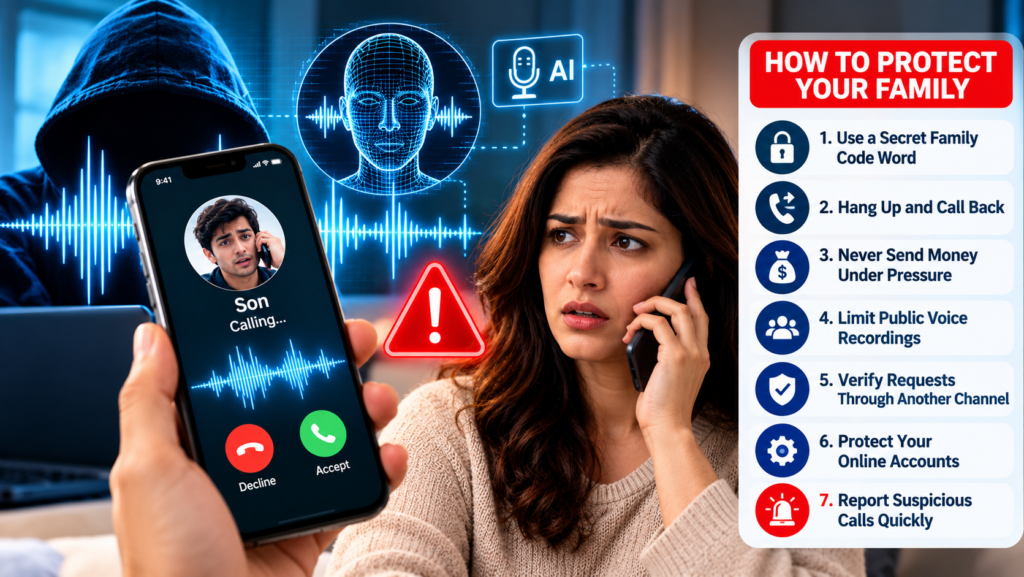
2. Hang Up and Call Back
If a caller claims to be a loved one who urgently needs money, stay calm. End the call and contact that person using a phone number already saved in your contacts.
If they do not answer, contact another trusted family member to verify the situation.
Do not automatically trust a new number supplied by the caller. Independent verification is more reliable than simply continuing the conversation.
3. Never Send Money Under Pressure
Scammers often use fear, urgency, and emotional manipulation to prevent victims from thinking clearly.
Be especially cautious if someone demands an immediate bank transfer, cryptocurrency payment, or gift card purchase.
A genuine emergency can still be verified. Take a moment to check the facts before making a financial decision.
4. Be Careful With Public Voice Recordings
Public videos, interviews, voice messages, and social media posts may provide material that criminals can misuse.
Review your privacy settings and think carefully before sharing personal recordings publicly. You do not need to delete all your videos or stop using social media, but limiting unnecessary exposure can reduce opportunities for misuse.
Remember that privacy settings cannot guarantee complete protection if recordings have already been copied.
5. Verify Unusual Requests Through Another Channel
Voice cloning is not limited to family emergencies. Criminals may impersonate managers, colleagues, suppliers, or business executives.
If someone requests a payment, password, confidential document, or account change, confirm the request through an established and independent channel.
For business payments, organizations should use approval procedures and require additional verification for unusual or high-value transactions.
6. Protect Your Online Accounts
Use strong, unique passwords for important accounts and enable two-factor authentication wherever available.
Keep your phone, computer, browser, and applications updated. Never share verification codes or account recovery information with an unexpected caller.
These measures cannot prevent every voice cloning scam, but they can help protect your accounts and reduce the damage caused by related fraud attempts.
7. Report Suspected Scams Quickly
If you receive a suspicious call, preserve relevant information when safe to do so. This may include the phone number, messages, payment details, and the time of the incident.
If you have already transferred money, contact your bank or payment provider immediately and ask whether the transaction can be stopped or recovered.
Report the incident to the appropriate local law enforcement or cybercrime reporting authority. In the United States, consumers can also report fraud through the Federal Trade Commission’s official website.
Avoid anyone who promises to recover your money for an upfront fee. Fraud victims are sometimes targeted again by criminals posing as recovery specialists.
Can You Identify an AI-Cloned Voice by Listening?
Sometimes an artificial voice may sound unusual, but modern AI-generated audio can be convincing. Pauses, pronunciation, background noise, or emotional tone are not reliable proof that a voice is real or fake.
Instead of depending on how a caller sounds, focus on the circumstances surrounding the request.
Ask yourself:
- Is the caller asking for money unexpectedly?
- Are they pressuring me to act immediately?
- Are they demanding secrecy?
- Can I verify the story using a known phone number or another trusted person?
- Is the requested payment unusual?
If something feels wrong, pause and verify before taking action.
What Should You Do If You Receive a Suspicious Emergency Call?
Follow these steps:
- Stay calm and do not share financial or personal information.
- End the call if you feel pressured.
- Call the supposed family member using a previously saved number.
- Contact another trusted person if you cannot reach them.
- Do not transfer money until the emergency has been independently verified.
- Report suspected fraud and contact your financial institution immediately if money has been sent.
If someone claims that a relative is in immediate physical danger, contact the appropriate emergency services rather than relying solely on the caller’s story.
Final Thoughts
AI voice cloning scams are an important digital safety concern in 2026. As AI-generated voices and videos become more convincing, recognizing a familiar voice is no longer enough to establish someone’s identity.
The most effective response is to combine awareness with simple verification habits. Create a private family code word, call people back using known numbers, protect your accounts, and never let an unexpected caller pressure you into sending money.
Share these precautions with your family, especially older relatives and anyone who may be vulnerable to urgent financial requests.
Remember: Pause, verify, and then act. A few minutes of checking can help protect your money, privacy, and loved ones.
Frequently Asked Questions
What are AI voice cloning scams?
They are scams in which criminals use AI-generated speech to imitate another person’s voice and deceive victims into sending money or sharing sensitive information.
Artificial intelligence is transforming everyday technology, making it important to understand both its benefits and potential risks. Read our guide to Apple HomeView Smart Home Features in 2026 to explore another example of AI-powered technology.
Can scammers clone a voice from social media?
Publicly available audio may provide material for voice imitation. Limiting unnecessary public access to personal recordings can reduce exposure, although it cannot guarantee complete protection.
What is the safest way to verify a family emergency call?
Hang up and call the person using a number you already trust. You can also contact another family member and use a previously agreed private code word.
What should I do if I have already sent money?
Contact your bank or payment provider immediately, request assistance with the transaction, preserve evidence, and report the incident to the appropriate authorities.
Are AI voice cloning scams limited to the United States?
No. Voice impersonation and other AI-enabled fraud can affect people and organizations in many countries. Everyone should independently verify unusual requests for money or confidential information.
Official Sources
- INTERPOL: AI Deepfake Scam Awareness Campaign
- US Federal Trade Commission: Scammers Use Fake Emergencies to Steal Your Money
This article provides general awareness information and is not a substitute for advice from your bank, cybersecurity professional, or local law enforcement authority.