Extreme heat is becoming a serious challenge for households, businesses, and cities around the world. As temperatures rise, millions of people depend on air conditioners and electric fans to maintain comfortable indoor environments. However, cooling buildings can increase electricity consumption, put pressure on power grids, and raise household expenses.
Passive cooling technology offers another approach. Instead of relying entirely on electricity-powered air conditioning, these methods use reflective surfaces, insulation, natural airflow, shade, vegetation, and innovative materials to reduce heat entering buildings or help excess heat escape.
Scientists are also developing advanced materials that reflect sunlight and release heat through infrared radiation. Some experimental systems can cool surfaces below the surrounding air temperature under favorable conditions, although results vary with weather, humidity, and installation.
For countries such as Pakistan, where hot summers make indoor comfort expensive, these technologies could offer useful ways to reduce heat gain and potentially lower cooling costs. Here is how they work, which options are available today, and what homeowners should know before investing.
The growing interest in passive cooling technology reflects a wider shift toward energy-efficient buildings. By reducing heat absorption and improving indoor comfort, these solutions can help homeowners manage hot weather while reducing their dependence on air conditioning.
What Is Passive Cooling Technology?
Passive cooling technology refers to building designs, materials, and techniques that reduce unwanted heat without depending primarily on conventional mechanical refrigeration.
Traditional air conditioners use electricity to move heat from indoor spaces to the outdoors. Passive cooling takes a different approach by limiting the amount of heat entering a building, encouraging heat to escape, or reducing the amount of solar energy absorbed by its surfaces.
Common examples include reflective roofs, external shading, improved insulation, natural ventilation, green roofs, and radiative cooling materials.
According to research published in Nature Reviews Clean Technology in 2026, passive cooling strategies include solar control, ventilation, radiative cooling, evaporative cooling, and hybrid systems. Their performance depends on the building, local climate, and environmental conditions.
The goal is not necessarily to eliminate air conditioning. Instead, passive cooling can reduce the workload on cooling equipment and improve indoor comfort when used as part of a well-designed building.
1. Cool Roofs That Reflect Sunlight
One of the most practical ways to reduce building heat is to change the roof’s ability to absorb sunlight.
Conventional dark roofs can absorb substantial solar energy during the day. That energy heats the roof surface and can transfer into the rooms below, particularly when insulation is poor.
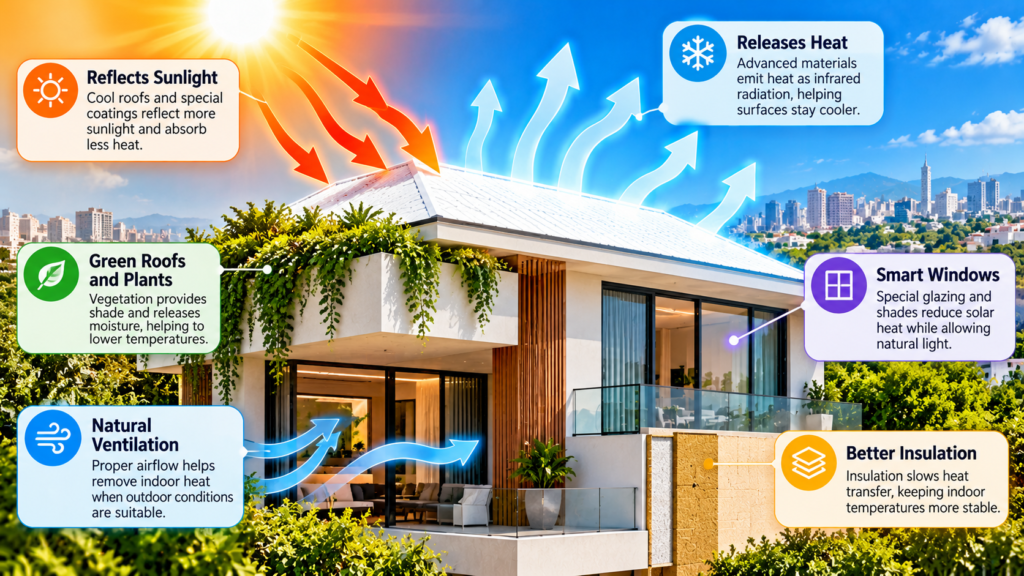
Cool roofs use reflective materials, light-colored finishes, or specially formulated coatings to reflect more sunlight and emit absorbed heat more effectively.
The US Environmental Protection Agency’s ENERGY STAR resource explains that reflective roofs can remain significantly cooler than conventional, less reflective surfaces under comparable sunny conditions.
Another advantage of passive cooling technology is its flexibility. Homeowners can combine reflective roof coatings with insulation and exterior shading to reduce heat entering their rooms. The right combination depends on the building structure, local climate, and installation budget.
How cool roofs work
A reflective roof helps reduce heat in three main ways:
- It reflects a greater proportion of incoming sunlight.
- It reduces the temperature reached by the roof surface.
- It limits the amount of heat transferred into the building.
For homeowners in Pakistan, a suitable reflective roof coating could be a relatively straightforward improvement for an existing house. However, the actual results depend on the original roof, insulation, product quality, maintenance, and local weather.
Before applying a coating, check that it is suitable for the existing roofing material, waterproofing requirements, and expected outdoor temperatures.
2. Radiative Cooling Materials That Release Heat Into the Sky
Radiative cooling is one of the most interesting developments in modern passive cooling technology.
Every warm object releases energy as thermal radiation. Specially engineered materials can be designed to reflect much of the sunlight they receive while emitting heat efficiently as infrared radiation.
Certain wavelengths of infrared radiation can pass through an atmospheric window, allowing heat to escape toward space. Under suitable conditions, this process can cool a material below the surrounding air temperature.
Researchers are exploring radiative cooling paints, polymer films, multilayer coatings, and engineered surfaces for roofs, building facades, and other applications.
Researchers continue to explore how passive cooling technology can improve building performance in different weather conditions. Advanced materials that reflect sunlight and release infrared heat could offer additional benefits, although their real-world effectiveness depends on humidity, cloud cover, and material durability.
Can radiative cooling work during the day?
Yes, some specially designed materials can provide daytime radiative cooling by balancing strong solar reflection with effective thermal emission.
However, laboratory performance does not automatically translate into the same results on every building. Clouds, humidity, surrounding structures, surface contamination, and the material’s durability can influence performance.
A 2025 review in Nature Reviews Clean Technology examined progress toward practical applications and identified scalability, cost, and real-world environmental performance as important challenges.
For homeowners, this technology is promising, but it is important to distinguish commercially available products from experimental materials that are still being evaluated.
3. Smart Windows That Reduce Solar Heat
Windows allow natural light into buildings, but they can also introduce unwanted heat, especially when direct sunlight reaches the glass for long periods.
Smart windows and advanced glazing systems aim to control how much sunlight and heat pass through a building’s windows.
Depending on the design, these systems may use special coatings, multiple glass layers, or adjustable optical properties to reduce solar heat gain while allowing useful daylight inside.
Why window design matters
A well-designed window system can help reduce overheating without making every room completely dark.
Useful options include:
- Solar-control glazing suited to the local climate.
- Exterior shading devices that block direct sunlight.
- Properly positioned awnings and overhangs.
- Curtains or blinds designed to limit solar heat gain.
External shading is especially useful because it can stop sunlight before it passes through the glass and heats the interior.
For existing homes, adding suitable exterior shade may be more affordable than replacing every window. The best choice depends on window orientation, available space, and the building’s design.
4. Natural Ventilation That Moves Heat Out
Natural ventilation uses outdoor air movement to help remove heat from indoor spaces. Instead of relying exclusively on air conditioning, a building can use carefully positioned openings to encourage airflow.
Cross-ventilation occurs when air enters through one opening and exits through another. High-level vents can also help warm air escape when the temperature and pressure conditions support airflow.
When does natural ventilation work best?
Natural ventilation is most useful when outdoor conditions are suitable for cooling the indoor environment.
For example, opening windows during a cooler evening may help remove heat accumulated during the day. Closing or shading windows during very hot daytime periods can sometimes prevent additional heat from entering.
However, ventilation is not always beneficial. If outdoor air is hotter than indoor air, or if humidity and pollution levels are high, opening windows may make indoor conditions less comfortable.
In dense urban areas, noise, dust, security, and outdoor air quality must also be considered.
A properly designed ventilation strategy should therefore respond to local conditions rather than keeping windows open at all times.
5. Green Roofs and Plants That Reduce Heat
Vegetation can help moderate building temperatures by shading surfaces and releasing moisture through evapotranspiration.
A green roof uses vegetation and specially designed layers installed over a roof structure. Depending on the system, these layers may include waterproofing, drainage, a growing medium, and suitable plants.
Trees and climbing plants can also shade walls and windows, reducing the amount of direct sunlight reaching a building.
Are green roofs suitable for hot climates?
They can be, but installation requires planning.
A green roof must account for structural loading, waterproofing, drainage, irrigation needs, plant selection, and maintenance. Water availability is particularly important in areas where summers are dry and water supplies are limited.
For smaller homes, strategically planted trees, shaded outdoor areas, and suitable climbing plants may offer a more practical starting point than installing a complete green roof.
Vegetation should be selected according to local conditions, with attention to root growth, water requirements, and the building’s structure.
6. Better Insulation Keeps Indoor Temperatures More Stable
Insulation slows the transfer of heat through roofs, walls, and other parts of a building.
During hot weather, effective insulation can reduce the rate at which outdoor heat reaches indoor spaces. Combined with reflective roofing and appropriate ventilation, it can make indoor temperatures easier to manage.
The effectiveness of insulation depends on its thickness, thermal properties, installation quality, and the building’s overall design.
Why insulation still matters
Even an advanced reflective coating cannot solve every source of heat gain. Heat can enter through walls, windows, ceilings, and gaps around doors.
A building assessment can help identify which improvements would make the biggest difference. In some homes, sealing unwanted air leaks and insulating the roof may be more valuable than investing in a new experimental cooling material.
Homeowners should also consider moisture control and ventilation when selecting insulation to avoid creating other building problems.
7. Hybrid Cooling Systems Combine Multiple Techniques
Some of the most promising approaches combine different cooling methods rather than relying on a single material or design feature.
A hybrid system might combine a reflective roof, radiative cooling coating, insulation, external shading, and carefully controlled ventilation.
Other research explores combinations of radiative cooling and evaporative cooling, in which heat is released through thermal radiation while evaporation provides an additional cooling effect.
These approaches can potentially improve performance under certain conditions, but they also introduce design considerations.
For example, evaporative cooling requires water and may be less suitable in humid environments. Radiative cooling can be affected by cloud cover and atmospheric conditions. Ventilation depends on outdoor air quality and temperature.
A hybrid design must therefore be adapted to the actual climate and building rather than assembled from technologies without considering how they interact.
Can Passive Cooling Technology Reduce Electricity Bills in Pakistan?
Passive cooling technology could help some Pakistani households reduce their need for mechanical cooling, particularly in buildings that experience substantial heat gain through roofs and windows.
However, savings are not guaranteed. They depend on the existing building, the selected improvements, the weather, household behavior, electricity tariffs, and the amount of cooling equipment used.
Homeowners can start with practical improvements before considering advanced materials.
Reducing energy consumption is becoming increasingly important as households look for practical ways to manage electricity costs. Alongside passive cooling technology, understanding the long-term expenses of modern vehicles and other energy-related choices can help consumers make better-informed decisions. Read our guide on the hidden ownership costs of electric cars to explore another side of the energy and technology conversation.
As energy costs continue to concern households and businesses, improving efficiency is becoming increasingly important. You can also read our guide to Pakistan’s competitive electricity market to understand changes in the country’s power sector and electricity supply system.
For Pakistani households, passive cooling technology may provide a practical way to address extreme summer temperatures. Reflective roofs, shaded windows, and better insulation are useful starting points, particularly when selected according to local weather conditions and the home’s construction.
Practical steps for homeowners
- Evaluate the roof: Check whether a suitable reflective coating or roofing material could reduce solar heat absorption.
- Improve shading: Use awnings, exterior shades, or appropriately placed vegetation to limit direct sunlight.
- Check insulation: Identify whether the roof or walls allow excessive heat to enter.
- Manage ventilation: Use cooler outdoor periods to remove accumulated indoor heat when conditions permit.
- Choose efficient appliances: If air conditioning is necessary, an appropriately sized, energy-efficient unit can complement passive cooling.
- Compare costs: Ask for installation costs, maintenance requirements, product specifications, and realistic performance estimates before making an investment.
For residents of Karachi and other hot cities, humidity deserves special attention. A strategy that works well in a dry climate may perform differently in a hot, humid coastal environment.
What Are the Main Limitations of Passive Cooling?
Although passive cooling technology has considerable potential, it is not a universal replacement for air conditioning.
Weather dependence: Cloud cover, humidity, wind, and nighttime temperatures can influence cooling performance.
Upfront costs: Advanced coatings, specialist glazing, insulation, and green-roof systems may require an initial investment.
Maintenance: Reflective surfaces can become less effective when dirty, while plants and green roofs require ongoing care.
Building design: Orientation, construction materials, window placement, and surrounding structures affect the results.
Limited cooling capacity: Passive methods may not maintain comfortable temperatures during extreme heat, particularly in poorly designed buildings or spaces with high internal heat loads.
A review published in Solar Energy in December 2025 also examined how future climate conditions could affect passive heat-mitigation strategies. Its findings reinforce the importance of evaluating performance under realistic local conditions rather than assuming that today’s results will remain unchanged in every future climate.
For safety, passive cooling should not be treated as sufficient protection during dangerous heat events. People who are vulnerable to heat may still need access to air conditioning, cooling centers, or other effective cooling measures.
What Does the Future Hold for Passive Cooling?
Research is moving beyond simple reflective paint toward materials with carefully engineered optical and thermal properties.
Scientists are studying polymer composites, multilayer films, photonic structures, and coatings designed to reflect sunlight while releasing heat efficiently. Researchers are also investigating durability, affordable manufacturing, performance in humid conditions, and methods for testing materials consistently.
The next major challenge is making promising technologies affordable, durable, and practical at building scale.
For cities facing rising temperatures, the most effective approach may combine better building design, reflective surfaces, vegetation, insulation, efficient air conditioning, and urban planning that reduces heat accumulation.
Passive cooling is not a single miracle invention. It is a collection of strategies that can work together to reduce heat gain, improve comfort, and potentially lower energy demand.
Frequently Asked Questions
1. What is passive cooling technology?
Passive cooling technology includes building materials and design methods that reduce heat gain or help dissipate heat without relying primarily on mechanical refrigeration. Examples include cool roofs, insulation, shading, natural ventilation, and radiative cooling materials.
2. Can passive cooling work without electricity?
Many passive cooling methods, including reflective roofs, external shading, insulation, and natural ventilation, can work without dedicated electricity use. Some hybrid systems may still require fans, pumps, sensors, or other electrical components.
3. Is radiative cooling technology available for homes?
Some reflective coatings and related cooling products are commercially available, while other advanced radiative cooling materials remain under development or evaluation. Buyers should verify product specifications, independent performance evidence, durability, and suitability for their climate.
4. Can a white roof make a house cooler?
A suitable reflective white roof can reduce solar heat absorption and lower roof surface temperatures. The impact on indoor temperatures and electricity consumption depends on insulation, construction, weather, and other sources of heat gain.
5. Is passive cooling suitable for Pakistan?
Several passive cooling measures can be useful in Pakistan, including reflective roofing, shading, insulation, and climate-appropriate ventilation. The best combination varies by region because dry inland climates and humid coastal conditions create different cooling challenges.
6. Can passive cooling completely replace air conditioning?
Not in every building or climate. Passive cooling can reduce heat gain and cooling demand, but extreme temperatures, humidity, and indoor heat loads may still make air conditioning necessary.
7. Which passive cooling method should homeowners try first?
Start by assessing the roof, windows, shading, and insulation. A suitable reflective roof treatment or improved shading may be a practical first step, but the most cost-effective option depends on the building’s existing condition.
As research advances, passive cooling technology could become an increasingly important part of energy-efficient building design. Combining proven cooling methods with newer materials may help reduce cooling demand while maintaining comfortable indoor spaces.
Final Thoughts
Passive cooling technology offers a practical way to rethink how buildings respond to extreme heat. From reflective roofs and better insulation to smart windows and advanced radiative cooling materials, these approaches can help reduce unwanted heat without depending entirely on electricity-powered cooling.
For homeowners in Pakistan, the best starting point is often a combination of affordable, proven improvements suited to the local climate. Advanced materials may offer additional benefits as their costs, durability, and real-world performance improve.
The future of cooling will likely depend on combining good building design with efficient technology—not on expecting one innovation to solve every heat-related challenge.
What do you think? Could reflective roofs and passive cooling materials make homes more comfortable during Pakistan’s hot summers? Share your thoughts.