Getting your first visitors can feel difficult when you launch a new website or blog. You publish useful content, share a few posts, and wait for people to arrive, but the traffic may remain low. The good news is that you can get website traffic without paid ads by using practical digital marketing strategies that help people discover your content naturally.
You do not need a large budget, an established brand, or thousands of social media followers to begin. What you need is a clear audience, helpful content, consistency, and a plan for reaching the right people. In this guide, you will learn how to attract your first 100 website visitors without spending money on advertising.
Why Is Getting Website Traffic Difficult for Beginners?
A new website usually has little search visibility, few backlinks, and no established audience. Search engines need time to discover and understand its pages, while potential readers may not know the website exists.
Publishing content alone is rarely enough. You also need to help people find it through search engines, social platforms, relevant online communities, and other useful channels.
The goal is not simply to attract random clicks. It is to reach people who are genuinely interested in what your website offers.
1. Choose a Clear Target Audience
Before promoting your website, decide who you want to reach. Trying to write for everyone can make your content less focused and harder to promote.
For example, a website about digital marketing might target:
- Small business owners who want more customers.
- Beginners learning SEO and blogging.
- Freelancers looking for online marketing skills.
- Website owners who want to improve their content.
Think about your audience’s questions, challenges, and goals. The more clearly you understand these needs, the easier it becomes to create content people want to read.
To get website traffic without paid ads, understand what your target audience needs and create content that directly answers their questions.
Practical tip: Write down five questions your target audience frequently asks. Each question could become a useful article, tutorial, or social media post.
2. Publish Helpful Content That Solves Real Problems
Useful content gives people a reason to visit your website. Instead of writing general articles that repeat familiar advice, focus on specific questions and provide clear, actionable answers.
For example, instead of writing a broad article about online marketing, you could create guides on improving a website’s title tags, researching keywords, or planning a simple content calendar.
Try to include:
- A clear explanation of the problem.
- Practical steps readers can follow.
- Examples that make the advice easier to understand.
- Relevant sources when factual claims need support.
- A helpful conclusion that tells readers what to do next.
Original examples, personal experience, and thoughtful analysis can make your articles more valuable than pages that simply summarize other websites.
You do not need to publish every day. A smaller collection of useful, well-organized articles can provide a stronger foundation than a large collection of rushed posts.
To get website traffic without paid ads, focus on answering real questions and giving readers practical solutions they can use immediately. Helpful content gives people a reason to visit your website and explore more of your articles.
3. Research Keywords Before Writing
Keyword research helps you understand the words people use when searching online. It can also reveal specific questions that smaller websites may be able to address effectively.
Start with a topic related to your website. Then explore longer, more specific search phrases that reflect a clear need.
For example:
- How to promote a new website.
- Free ways to increase blog traffic.
- How to improve website visibility.
- How to get website traffic without paid ads.
You can begin with free tools such as Google Trends and Google Search Console. Search suggestions and the questions people ask online can also help you discover useful content ideas.
Choose keywords that match the article’s actual purpose. Include the main keyword naturally in the title, introduction, a relevant heading, and the body where appropriate. Avoid repeating it unnecessarily.
Remember that keyword research helps guide your content; it does not guarantee that an article will rank in search results.
If your goal is to get website traffic without paid ads, choose relevant keywords that match what your readers are actually searching for.
4. Improve Your Website’s Basic SEO
Search engine optimization (SEO) helps search engines understand your pages and can improve the chances that your content appears for relevant searches.
You can start with these essential tasks:
- Write descriptive SEO titles: Make each title clear and relevant to the page.
- Create useful meta descriptions: Summarize the article accurately and encourage interested readers to click.
- Use a simple URL: Keep your permalink readable and closely related to the topic.
- Organize headings: Use one clear H1 title and meaningful H2 and H3 subheadings.
- Add descriptive image alt text: Explain what each meaningful image shows.
- Link related articles: Help readers discover more useful information on your website.
- Check mobile usability: Make sure the content is readable on phones and tablets.
If you use WordPress, an SEO plugin such as Rank Math can help you manage several of these elements. However, a high plugin score does not guarantee search rankings or traffic.
You can also submit your sitemap through Google Search Console and monitor whether Google discovers and indexes your important pages.
One effective way to get website traffic without paid ads is to improve your page titles, headings, internal links, and content quality. These steps help search engines understand your pages and help readers find relevant information.
5. Share Your Articles on Social Media
Social media can help a new website reach people before it gains meaningful search traffic. You do not need to use every platform. Choose the channels that fit your content and audience.
For example:
- Facebook: Share useful articles in relevant groups when group rules permit promotional posts.
- Pinterest: Create attractive pins for tutorials, checklists, lifestyle guides, and other visually useful content.
- Instagram: Turn key points from an article into a carousel or short video.
- LinkedIn: Share professional insights, business advice, and marketing lessons.
- X: Post concise tips, useful observations, and links to relevant articles.
Avoid publishing the same promotional message everywhere without considering the platform. A short practical tip may work well on X, while a step-by-step visual guide may be more suitable for Pinterest.
Focus on being helpful rather than repeatedly asking people to visit your website. Meaningful engagement can help you build an audience over time.
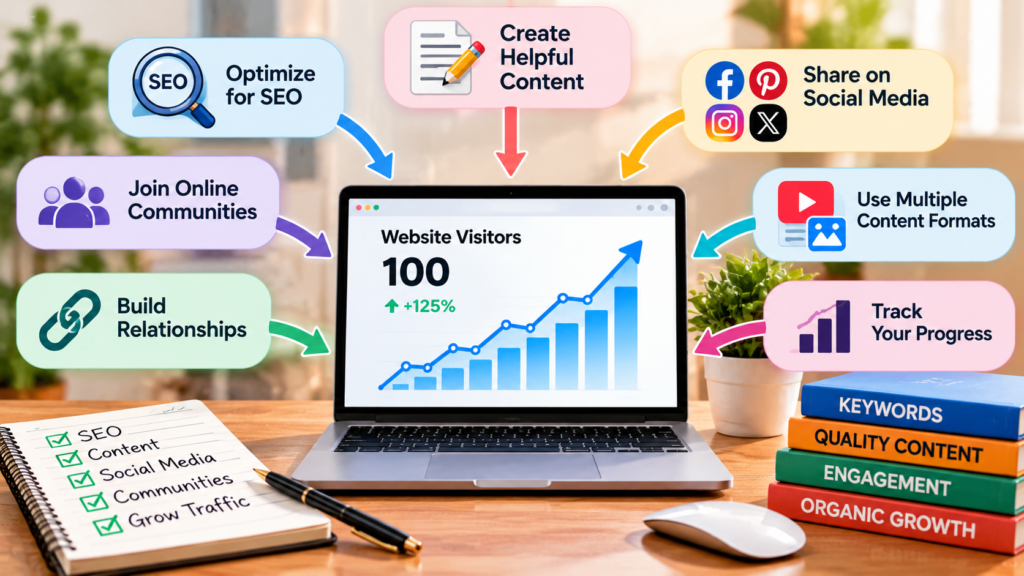
You can also get website traffic without paid ads by sharing useful tips on social platforms where your target audience spends time. Choose relevant platforms and focus on genuine engagement rather than posting links repeatedly.
6. Turn One Article Into Several Pieces of Content
You can promote an article in multiple ways without writing an entirely new piece of content for each platform.
Suppose you publish a detailed guide about website traffic. You could turn it into:
- A short video explaining three traffic-building tips.
- A Pinterest graphic highlighting the main steps.
- An Instagram carousel with practical examples.
- A Facebook post discussing one common mistake.
- An X thread summarizing the most useful lessons.
Each version should offer value on its own and direct interested readers to the full article when appropriate.
This approach helps you get more value from the time spent researching and writing. It also lets you test which content formats attract the most attention from your target audience.
7. Participate in Relevant Online Communities
Online communities can connect you with people who already care about your topic. Depending on your niche, useful places may include Reddit communities, specialist forums, Facebook groups, and professional discussion groups.
Start by answering questions and sharing useful information. Read the community rules before posting links, because some communities restrict self-promotion.
For example, if someone asks how to improve a new website, provide a genuinely helpful answer rather than posting only your homepage link. If one of your articles directly answers the question, you can share it when permitted.
Avoid spam, copied comments, and repetitive promotional messages. These tactics can damage trust and may get your posts removed.
The purpose is to become a useful participant, not to turn every discussion into an advertisement.
8. Build Relationships With Other Website Owners
Relationships with relevant creators and website owners can introduce your content to new audiences.
Look for websites that serve a similar audience without being direct substitutes for your content. You might collaborate on an expert discussion, contribute an original guest article, or share useful resources with each other when there is a genuine fit.
A successful collaboration should provide value to both audiences. Avoid buying links or arranging manipulative link exchanges to influence search rankings.
You can also identify outdated resources in your niche and suggest a relevant, genuinely useful alternative to the website owner. There is no guarantee that they will include your resource, but a thoughtful and personalized approach is more constructive than mass messaging.
9. Make Your Website Easy to Explore
Your first visitors may leave without reading another article if your website is confusing, slow, or difficult to navigate.
Make it easy for readers to understand what your website covers and where they should go next.
Check that your website has:
- A clear navigation menu.
- Readable text and comfortable spacing.
- Fast-loading, appropriately sized images.
- Working links and buttons.
- Useful category pages.
- Related articles where they genuinely help.
- A layout that works on mobile devices.
Internal links are especially useful because they help readers move from one relevant article to another. For example, a digital marketing guide could link to related business or technology articles on your website.
A good user experience will not automatically create traffic, but it can help visitors make better use of the content they find.
10. Use Free Tools to Measure Your Progress
Guessing which promotion methods work can waste time. Use free analytics tools to understand how people discover and use your website.
Google Search Console can show search queries, impressions, clicks, and indexing information for your website’s Google search presence.
Google Analytics can help you understand website visits and how users interact with your content, once it is configured correctly.
Review your results regularly and ask practical questions:
- Which articles receive the most impressions?
- Which search queries generate clicks?
- Which social platforms send visitors?
- Which pages encourage readers to explore other content?
- Which articles need clearer titles or more useful information?
Do not worry if the numbers are small at first. Early results can help you identify what to improve and where to focus your efforts.
Tracking your results can help you discover which strategies work best to get website traffic without paid ads and where your next improvements should focus.
11. Follow a Simple Plan to Reach Your First 100 Visitors
Instead of trying every strategy at once, follow a manageable plan. The numbers below are goals for organizing your work, not guaranteed visitor totals.
Week 1: Prepare Your Website
- Choose one clear audience.
- Publish or improve two useful articles.
- Check titles, meta descriptions, links, and mobile usability.
- Set up Google Search Console.
Week 2: Promote Your Content
- Share your articles on two suitable social platforms.
- Create several useful posts based on your articles.
- Participate in relevant online discussions.
- Answer questions without spamming links.
Week 3: Expand Your Reach
- Publish another useful article based on keyword research.
- Create a visual post or short video from an existing guide.
- Connect with relevant creators or website owners.
- Add internal links between related articles.
Week 4: Review and Improve
- Check Search Console for impressions and clicks.
- Review available analytics data.
- Improve pages that receive impressions but few clicks.
- Continue the activities that bring relevant visitors.
Some websites may reach 100 visitors quickly, while others may need considerably more time. Your niche, content quality, competition, promotion, and website history all influence the result.
12. Avoid Mistakes That Can Waste Your Time
When trying to get website traffic without paid ads, avoid shortcuts that produce little lasting value.
Buying fake traffic: Automated visits and low-quality traffic may inflate numbers without bringing a genuinely interested audience.
Keyword stuffing: Repeating the same phrase unnaturally makes content harder to read and does not guarantee better rankings.
Publishing thin articles: Content created only to target keywords may fail to answer the reader’s question.
Spamming links: Repeatedly dropping your website link into unrelated discussions can damage your reputation.
Expecting instant results: SEO and audience building often require patience, testing, and consistent improvement.
Ignoring useful data: If you never review performance, you may continue spending time on strategies that do not reach your audience.
A sustainable approach focuses on real readers, relevant content, and steady improvements.
Frequently Asked Questions
How can I get website traffic without paid ads?
Start by publishing helpful, keyword-informed articles, improving your basic SEO, sharing content on relevant social platforms, participating in online communities, and monitoring results with free analytics tools. Focus on the methods that suit your audience.
How long does it take to get the first 100 website visitors?
There is no fixed timeline. Some websites may attract 100 visitors within days through an existing audience or successful social sharing. Others may take weeks or months, particularly when relying on organic search from a new domain.
Can a new website get traffic from Google?
Yes. A new website can appear in Google Search, but indexing and ranking are not guaranteed. Publish useful content, make important pages accessible, follow SEO best practices, and monitor indexing through Google Search Console.
Which free tools are useful for website promotion?
Google Search Console helps monitor search performance, Google Trends supports topic research, and Google Analytics provides website usage insights when configured. Social platforms and relevant online communities can also help you reach potential readers without buying ads.
Is social media enough to grow a website?
Social media can bring visitors, but relying on one channel may make your results less predictable. Combining social promotion, useful content, SEO, community participation, and performance tracking can create more opportunities to reach your audience.
Final Thoughts
You do not need a large advertising budget to start building an audience. To get website traffic without paid ads, focus on helping the right people find content that genuinely answers their questions.
Begin with a few useful articles, make your website easy to use, share your work thoughtfully, and measure what happens. Improve your approach as you learn which topics and channels connect with readers.
Your first 100 visitors are an achievable milestone to work toward, but they are only the beginning. The real goal is to build a website that continues providing value and earns the attention of the audience you want to reach.
Learning how to get website traffic without paid ads takes patience, but consistent content creation and thoughtful promotion can help you build an audience over time.
Want to learn more about growing your online presence? Visit NuvWire for more practical guides, useful ideas, and insights on technology, business, and digital marketing.