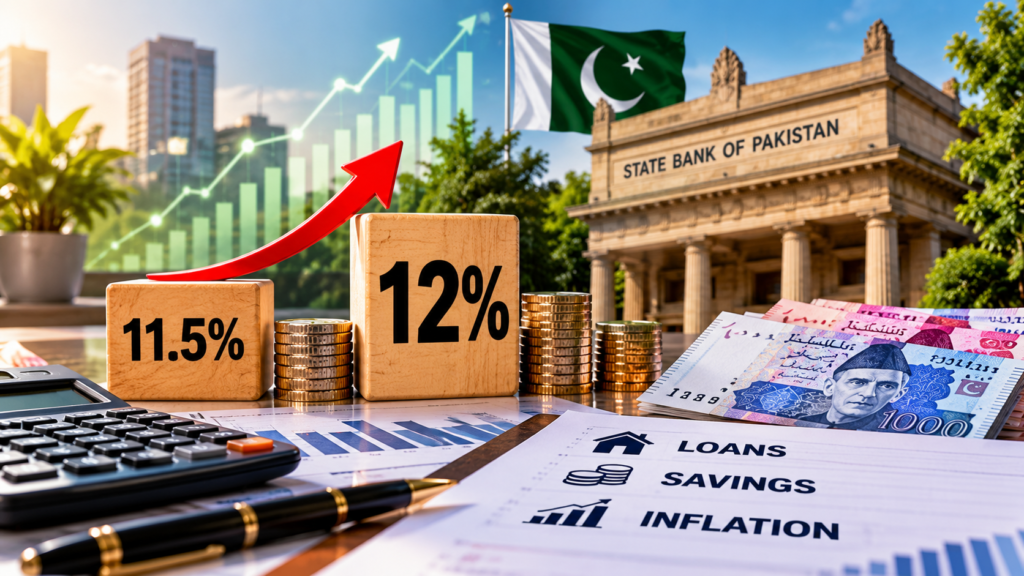
Pakistan interest rate 2026 has become a major financial news story after the State Bank of Pakistan (SBP) raised its benchmark policy rate from 11.5% to 12%. Announced on October 26, the 0.5 percentage-point increase will take effect on October 27, 2026. The decision comes as the central bank faces renewed inflationary pressure linked to higher energy costs, geopolitical uncertainty and domestic food-price concerns.
For ordinary Pakistanis, the announcement raises important questions. Will bank loans become more expensive? Could savings accounts offer better returns? And will the decision help control inflation? Here is what the latest policy change means for households, borrowers, savers and businesses.
The Pakistan interest rate 2026 decision is important for households and businesses because changes in borrowing costs can influence monthly budgets, savings decisions and investment plans. The actual impact will depend on individual bank rates and the terms of each financial product.
Pakistan Interest Rate 2026: What Has Changed?
The State Bank of Pakistan has increased its policy rate by 50 basis points, moving it from 11.5% to 12%.
The Monetary Policy Committee (MPC) approved the increase at its October 26 meeting. According to reporting by Dawn, nine of the committee’s ten members supported the decision.
The central bank explained that the inflation outlook had worsened compared with its earlier assessment. Rising international energy prices, continued geopolitical tensions in the Middle East and domestic wheat-supply pressures were among the factors influencing the decision.
The SBP aims to bring inflation within its medium-term target range of 5% to 7%. Raising the policy rate is one of the tools it uses to influence borrowing, spending and overall economic activity.
Key details of the latest announcement:
- Previous policy rate: 11.5%
- New policy rate: 12%
- Increase: 0.5 percentage points, or 50 basis points
- Announcement date: October 26, 2026
- Effective date: October 27, 2026
- Main concern: A deteriorating inflation outlook
Readers can check the official State Bank of Pakistan website for monetary policy announcements and related information.
Understanding the Pakistan interest rate 2026 update can help consumers assess how changes in monetary policy may influence borrowing costs, deposit returns and household financial planning.
Why Has the State Bank Increased the Policy Rate?
The decision reflects the central bank’s concern that inflationary pressures could remain elevated if energy and food costs continue to rise.
1. Higher Global Energy Prices
Pakistan relies heavily on imported energy, making its economy sensitive to international oil prices and supply disruptions. When imported energy becomes more expensive, transportation, electricity generation and business operations can face additional cost pressure.
Businesses may pass some of these higher costs on to consumers, depending on market conditions.
2. Rising Inflation Concerns
Inflation reduces the purchasing power of money. When everyday essentials become more expensive, households have less room in their budgets for savings and discretionary spending.
The SBP’s latest decision reflects its assessment that inflation risks have increased. Higher interest rates can help moderate demand and influence inflation expectations, although they cannot directly resolve every supply-side problem.
3. Domestic Food-Price Pressures
Domestic wheat-supply difficulties have also contributed to concerns about the inflation outlook. Food prices are particularly important for Pakistani households because groceries account for a significant share of many family budgets.
If food and energy costs remain elevated, inflation could continue to put pressure on consumers even when other parts of the economy are performing better.
The Pakistan interest rate 2026 announcement highlights the central bank’s effort to manage inflation risks while considering the wider effects of borrowing costs on economic activity.
Will Bank Loans Become More Expensive in Pakistan?
The Pakistan interest rate 2026 increase may affect borrowers when banks adjust variable lending rates. Customers should review their loan agreements and contact their banks to understand whether their monthly repayments could change.
Borrowers are among the groups most likely to watch the policy-rate increase closely.
The SBP policy rate influences money-market conditions and can affect the rates banks charge for lending. However, the impact on an individual loan depends on its contract, benchmark, repricing schedule and other terms.
Home Loans
People with variable-rate home financing may face higher repayments if their financing rate is linked to a benchmark that rises following the policy change.
However, the increase will not automatically raise every home-loan payment by the same amount. Fixed-rate arrangements and the specific terms of a financing agreement can produce different outcomes.
Personal Loans
Personal-loan rates vary by lender, product and borrower. A higher benchmark rate can increase banks’ funding costs, potentially putting upward pressure on new borrowing rates.
Anyone considering a personal loan should compare the total repayment amount, fees, applicable rate and repayment period before making a decision.
Business Financing
Businesses often borrow to purchase inventory, manage cash flow, invest in equipment or expand operations.
If financing costs rise, some businesses may delay expansion or reduce borrowing. Small businesses with limited cash reserves could be particularly sensitive to changes in lending costs.
Business owners should review their existing financing agreements and assess whether upcoming repayments could change.
Could Savings Accounts Offer Better Returns?
A higher policy rate can create the possibility of improved returns on certain savings products and fixed-term deposits. Banks may adjust their deposit rates in response to changing market conditions.
However, a policy-rate increase does not guarantee an immediate or equal increase in every savings account’s return. Actual rates depend on the bank, account type, product conditions and applicable regulations.
Before moving money into a deposit product, savers should compare the advertised return, withdrawal restrictions, fees and tax treatment.
It is also important to consider inflation. A savings account may pay a higher nominal return while the purchasing power of that money still depends on how quickly consumer prices rise.
For people building their financial safety net, our guide to the cost of living crisis in 2026 explores why everyday expenses can make saving more difficult.
For savers, the Pakistan interest rate 2026 change may create opportunities for different deposit returns, but banks do not necessarily adjust every account rate immediately. Comparing available savings products can help customers make informed choices.
Will the New Interest Rate Reduce Inflation?
Controlling inflation is one of the main reasons central banks change interest rates.
When borrowing becomes more expensive, households and businesses may reduce some spending and investment. Lower demand can gradually ease pressure on prices, helping inflation move towards the central bank’s target.
However, monetary policy does not work instantly.
The effect of higher interest rates depends on several factors, including consumer demand, international commodity prices, exchange-rate movements, government policies and domestic food supplies.
If global energy prices remain high or food shortages continue, inflation may remain under pressure despite tighter monetary policy.
The latest increase should therefore be viewed as part of the SBP’s effort to manage inflation risks rather than a guarantee that prices will fall immediately.
What Does the Rate Increase Mean for Pakistan’s Economy?
Higher interest rates can have both benefits and costs.
On the positive side, tighter monetary policy may help contain inflation expectations and support price stability over time. Predictable inflation is important for households, businesses and long-term investment decisions.
On the other hand, expensive borrowing can discourage investment and reduce demand for goods and services. Businesses may become more cautious about expansion, while households may postpone major purchases.
The SBP has maintained its real GDP growth forecast of 3.5% to 4.5% for fiscal year 2026–27, according to reporting by Business Recorder. This forecast remains subject to risks, including developments in the Middle East and adverse climate conditions.
The eventual economic impact will depend on how inflation, energy prices, consumer demand and business activity evolve in the coming months.
The impact of the Pakistan interest rate 2026 decision will depend on future inflation trends, energy prices, bank lending conditions and consumer spending.
What Should Borrowers and Savers Do Now?
The policy announcement is a useful reason to review personal finances, but it does not mean everyone needs to make an immediate financial change.
Consider these practical steps:
- Review existing loans: Check whether your financing rate is fixed or variable and when the next repricing may occur.
- Compare savings products: Look at the actual return, fees and withdrawal conditions instead of assuming every bank will increase its rates.
- Reassess your monthly budget: Allow room for essential expenses and possible changes in loan repayments.
- Avoid unnecessary borrowing: Before taking a new loan, calculate the full repayment cost and make sure it fits your income.
- Build savings gradually: If your budget allows, maintain an emergency fund for unexpected bills or income disruptions.
- Follow official announcements: Use SBP statements and your bank’s published terms to confirm changes that affect your account or loan.
These steps can help households make informed decisions without reacting to headlines alone.
Frequently Asked Questions
What is Pakistan’s new policy interest rate in October 2026?
The State Bank of Pakistan raised the policy rate to 12% from 11.5% on October 26, 2026. The new rate takes effect on October 27, 2026.
Why did the SBP raise the interest rate?
The central bank cited a worsening inflation outlook, including risks associated with higher global energy prices, geopolitical developments and domestic wheat-supply pressures.
Will all bank loan payments increase?
No. The impact depends on the loan agreement, whether the rate is fixed or variable, the benchmark used and the timing of any repricing.
Will savings account rates increase automatically?
Not necessarily. Banks may adjust their rates, but the effect varies by product and institution. Customers should check their bank’s current terms.
Will inflation fall after the rate increase?
The increase may help contain inflationary pressure over time, but it cannot guarantee an immediate decline in prices. Energy costs, food supplies and other economic factors will also influence inflation.
Readers following Pakistan interest rate 2026 news should rely on official SBP announcements and confirm any changes to loan or savings rates directly with their banks.
Conclusion
Pakistan’s policy rate increase to 12% is an important economic development for borrowers, savers, businesses and consumers. The State Bank of Pakistan has raised the benchmark rate by 50 basis points in response to a more challenging inflation outlook, with the change effective from October 27, 2026.
The immediate effect on individual finances will vary. Some borrowers may face higher costs when their loans are repriced, while certain savings products could offer improved returns if banks adjust their rates. Neither outcome is automatic for every customer.
For now, the most useful approach is to review loan terms, compare savings options and follow official economic updates. The coming months will show how effectively the policy change helps contain inflation while supporting Pakistan’s economic growth.
As Pakistan interest rate 2026 developments continue, borrowers and savers should follow official State Bank announcements and check the latest terms offered by their banks.
Sources:
- State Bank of Pakistan — Official website
- Dawn — Central bank raises policy rate to 12%
- Business Recorder — SBP hikes policy rate to 12%
This article is for general news and information purposes. Readers should consult their banks for advice about specific loans and deposit products.