
The Spain train crash 2026 has become a major international news story after at least 68 people were reported dead in a collision involving two high-speed trains near Urda, in Toledo province, on October 28. Dozens of other people were injured, and authorities launched an investigation into the circumstances surrounding the disaster. Spain has declared three days of national mourning as emergency teams and investigators respond to the tragedy.
The collision has raised urgent questions about railway signalling, traffic control decisions and safety procedures on one of Europe’s major high-speed rail networks.
The Spain train crash 2026 has raised serious concerns about railway safety and emergency response procedures across Europe.
What Happened in the Spain Train Crash?
The accident occurred on the high-speed railway connecting Madrid and Seville in central Spain. According to initial reports, a train operated by Spain’s state railway company Renfe struck the rear of a stationary train operated by private rail company Iryo.
The impact caused carriages to derail, with some wreckage falling down an embankment beside the railway line. Emergency services rushed to the scene to evacuate passengers, assist injured people and search the damaged carriages.
Authorities reported at least 68 fatalities following the collision on October 28. Many passengers required medical treatment, including people with serious injuries.
The full circumstances of the collision are still being investigated. Officials have warned that the findings must be established through evidence rather than assumptions.
Why Is the Spain Train Crash Under Investigation?
Investigators examining the Spain train crash 2026 are reviewing signalling records, train movements, and communication between railway control staff.
One of the central questions concerns a reported failure in the railway’s signalling and train-control systems.
Spain’s transport minister, Óscar Puente, said a computer-related problem affected the LZB train-control system across a section of the railway. The failure reportedly caused several trains to stop while traffic management procedures were handled centrally.
According to the minister’s account, a Renfe train was subsequently authorised to resume normal operation even though a red signal remained active. That train later collided with the stationary Iryo service.
Officials are examining why the train was permitted to continue under those circumstances and whether established safety procedures were followed.
The precise sequence of events, the decisions made by railway control staff and the role of the technical failure remain subjects of investigation. It would be premature to assign final responsibility before investigators complete their work.
How Many People Were Killed or Injured?
Regional authorities reported at least 68 deaths after the crash. Numerous other passengers were injured, with some requiring hospital treatment for serious injuries.
Emergency workers searched damaged train carriages and the surrounding area as authorities worked to establish the identities of victims and provide information to their families.
The casualty figures in a developing disaster can change as rescue operations progress and officials verify information. Readers should therefore check the latest statements from Spanish authorities for any confirmed updates.
The tragedy has affected passengers, families and communities across Spain, while emergency personnel continue to support those affected.
The Spain train crash 2026 has also highlighted the importance of timely emergency assistance and accurate casualty reporting.
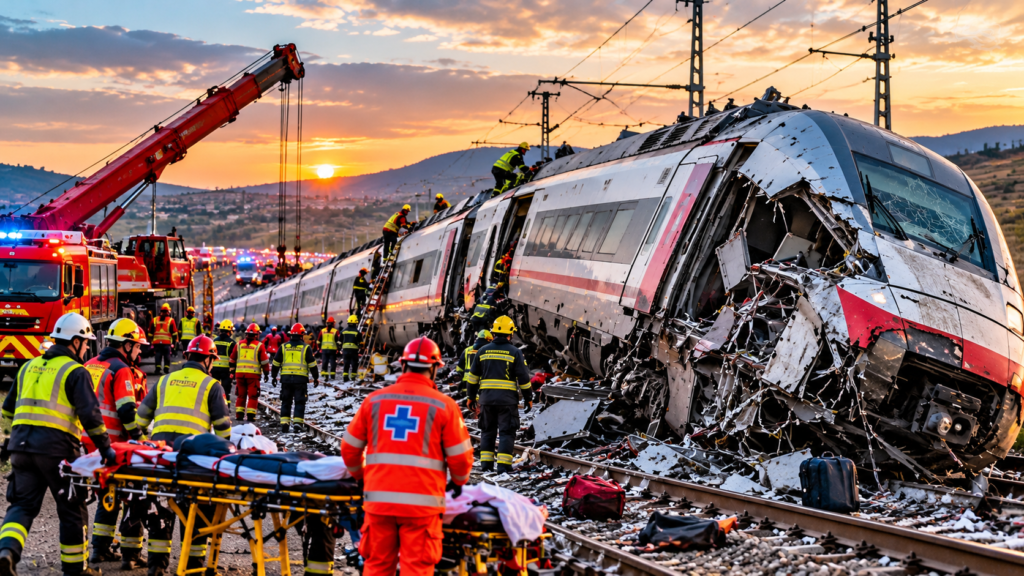
Spain Declares Three Days of Mourning
Spanish Prime Minister Pedro Sánchez announced three days of mourning following the disaster and expressed solidarity with victims and their families.
The crash has prompted renewed attention to the safety of Spain’s high-speed railway network. The country operates an extensive network connecting major cities, and high-speed trains are an important part of domestic travel.
A serious accident of this scale naturally leads to questions about technical safeguards, operational decisions and emergency procedures. However, conclusions about the wider railway system should be based on the investigation’s findings and verified safety data.
Authorities and railway personnel are working to establish what happened and determine what measures may be needed in response.
Updates on the Spain train crash 2026 will help readers follow official announcements and confirmed investigation findings.
Could Railway Signalling Failure Have Contributed to the Collision?
Railway signalling systems help regulate train movements and maintain safe distances between trains. Depending on the system, they can communicate speed restrictions, warn drivers about hazards and automatically intervene when operating conditions require it.
When a signalling or train-control system fails, railway operators must follow specific procedures designed to keep trains moving safely, if movement is permitted at all.
In this case, officials have identified a reported technical failure and a subsequent traffic-control decision as important areas of investigation. The key questions include how the system failure affected operations, what information was available to control staff and why normal running was reportedly authorised.
Investigators will need to examine technical records, signalling data, communications and other evidence to reconstruct the sequence of events.
The findings could help establish whether equipment, procedures, human decisions or a combination of factors contributed to the collision.
What Happens Next in the Investigation?
Investigators are expected to examine several important areas:
- Signalling records: Establishing when the technical problem began and how it affected train movements.
- Control-centre communications: Reviewing the instructions given to railway personnel and the decisions made before the collision.
- Train data: Examining available operational records to reconstruct the trains’ movements.
- Safety procedures: Determining whether the required protocols were followed after the reported system failure.
- Preventive measures: Identifying any changes needed to reduce the risk of similar accidents.
These are areas of investigation, not final conclusions. Any confirmed findings or recommendations will depend on evidence collected and assessed by the relevant authorities.
The Spain train crash 2026 investigation may help authorities identify safety improvements and prevent similar railway accidents in the future.
Why This Accident Matters Beyond Spain
The disaster has implications for wider discussions about rail safety because high-speed railway systems depend on reliable equipment, clear operating procedures and effective communication between train crews and traffic controllers.
A technical fault does not automatically explain an entire accident. Investigators must also determine how the railway system responded to the fault and whether its safeguards worked as intended.
For railway operators in Spain and elsewhere, the eventual findings may provide important lessons about managing disruptions, authorising train movements and maintaining safety when automated systems are unavailable.
It is too early to determine what changes may follow, but the investigation will be closely watched by passengers, transport authorities and railway professionals.
More World News and Updates
Stay informed with the latest international developments, technology updates, and breaking stories on NuvWire’s latest news and insights.
Latest Updates on the Spain Train Crash
As of October 29, 2026, the reported death toll stands at at least 68, and authorities are continuing to investigate the collision near Urda in Toledo province.
The Spanish government has declared three days of mourning. Officials have identified a reported signalling-system failure and a decision to permit a train to resume normal operation as key issues requiring examination.
The investigation must establish the exact sequence of events and determine whether additional safety measures are necessary.
For readers following the Spain train crash 2026, the most reliable updates will come from official statements and established news organisations reporting confirmed developments.
This is a developing story. NuvWire will update this report as verified information becomes available.
Readers following the Spain train crash 2026 should check official updates for verified information about the investigation and any changes to the reported casualty figures.
Sources and Further Reading
- Reuters: At least 68 people dead in Spain’s second major train crash this year
- Euronews: Investigation into the Spain train crash
- Renfe: Official statement on the accident near Urda
- European Union Agency for Railways: Statement on the train accident near Urda
Editorial note: Casualty figures and investigation details reflect reporting available on October 29, 2026. Update them against official statements before republishing.