
Google Project Suncatcher is an ambitious artificial intelligence research project that could change how future computing infrastructure is developed. Google is exploring whether powerful AI computers can operate on satellites in space, using solar energy to support their operations. The project recently achieved an important milestone when Google’s prototype satellite successfully generated its first AI response while orbiting Earth. This achievement has attracted attention from technology enthusiasts, researchers, and the wider space industry.
On October 30, 2026, Google confirmed that its experimental satellite had successfully run an onboard AI model using a Tensor Processing Unit (TPU). The model generated a short poem after receiving a prompt from engineers on Earth. Although this was an early experiment rather than a commercial AI service, it demonstrated an important possibility: artificial intelligence computing could eventually operate beyond our planet.
In this article, we explore seven important facts about Google Project Suncatcher, its satellite technology, the recent AI breakthrough, and what this ambitious project could mean for the future.
Latest Technology Newshttps://nuvwire.com/category/technology/
1. What Is Google Project Suncatcher?
Google Project Suncatcher is a long-term research initiative designed to investigate the possibility of building AI computing infrastructure in space.
Traditional AI systems depend on large data centers located on Earth. These facilities require electricity, cooling systems, networking equipment, and significant physical infrastructure. As artificial intelligence continues to grow, technology companies are exploring new ways to support increasing computing demands.
Google wants to investigate whether satellites equipped with specialized AI processors could eventually perform computing tasks in orbit.
The project focuses on using solar-powered satellites and advanced communication systems to create a network capable of processing AI workloads in space.
Google introduced Project Suncatcher in November 2025. Its research focuses on understanding the engineering requirements and technical challenges involved in operating AI hardware beyond Earth.
It is important to understand that Project Suncatcher is still experimental. Google has not announced a publicly available space-based AI service.
Google’s official Project Suncatcher announcementhttps://blog.google/innovation-and-ai/technology/research/google-project-suncatcher/
2. Google Successfully Launched Its First AI Satellite
One of the most important developments in Project Suncatcher happened on October 1, 2026.
Google confirmed that its prototype satellite successfully launched into orbit aboard SpaceX’s Transporter-18 rideshare mission.
The satellite was developed in partnership with Planet, a company known for its satellite technology and Earth observation services.
After launch, Google’s team established contact with the spacecraft and confirmed that it was operating as expected.
This mission represents the first practical stage of Google’s research into space-based AI computing.
Rather than immediately building a large network of satellites, Google started with a prototype to examine how its AI processors perform under real space conditions.
The engineers are collecting important information about hardware reliability, radiation exposure, temperature changes, and other environmental factors.
This early testing will help Google understand what needs to improve before developing more advanced satellite systems.
3. Google’s Satellite Generated Its First AI Response in Space
The biggest Project Suncatcher development so far came on October 30, 2026.
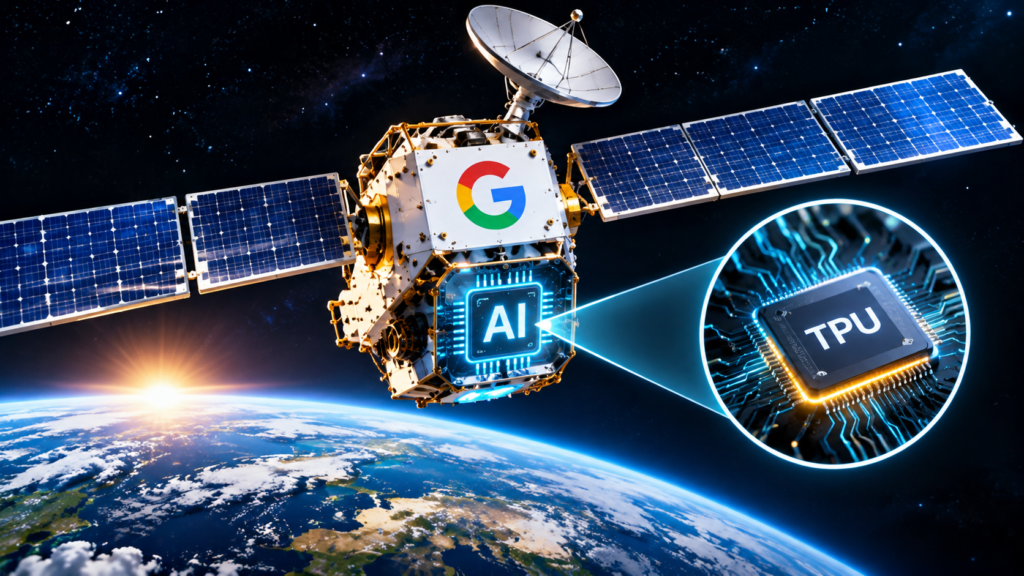
Google announced that its prototype satellite had successfully generated its first AI response using a data-center-class Tensor Processing Unit in orbit.
Engineers uploaded a prompt to an AI model called Gemma 4, which was running onboard the satellite.
The request was simple: generate a haiku about space.
The satellite processed the prompt and returned the following response:
Blue marble below
Data streams in silent grace
Starlight feeds my core.
The response was received during a satellite pass over Svalbard, Norway.
This experiment demonstrated that engineers could send a request from Earth, process it using AI hardware in orbit, and receive the generated response back on the ground.
Google also tested space-themed limericks and prompts asking the satellite to report technical information about its onboard systems.
Although generating a short poem might sound like a small achievement, the experiment was an important technical milestone. It demonstrated that the onboard hardware could successfully execute an AI workload in space.
4. How Does Google Project Suncatcher Use Solar Energy?
Solar energy is one of the most important elements of Google’s long-term vision.
AI computing requires electricity, particularly when powerful processors are used to perform complex calculations. Traditional data centers consume significant amounts of energy and require infrastructure to distribute electricity and manage heat.
Google is exploring whether satellites could use solar panels to generate electricity for onboard computing equipment.
Satellites in suitable orbits can receive sunlight for extended periods. This creates an opportunity to investigate solar-powered computing systems outside Earth’s atmosphere.
However, generating electricity in space does not automatically solve every energy challenge.
Engineers must also consider battery storage, power distribution, hardware efficiency, and temperature management.
The goal is to determine whether solar-powered satellite systems could eventually support useful AI computing workloads at a practical scale.
For now, this remains a research objective rather than a proven replacement for traditional data centers.
5. Why Does Google Want Satellites to Communicate With Each Other?
A single satellite has limited computing resources. If Google eventually wants to build a larger space-based AI system, multiple satellites may need to work together.
This is where optical communication technology becomes important.
Google is investigating the use of laser communication links to connect satellites and transfer information between them.
Unlike conventional radio communication, optical links use focused beams of light to transmit data.
These connections could help future satellites exchange information and coordinate computing tasks.
However, establishing reliable laser connections between moving spacecraft is technically difficult.
Satellites must maintain extremely precise alignment while travelling at high speeds around Earth.
Google’s planned next milestone is to test two interconnected satellites in 2027.
If successful, this experiment could provide valuable information about how multiple satellites might cooperate on computing workloads.
6. What Are the Biggest Challenges Facing Google’s AI Satellite Project?
Despite the recent breakthrough, Google Project Suncatcher faces several significant engineering challenges.
Building a reliable AI computer in space is very different from operating one inside a traditional data center.
Here are some of the biggest challenges.
Radiation Exposure
Space contains radiation that can affect electronic components and computer processors.
Radiation may cause hardware errors or interfere with the operation of computing systems.
Google needs to understand how its Tensor Processing Units behave under real orbital radiation conditions.
Extreme Temperature Changes
Electronic processors generate heat when performing computing tasks.
On Earth, data centers use advanced cooling systems to manage this heat.
In space, cooling is more complicated because there is no surrounding air to carry heat away through conventional airflow.
Engineers must develop suitable thermal management systems to protect the onboard equipment.
Communication Difficulties
Future satellite networks may depend on high-speed communication between spacecraft.
Maintaining accurate laser connections between moving satellites requires advanced positioning and communication technology.
Even small alignment errors could interrupt a connection.
Hardware Reliability
Satellites operate in a challenging environment involving vibration during launch, radiation, temperature variations, and long periods without physical maintenance.
Google must determine whether its AI hardware can operate reliably over extended periods.
Development and Operating Costs
Launching satellites, maintaining ground communication systems, and developing specialized space hardware can require significant investment.
For space-based AI computing to become commercially useful, its overall costs must eventually make sense compared with computing infrastructure on Earth.
These challenges explain why Google is testing the technology carefully instead of immediately announcing a commercial product.
7. How Could Google Project Suncatcher Change the Future of AI?
Google Project Suncatcher could become an important part of future discussions about artificial intelligence and space infrastructure.
If the technology develops successfully, it could introduce new ways to build and operate computing systems.
Some potential long-term possibilities include:
- Solar-powered computing: Exploring alternative ways to provide electricity for AI infrastructure.
- Satellite computing networks: Connecting multiple spacecraft to perform computing tasks together.
- Advanced communication: Developing high-speed optical links between satellites.
- Space technology research: Improving our understanding of how computer hardware performs in orbit.
- Future AI infrastructure: Investigating additional locations for computing systems beyond traditional data centers.
These possibilities are exciting, but they should not be confused with services that are already available.
Google still needs to demonstrate that its technology can operate reliably, efficiently, and economically before large-scale deployment becomes realistic.
The planned interconnected satellite tests in 2027 will be an important step in evaluating the concept.
Is Google Project Suncatcher Available to the Public?
No. Google Project Suncatcher is currently an experimental research initiative.
It is not a publicly available AI chatbot, satellite internet service, or commercial cloud computing platform.
People cannot currently connect to the experimental satellite and use its onboard AI model for everyday tasks.
Google is using the project to investigate whether specialized computing hardware can operate in space and whether multiple satellites could eventually support larger AI workloads.
The successful AI response in October 2026 represents a research milestone, not the launch of a new consumer product.
Google Project Suncatcher vs Traditional AI Data Centers
Traditional AI data centers and Google’s proposed space-based computing infrastructure have different operating environments.
| Feature | Traditional AI Data Centers | Project Suncatcher Concept |
|---|---|---|
| Location | On Earth | In space |
| Power source | Electricity grids and other energy sources | Solar energy |
| Computing hardware | AI processors and GPUs | Google TPUs |
| Cooling | Air and liquid cooling systems | Specialized thermal management |
| Communication | Terrestrial networks | Satellite and optical links |
| Maintenance | Physical access is possible | Much more difficult |
| Availability | Established commercial infrastructure | Experimental research |
This comparison highlights why Project Suncatcher is interesting, but also why it is challenging to develop.
Traditional data centers already support commercial AI services around the world. Space-based computing must overcome significant technical and economic obstacles before it can compete with established infrastructure.
Frequently Asked Questions (FAQs)
What is Google Project Suncatcher?
Google Project Suncatcher is an experimental research initiative exploring whether solar-powered satellites can support artificial intelligence computing in space.
Did Google’s AI satellite really work?
Yes. Google confirmed on October 30, 2026, that its prototype satellite successfully generated an AI response using an onboard Tensor Processing Unit and the Gemma 4 model.
Which AI model does Google’s satellite use?
Google reported that its prototype used the Gemma 4 open model to generate its first AI response in orbit.
When was Google’s Project Suncatcher satellite launched?
The prototype satellite launched on October 1, 2026, aboard SpaceX’s Transporter-18 rideshare mission.
Will Google build AI data centers in space?
Google is researching the possibility of building scalable AI computing infrastructure in space. However, large-scale deployment has not yet been achieved.
When is Google’s next Project Suncatcher milestone?
Google has identified interconnected satellite testing in 2027 as its next major milestone.
Can people use Google Project Suncatcher?
No. It remains an experimental research project and is not available as a public AI service.
Final Conclusion
Google Project Suncatcher is an ambitious experiment that could help shape the future of artificial intelligence and space technology.
Its prototype satellite has already achieved an important milestone by successfully generating an AI response while orbiting Earth. This demonstrates that specialized AI hardware can execute an onboard model and return a response to engineers on the ground.
However, many challenges remain, including radiation protection, thermal management, satellite communication, hardware reliability, and development costs.
Google’s planned interconnected satellite tests in 2027 could provide further insight into whether this technology can eventually support larger computing workloads.
For now, Project Suncatcher is an exciting research project rather than a replacement for traditional AI data centers. Its progress will be worth watching as technology companies continue exploring new possibilities for artificial intelligence.
About NuvWirehttps://nuvwire.com/about-us/