
Pakistan has successfully completed the flight test of its first indigenously developed Fa’az missile, marking an important development in the country’s defence technology programme. The announcement was made by the Inter-Services Public Relations (ISPR) on November 3, 2026. The test represents a significant step towards strengthening Pakistan’s ability to develop advanced air-to-air weapons locally.
The new missile is designed to engage aerial targets at longer ranges and features an advanced terminal guidance system, according to the military’s announcement. The development has attracted attention because it could give the Pakistan Air Force (PAF) greater flexibility in its future weapons planning.
Here are seven important facts about the Fa’az missile, its reported capabilities and why this development matters.
1. Pakistan Successfully Tests Its First Indigenous Fa’az Missile
The successful flight test is the biggest recent milestone in the Fa’az programme.
According to ISPR, Pakistan conducted the test on November 3, 2026. Senior military officers, scientists and engineers involved in the development programme witnessed the launch.
The military described the achievement as an important advancement in the country’s aerospace and defence capabilities.
Developing an air-to-air missile locally is significant because such weapons require advanced engineering, guidance technology and careful testing. A successful flight test provides an important step towards evaluating the system’s performance.
Radio Pakistan also confirmed the successful flight test of Pakistan’s first indigenously developed Fa’az air-to-air missile.
2. What Is the Fa’az Air-to-Air Missile?
The Fa’az is an air-to-air missile, meaning it is designed to be launched from an aircraft to engage another aerial target.
Unlike ground-based weapons, air-to-air missiles are part of a fighter aircraft’s combat equipment. They can support missions involving the protection of airspace and engagements with hostile aircraft.
The Fa’az programme reflects Pakistan’s wider interest in developing more defence technologies within the country.
However, the successful test should not automatically be interpreted as confirmation that the missile has entered regular operational service.
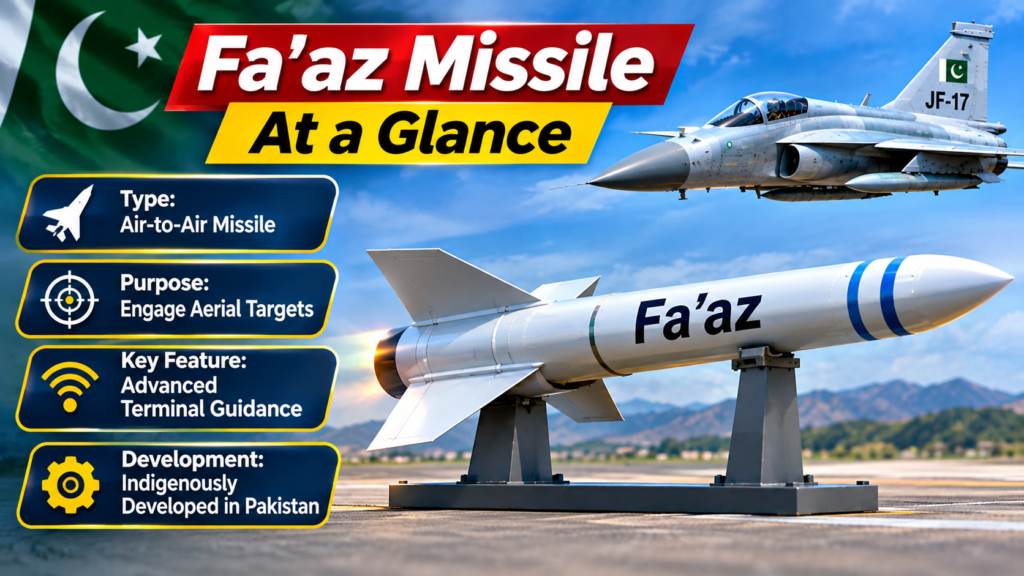
3. It Features an Advanced Terminal Guidance System
One of the key features highlighted by ISPR is the missile’s advanced terminal guidance system.
Terminal guidance refers to the final phase of a missile’s flight, when its guidance technology helps it move towards the intended target.
This stage is particularly important because aerial targets can change direction and altitude while attempting to avoid an incoming weapon.
ISPR stated that the Fa’az can engage aerial targets at longer ranges. However, the military has not publicly released detailed information about the missile’s guidance architecture or its full technical performance.
4. The JF-17 Thunder Connection
The Pakistan Air Force’s JF-17 Thunder is an important part of the country’s modern fighter fleet.
According to reporting by Dawn, the Fa’az test was associated with a JF-17 aircraft. This has attracted attention because locally developed weapons could potentially support the future development of Pakistan’s fighter capabilities.
The JF-17 programme itself represents cooperation between Pakistan and China. It has become a major component of the PAF’s efforts to maintain and modernise its combat aircraft fleet.
The integration of a domestically developed missile could provide additional options for future weapons planning. However, the precise integration status and operational compatibility of Fa’az have not been fully disclosed.
5. The Exact Range and Speed Have Not Been Officially Confirmed
One of the biggest questions surrounding the Fa’az missile concerns its range and speed.
Although ISPR described the weapon as capable of engaging aerial targets at longer ranges, its official announcement did not provide exact figures for:
- Maximum operational range
- Maximum speed
- Missile weight
- Dimensions
- Detailed seeker specifications
- Operational induction date
Some defence publications have discussed possible specifications associated with the wider Fa’az programme. However, projected or previously advertised figures should not be treated as confirmed performance results from the November 2026 test.
For readers, the most reliable approach is to distinguish between officially confirmed information and technical estimates.
According to Dawn’s report, some technical details have been discussed by defence observers, but the military has not officially confirmed the missile’s exact performance specifications.
6. Why Is Indigenous Missile Development Important for Pakistan?
Modern fighter aircraft depend on more than their engines, radar systems and airframes. Their weapons also play an important role in determining their overall capabilities.
Developing an indigenous air-to-air missile could offer Pakistan several long-term advantages.
Greater domestic control: Local development may provide more control over future production, maintenance and upgrades.
Reduced dependence on imports: A successful domestic programme could gradually reduce reliance on foreign suppliers for certain weapons.
Technical expertise: Missile development encourages progress in engineering, electronics, guidance systems and aerospace research.
Future development opportunities: Experience gained through testing can support improvements and future versions of the programme.
These benefits depend on the programme’s ability to move beyond testing and achieve reliable production and integration.
Arab News has also highlighted Pakistan’s wider efforts to modernise its military capabilities through locally developed defence technologies.
For more updates on Pakistan’s latest technology and defence developments, visit our Technology News section on NuvWire.
7. What Happens After the Successful Fa’az Missile Test?
A successful flight test is an important achievement, but it is only one stage in the development of a new weapon system.
Further evaluation, testing and integration work may be needed before a missile can become part of regular military operations.
The next developments to watch include additional official test announcements, technical information, production decisions and confirmation of integration with aircraft.
Pakistan has not yet publicly announced a confirmed operational induction date for the Fa’az missile.
Its future progress will therefore be important for understanding how the programme develops over the coming years.
Why the Fa’az Missile Test Matters for Pakistan’s Defence Industry
The Fa’az programme represents more than a single successful launch. It highlights Pakistan’s continued efforts to strengthen its domestic aerospace and defence manufacturing capabilities.
Developing advanced weapons locally requires investment in research, testing facilities, skilled engineers and long-term technical planning.
If the programme progresses successfully, it could contribute to a stronger domestic defence industry and provide the Pakistan Air Force with additional options for future modernisation.
At the same time, actual military capability depends on proven performance, reliable production, aircraft integration and operational experience—not simply the announcement of a successful test.
Final Words
The successful flight test of the Fa’az missile is an important milestone for Pakistan’s indigenous defence technology programme. Its advanced terminal guidance system and reported longer-range engagement capability make it a development worth watching.
Although several technical details remain undisclosed, the test demonstrates progress in Pakistan’s efforts to develop air-to-air weapons locally.
The next major step will be to see how the programme advances through further testing, integration and potential operational deployment.
For more updates on Pakistan’s technology, defence developments and important national news, keep visiting NuvWire.
Frequently Asked Questions
1. What is the Fa’az missile?
Fa’az is Pakistan’s indigenously developed air-to-air missile, designed to engage aerial targets.
2. When did Pakistan test the Fa’az missile?
Pakistan successfully conducted its first announced flight test on November 3, 2026.
3. Which aircraft was associated with the Fa’az missile test?
Dawn reported that the missile was test-launched from a JF-17 fighter aircraft.
4. What is the main feature of the Fa’az missile?
According to ISPR, it features an advanced terminal guidance system and is designed to engage aerial targets at longer ranges.
5. What is the exact range of the Fa’az missile?
Pakistan has not officially disclosed the missile’s exact range.
6. Is the Fa’az missile operational?
A successful flight test has been announced, but an official operational induction date has not been confirmed.
7. Why is the Fa’az missile important for Pakistan?
It represents progress in domestic missile development and could provide the Pakistan Air Force with additional options for future weapons modernisation.