
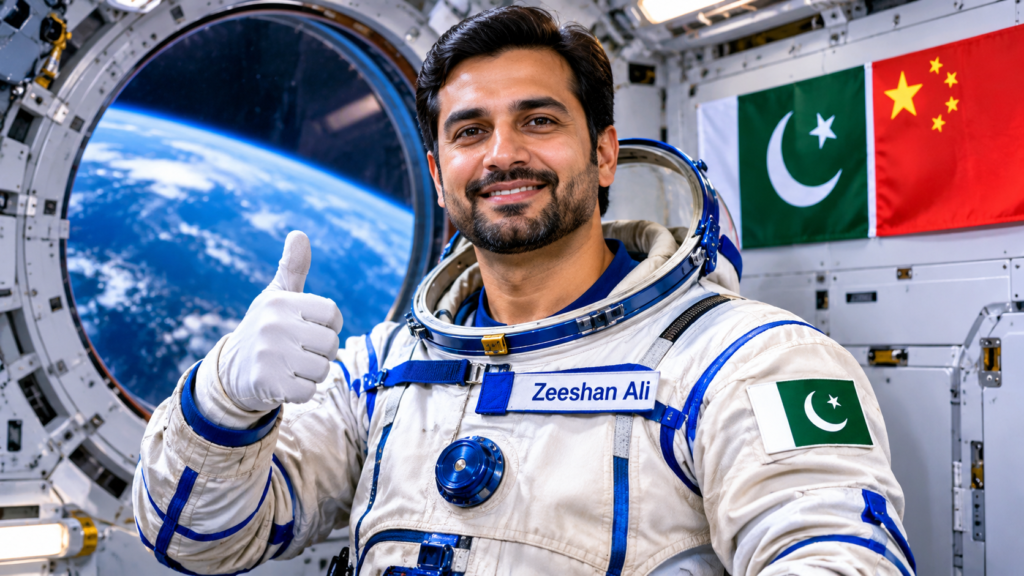
The Pakistani astronaut Zeeshan Ali is preparing to make history as Pakistan takes its first major step into human spaceflight. Muhammad Zeeshan Ali has been selected as part of China’s Shenzhou-24 crew, which is scheduled to travel to the Tiangong Space Station on November 25, 2026. His participation will make him the first Pakistani to travel into orbit and the first foreign astronaut to visit China’s space station.
This achievement represents an important moment for Pakistan’s growing space ambitions and its long-standing partnership with China. It also creates new opportunities for Pakistani scientists, researchers and future generations interested in space exploration.
The Pakistani astronaut Zeeshan Ali will represent Pakistan in an important international space exploration programme.
1. Who Is Muhammad Zeeshan Ali?
Muhammad Zeeshan Ali is a Pakistan Air Force pilot selected to participate in China’s human spaceflight programme. At 40 years old, he has earned an opportunity to represent Pakistan in an international crewed space mission.
His selection followed a competitive process involving Pakistani astronaut candidates who underwent specialised training in China.
Ali was selected alongside another Pakistani candidate, Khurram Daud, for the final astronaut training programme. Both candidates completed demanding preparation before the final mission selection was announced.
For Ali, this opportunity represents more than a personal achievement. It is also a significant step forward for Pakistan’s participation in international space exploration. The selection of Pakistani astronaut Zeeshan Ali reflects the growing importance of Pakistan’s participation in international space programmes. Pakistan’s space programme has gained international attention following the selection of Pakistani astronaut Zeeshan Ali for the Shenzhou-24 mission.
2. When Will Pakistan’s First Astronaut Launch Into Space?
The Shenzhou-24 mission is scheduled to launch on November 25, 2026, from the Jiuquan Satellite Launch Centre in northwestern China.
According to the China Manned Space Agency, the planned launch time is 8:18 AM Beijing time, which corresponds to 5:18 AM Pakistan Standard Time.
The spacecraft will travel aboard China’s Long March-2F rocket before entering orbit and heading towards the Tiangong Space Station.
Here are the important mission details:
- Astronaut: Muhammad Zeeshan Ali
- Mission: Shenzhou-24
- Launch date: November 25, 2026
- Scheduled launch time: 5:18 AM Pakistan time
- Launch location: Jiuquan Satellite Launch Centre, China
- Destination: Tiangong Space Station
- Rocket: Long March-2F
- Expected stay: Approximately one week
The launch will mark an important milestone in Pakistan’s journey towards human space exploration.
The Pakistani astronaut Zeeshan Ali mission is attracting attention because of its historic importance for Pakistan’s space programme.

3. What Is China’s Shenzhou-24 Mission?
Shenzhou-24 is a crewed spaceflight mission organised by China’s human spaceflight programme. Its primary destination is the Tiangong Space Station, where astronauts conduct scientific research, technology experiments and routine station operations.
The mission is particularly important because it includes an international astronaut for the first time in China’s crewed spaceflight programme.
The spacecraft will carry three astronauts, including one Pakistani participant. After reaching orbit, it is expected to dock with the Chinese space station.
The crew will support ongoing scientific activities, conduct experiments and work alongside astronauts already living aboard the station.
For China, the mission demonstrates its expanding ability to support international cooperation in human spaceflight.
- Anchor Text:
China National Space Administration - URL: https://www.cnsa.gov.cn/english/.
For Pakistani astronaut Zeeshan Ali, this mission offers a valuable opportunity to experience China’s advanced space technology. The participation of Pakistani astronaut Zeeshan Ali makes this mission particularly important for international space cooperation.
4. Who Are the Other Astronauts in the Shenzhou-24 Crew?
Muhammad Zeeshan Ali will travel alongside two Chinese astronauts who have different responsibilities during the mission.
The announced crew includes:
Tang Hongbo – Mission Commander
Tang Hongbo will lead the Shenzhou-24 crew. He is an experienced Chinese astronaut who has previously participated in the Shenzhou-12 and Shenzhou-17 missions.
Wu Yi – Flight Engineer
Wu Yi will serve as the flight engineer. The mission will be his first spaceflight.
Muhammad Zeeshan Ali – Payload Specialist
Ali will participate as a payload specialist, focusing on scientific experiments and related activities aboard the space station.
The three astronauts have completed joint preparations to ensure they can work together during their time in orbit.
5. What Will Pakistani Astronaut Zeeshan Ali Do in Space?
One of the most interesting aspects of this mission is its scientific purpose.
Ali will participate in research activities involving biotechnology and materials science. These experiments are expected to include projects developed through cooperation between Pakistani and Chinese researchers.
Reports indicate that four joint biotechnology experiments prepared by Pakistani researchers will be part of the mission’s scientific work.
The research is expected to help scientists better understand how biological materials and other scientific processes behave in the space environment.
Ali’s responsibilities will include supporting the experiments and handling scientific payloads.
His participation could also help Pakistani researchers gain valuable experience in conducting experiments in microgravity. Pakistani astronaut Zeeshan Ali will contribute to scientific research activities during his planned stay aboard the space station.
Through this mission, Pakistani astronaut Zeeshan Ali will gain valuable experience in scientific research and space operations.
6. How Long Will Zeeshan Ali Stay in Space?
Muhammad Zeeshan Ali is expected to spend approximately one week aboard China’s Tiangong Space Station.
Unlike long-duration missions involving several months in orbit, his participation is planned as a short-term visit.
An interesting detail is that Ali is expected to return to Earth aboard the Shenzhou-23 spacecraft rather than the Shenzhou-24 vehicle that carries him to the station.
This arrangement is connected to the planned crew rotation and operations aboard Tiangong.
His short stay will nevertheless provide valuable experience for Pakistan’s developing human spaceflight programme. The short stay will give Pakistani astronaut Zeeshan Ali an opportunity to participate in scientific activities aboard Tiangong.
7. How Did Pakistan and China Make This Space Mission Possible?
Pakistan and China have maintained cooperation in space science and technology for several decades.
A major development came in February 2025, when the two countries signed an agreement allowing Pakistani astronaut candidates to receive training in China and participate in its crewed spaceflight programme.
Under this arrangement, Pakistani candidates received specialised preparation at China’s Astronaut Centre.
The programme involved demanding activities, including physical conditioning, technical training, spacecraft simulations and emergency procedures.
Muhammad Zeeshan Ali and Khurram Daud emerged as the two Pakistani candidates selected for the final training process.
The eventual selection of Ali represents a major achievement in the development of Pakistan-China space cooperation.
- Anchor Text:
Pakistan's Space and Upper Atmosphere Research Commission (SUPARCO) - URL: https://suparco.gov.pk/
8. Why Is This Mission Important for Pakistan?
Pakistan’s participation in the Shenzhou-24 mission is significant for several reasons.
A Historic Achievement
Pakistan will have its first citizen travel into orbit, marking an important moment in the country’s space exploration history.
New Scientific Opportunities
Participation in international space experiments could help Pakistani researchers develop knowledge in biotechnology, materials science and other research fields.
Stronger International Cooperation
The mission highlights the growing relationship between Pakistan and China in scientific research and advanced technology.
Inspiration for Young Students
Ali’s journey could encourage students to explore careers in science, engineering, aviation, astronomy and space technology.
Future Space Exploration
The experience gained through international missions may help Pakistan develop stronger capabilities and participate in additional space research programmes.
The participation of Pakistani astronaut Zeeshan Ali could inspire young Pakistanis to pursue careers in science and space technology.
Read more about Pakistan’s technology developments.
9. What Is the Tiangong Space Station?
Tiangong is China’s independently developed space station located in low Earth orbit. Its name translates into English as Heavenly Palace.
The station provides a working environment for astronauts to conduct scientific experiments, study the effects of microgravity and test new technologies.
It is an important part of China’s long-term space exploration programme.
The arrival of Muhammad Zeeshan Ali will be especially significant because he is expected to become the first foreign astronaut to visit Tiangong.
This development could open new opportunities for international participation in China’s future space missions.
- Anchor Text:
China's Human Spaceflight Programme - URL: http://en.cmse.gov.cn/.

10. What Could This Mission Mean for Pakistan’s Future in Space?
The Shenzhou-24 mission should be viewed as a starting point rather than the final destination of Pakistan’s space ambitions.
Pakistan already has experience in satellite technology, scientific research and space-related development through SUPARCO, the country’s Space and Upper Atmosphere Research Commission.
However, human spaceflight requires additional expertise, infrastructure, research investment and international partnerships.
Ali’s experience could provide useful knowledge for future Pakistani scientists and space professionals.
If cooperation continues to grow, Pakistan may have opportunities to participate in more international experiments, astronaut training programmes and advanced space research projects.
The mission could also encourage greater investment in science education and technology development.
The experience of Pakistani astronaut Zeeshan Ali could help strengthen Pakistan’s future cooperation in human spaceflight.
Conclusion
The upcoming Shenzhou-24 mission represents a historic opportunity for Pakistan’s space programme. Muhammad Zeeshan Ali is preparing to become the first Pakistani to travel into orbit and the first foreign astronaut to visit China’s Tiangong Space Station. Pakistani astronaut Zeeshan Ali’s journey is an important milestone that could encourage further investment in Pakistan’s space research.
Beyond the excitement of space travel, the mission carries scientific and educational importance. It highlights the value of international cooperation and provides Pakistani researchers with an opportunity to participate in advanced space experiments.
For millions of Pakistanis, Ali’s journey represents a proud moment and a reminder that the country’s future in science and technology can extend far beyond Earth.
Explore more technology news and updates on NuvWire.
Frequently Asked Questions (FAQs)
1. Who is Pakistan’s first astronaut?
Muhammad Zeeshan Ali is set to become the first Pakistani to travel into orbit aboard China’s Shenzhou-24 crewed space mission.
2. When will Pakistani astronaut Zeeshan Ali go to space?
The Shenzhou-24 mission is scheduled to launch on November 25, 2026, at 5:18 AM Pakistan Standard Time.
3. What is the name of the spacecraft carrying Zeeshan Ali?
He will travel aboard China’s Shenzhou-24 spacecraft, which is designed to transport astronauts to the Tiangong Space Station.
4. Will Zeeshan Ali be the first foreign astronaut to visit China’s space station?
Yes. His participation will make him the first foreign astronaut to visit China’s Tiangong Space Station.
5. How long will Zeeshan Ali stay in space?
He is expected to spend approximately one week aboard the Tiangong Space Station.
6. What will Zeeshan Ali do during his space mission?
He will serve as a payload specialist and participate in scientific activities, including biotechnology and materials science experiments.
7. Who will travel with Zeeshan Ali?
The Shenzhou-24 crew includes Chinese astronauts Tang Hongbo, who will serve as commander, and Wu Yi, who will serve as flight engineer.
8. Which rocket will launch the Shenzhou-24 spacecraft?
China’s Long March-2F rocket is scheduled to carry the Shenzhou-24 spacecraft into orbit.
9. What is the role of SUPARCO in Pakistan’s astronaut programme?
SUPARCO has played an important role in Pakistan’s space cooperation programme and coordination with Chinese space authorities for astronaut selection and training.
10. Will Zeeshan Ali return to Earth aboard Shenzhou-24?
No. According to the announced mission plan, he is expected to return aboard the Shenzhou-23 spacecraft after his short stay at the Tiangong Space Station.
11. What is the importance of the Shenzhou-24 mission for Pakistan?
The mission marks Pakistan’s first participation in a crewed orbital spaceflight. It also creates opportunities for scientific research, international cooperation and future space exploration.
12. What is China’s Tiangong Space Station?
Tiangong is China’s space station in low Earth orbit. It is used for scientific research, technology experiments and astronaut missions.