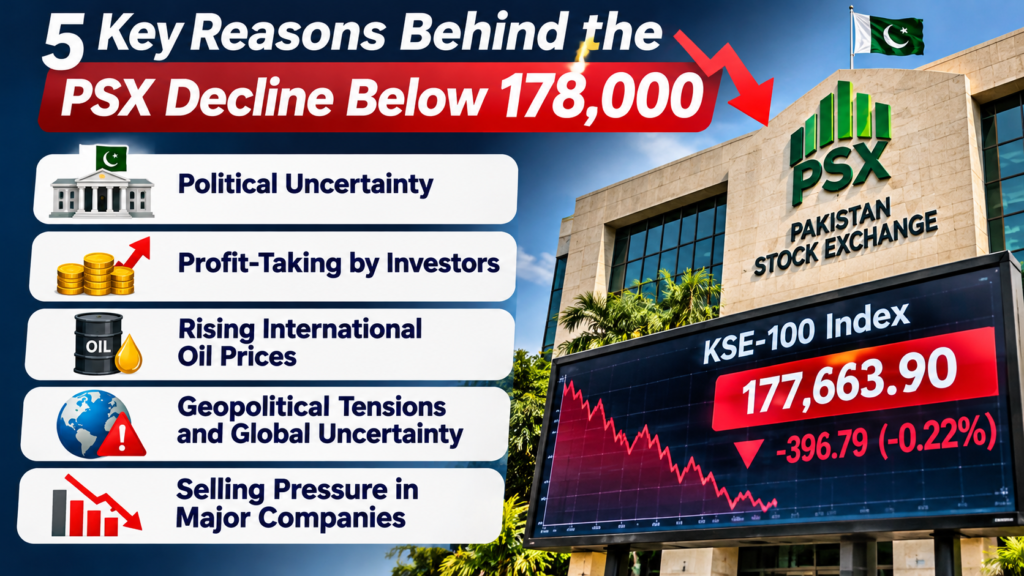
The PSX below 178,000 development has attracted attention across Pakistan’s financial markets after the benchmark KSE-100 Index ended Friday’s trading session in negative territory. The index lost nearly 397 points and closed at 177,663.90, slipping below an important psychological level that investors had been watching.
The decline came amid cautious investor sentiment, political uncertainty, profit-taking and concerns about rising international oil prices. Selling pressure in several heavyweight companies also contributed to the market’s weaker performance.
Although the latest session ended negatively, the broader picture is more complicated. The stock market had recorded gains during November, showing that a single weak session does not necessarily indicate a long-term downward trend.
In this report, NuvWire explains why the PSX below 178,000 movement matters, which companies contributed to the decline, what is influencing investor confidence and what market participants may watch in the coming sessions.
The latest PSX below 178,000 movement has raised questions among investors about the direction of Pakistan’s stock market and the factors influencing market confidence.
Pakistan Stock Exchange Below 178,000: What Happened?
The Pakistan Stock Exchange closed lower on Friday, November 27, 2026, as selling pressure continued across major sectors.
According to market reports, the KSE-100 Index settled at 177,663.90 points, declining by 396.79 points or approximately 0.22% compared with the previous close of 178,060.69.
The PSX below 178,000 level became an important talking point after the KSE-100 Index closed at 177,663.90 points on November 27, 2026.
The index moved within a range of approximately 177,306 to 178,073 points during the session. Although some buying activity appeared towards the end of trading, it was not enough to bring the benchmark back above 178,000.
| Market indicator | Latest reported figure |
|---|---|
| Closing KSE-100 Index | 177,663.90 |
| Previous close | 178,060.69 |
| Points lost | 396.79 |
| Percentage decline | 0.22% |
| Intraday high | 178,073.03 |
| Intraday low | 177,305.99 |
| Total market turnover | 717.78 million shares |
| Total traded value | Approximately Rs19.52 billion |
The latest PSX below 178,000 movement reflects cautious trading rather than a sudden collapse in the market.
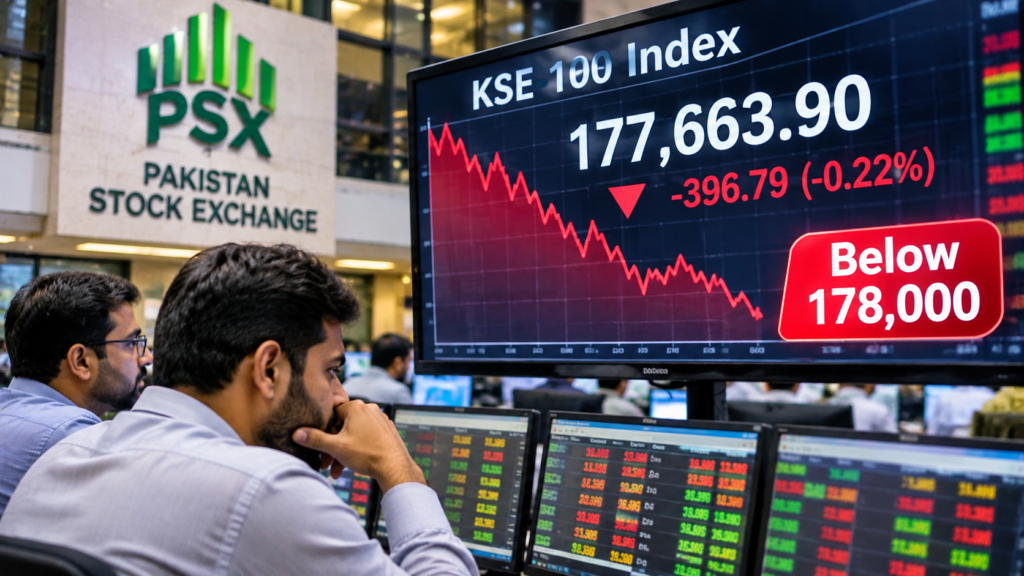
5 Major Reasons Behind the PSX Decline
Several developments influenced market sentiment during the latest trading session. The following factors help explain why investors remained cautious.
1. Political Uncertainty in Pakistan
Political developments remain an important influence on Pakistan’s financial markets.
When investors are uncertain about government decisions, economic policies or the political environment, they may become more cautious about committing additional money to equities.
The latest trading session took place amid continuing political tensions. This uncertainty contributed to an environment in which investors preferred a more defensive approach.
Political stability is important because businesses and investors generally need predictable policies and a clear economic direction to make long-term decisions.
Political uncertainty remains one of the factors investors consider when evaluating the PSX below 178,000 market situation.
2. Profit-Taking by Investors
Profit-taking was another important reason behind the market’s decline.
When share prices increase over a period, some investors decide to sell their holdings to secure gains. This can create additional selling pressure, particularly in companies with large weightings in the benchmark index.
The KSE-100 had experienced positive performance during November. Consequently, some market participants used the latest trading sessions to book profits.
Profit-taking does not always indicate that investors have lost confidence in the entire market. Sometimes it is simply a normal part of stock market activity.
3. Rising International Oil Prices
International oil prices also influenced investor sentiment.
Concerns about geopolitical developments in the Middle East, including reported attacks involving tankers in the Strait of Hormuz and Saudi energy infrastructure, increased worries about global energy supplies.
Higher oil prices can create challenges for countries that rely heavily on imported petroleum.
For Pakistan, expensive imported energy can increase pressure on the import bill, inflation expectations and the country’s external account.
This explains why rising oil prices can influence the Pakistan Stock Exchange even when the immediate developments are taking place outside the country.
The PSX below 178,000 decline also reflects concerns about the possible impact of expensive imported energy on Pakistan’s economy.
4. Geopolitical Tensions and Global Uncertainty
International developments can affect financial markets through energy prices, trade, currencies and investor confidence.
The latest concerns surrounding regional tensions made investors more careful about taking additional risks.
Global uncertainty can also influence foreign investment decisions. When international markets become unpredictable, investors may prefer to reduce exposure to riskier assets.
The combination of geopolitical concerns and local political uncertainty contributed to the cautious environment surrounding the PSX below 178,000 movement.
5. Selling Pressure in Major Companies
Selling in heavyweight companies played a significant role in the KSE-100’s decline.
Market reports identified the following companies among the major negative contributors:
- Lucky Cement
- Engro Holdings
- Meezan Bank
- Mari Energies
- Pakistan State Oil (PSO)
These five companies collectively reduced the benchmark index by approximately 237 points, according to market commentary reported by local financial publications.
Because large companies carry significant weight in the benchmark, their share-price movements can influence the overall direction of the KSE-100.
Which Companies Dragged the KSE-100 Index Down?
The latest session showed that selling pressure was not limited to one particular industry.
Companies from cement, banking, energy and other major sectors contributed to the negative performance.
Lucky Cement, Engro Holdings, Meezan Bank, Mari Energies and PSO were among the leading laggards.
However, not every listed company finished the session lower. Some stocks recorded gains, showing that market performance can vary significantly between individual companies.
Investors should therefore avoid judging every listed company solely by the movement of the overall index.
Trading Activity Remained Strong Despite the Decline
Despite the negative closing figure, trading activity remained active.
Approximately 717.78 million shares changed hands during the session, with the total traded value reaching around Rs19.52 billion.
Out of 495 companies traded, 309 closed lower, 156 advanced and 30 remained unchanged.
These figures indicate that selling pressure was relatively broad across the market.
Higher trading volume during a declining session can provide additional insight into investor activity. However, volume alone does not establish whether the market will continue falling or recover.
Is Pakistan’s Stock Market in a Bearish Trend?
The latest decline has raised questions about whether the Pakistan Stock Exchange is entering a longer bearish phase.
However, one negative trading session is not enough to confirm a sustained bear market.
The KSE-100 had gained approximately 7.3% during November up to November 25, according to market data cited in recent financial reporting. The index also recorded a weekly gain of approximately 0.20% during the week ending November 27.
This means the latest daily decline needs to be considered alongside the broader market performance.
Investors generally examine several indicators before identifying a longer-term trend, including earnings, interest rates, inflation, economic growth, foreign investment and market liquidity.
The PSX below 178,000 development is an important short-term market signal, but it should not be treated as proof of a long-term collapse.
What Should Investors Watch Next?
The next trading sessions may provide a clearer picture of market direction.
There are several developments that investors may monitor:
1. The 178,000-point level: Whether the KSE-100 can recover and sustain this psychological level may influence short-term sentiment.
2. International oil prices: Further increases in global energy prices could create additional concerns for Pakistan’s economy.
3. Political developments: Greater political clarity may help improve investor confidence.
4. Corporate earnings: Financial results and business performance remain important factors when assessing individual stocks.
5. Economic indicators: Inflation, interest rates, foreign exchange reserves and progress under Pakistan’s IMF programme may influence market expectations.
Market analysts also highlighted the possibility of continued range-bound and volatile trading below 180,000 points amid geopolitical uncertainty and rising international oil prices.
These observations are market commentary, not a guaranteed prediction of future performance.
Investors following the PSX below 178,000 development will be watching whether the benchmark index can regain the 178,000-point level.Investors following the PSX below 178,000 development will be watching whether the benchmark index can regain the 178,000-point level.

What Does the PSX Decline Mean for Pakistan’s Economy?
The stock market is one indicator of economic confidence, but it does not represent the entire economy.
A falling index can reflect concerns about political uncertainty, corporate earnings, interest rates, inflation or international developments.
However, the relationship between the stock market and the wider economy is not always immediate.
For example, companies can continue operating, producing goods and generating revenue even when their share prices decline.
Pakistan’s economic outlook also depends on factors such as exports, imports, industrial production, government finances, foreign investment and the stability of the currency.
Readers interested in the wider economic picture can also explore NuvWire’s coverage of the Pakistan IMF $1.2 billion deal and Pakistan petrol price developments.
The PSX below 178,000 movement highlights how local political developments and international economic conditions can influence Pakistan’s financial markets.
Final Verdict: Can the KSE-100 Recover Above 178,000?
The latest session has put the Pakistan Stock Exchange under renewed attention after the KSE-100 closed at 177,663.90 points.
Political uncertainty, profit-taking, geopolitical tensions and rising oil prices contributed to cautious investor sentiment. Selling in heavyweight companies also played an important role in the decline.
However, the index’s recent monthly and weekly performance shows why investors should consider a wider timeframe rather than focusing on one session.
Whether the PSX below 178,000 level becomes a temporary setback or develops into a longer period of weakness will depend on upcoming economic developments, corporate results, political conditions and international market trends.
For investors, the most sensible approach is to focus on reliable information, understand the risks and avoid making rushed decisions based on daily market movements.
NuvWire will continue following Pakistan’s financial markets and reporting important developments affecting investors and the wider economy.
Frequently Asked Questions (FAQs)
1. Why did the Pakistan Stock Exchange fall below 178,000 points?
The KSE-100 declined because of profit-taking, political uncertainty, geopolitical tensions, rising international oil prices and selling pressure in major companies.
2. What was the KSE-100 Index closing value on November 27, 2026?
The benchmark KSE-100 Index closed at 177,663.90 points on Friday, November 27, 2026.
3. How many points did the PSX lose?
The KSE-100 Index lost 396.79 points, representing a decline of approximately 0.22%.
4. Which companies contributed most to the decline?
Lucky Cement, Engro Holdings, Meezan Bank, Mari Energies and Pakistan State Oil were among the major negative contributors.
5. How does rising oil prices affect Pakistan’s stock market?
Higher oil prices can increase Pakistan’s import costs, create inflationary pressure and affect business expenses. These concerns may influence investor confidence.
6. Is the Pakistan Stock Exchange entering a bear market?
The latest decline alone does not confirm a bear market. Investors need to examine longer-term price movements, economic conditions and corporate performance.
7. What is the importance of the 178,000-point level?
It is a psychological market level that investors monitor. A sustained move above or below it can influence short-term market sentiment.
8. What was the total trading volume during the latest session?
Approximately 717.78 million shares were traded, with a total traded value of around Rs19.52 billion.
9. Can the KSE-100 recover above 178,000 points?
A recovery is possible, but it depends on market sentiment, economic developments, oil prices, political conditions and buying activity. No recovery is guaranteed.
10. Where can investors check official Pakistan Stock Exchange information?
Investors can visit the official Pakistan Stock Exchange website for market information, listed companies and official announcements.
11. Does a declining stock market mean Pakistan’s economy is collapsing?
No. The stock market reflects investor expectations and company valuations, but it is only one part of the wider economy.
12. Should investors buy shares when the PSX falls?
A market decline does not automatically make every share a good investment. Investors should assess company fundamentals, financial risks, valuation and their own financial circumstances before making investment decisions.
Disclaimer: This article is for general news and educational purposes only. It does not constitute financial or investment advice. Stock market investments involve risk, and readers should conduct their own research or consult a qualified financial adviser.