Artificial intelligence is changing the way people work, businesses operate, and companies hire employees. From automated customer support to AI-powered software and content creation, new technology is transforming workplaces across the world.
The debate around AI vs Human Jobs 2026 is becoming increasingly important for workers, students, employers, and job seekers. Some tasks can now be completed faster with AI, while other responsibilities still depend on human judgment, creativity, communication, and experience.
According to the International Monetary Fund (IMF), almost 40% of global employment is exposed to AI. This does not mean that 40% of jobs will disappear. Some workers may benefit from AI tools, while other roles could face changes in responsibilities, hiring, or demand. The International Labour Organization (ILO) has also reported that job transformation is generally more likely than complete replacement for many occupations.
1. AI vs Human Jobs 2026: Why the Workplace Is Changing
AI tools can process information, summarize documents, analyze data, answer routine questions, and assist with many digital tasks. Businesses are adopting these technologies to improve productivity, reduce repetitive work, and support decision-making.
However, adopting AI does not automatically mean eliminating employees. Many organizations need people to supervise AI systems, check their accuracy, protect customer information, and make decisions that require context and accountability.
The impact will differ by industry, country, company, and occupation.
2. Seven Major Changes Workers Should Understand
Change 1: Routine Office Tasks May Become More Automated
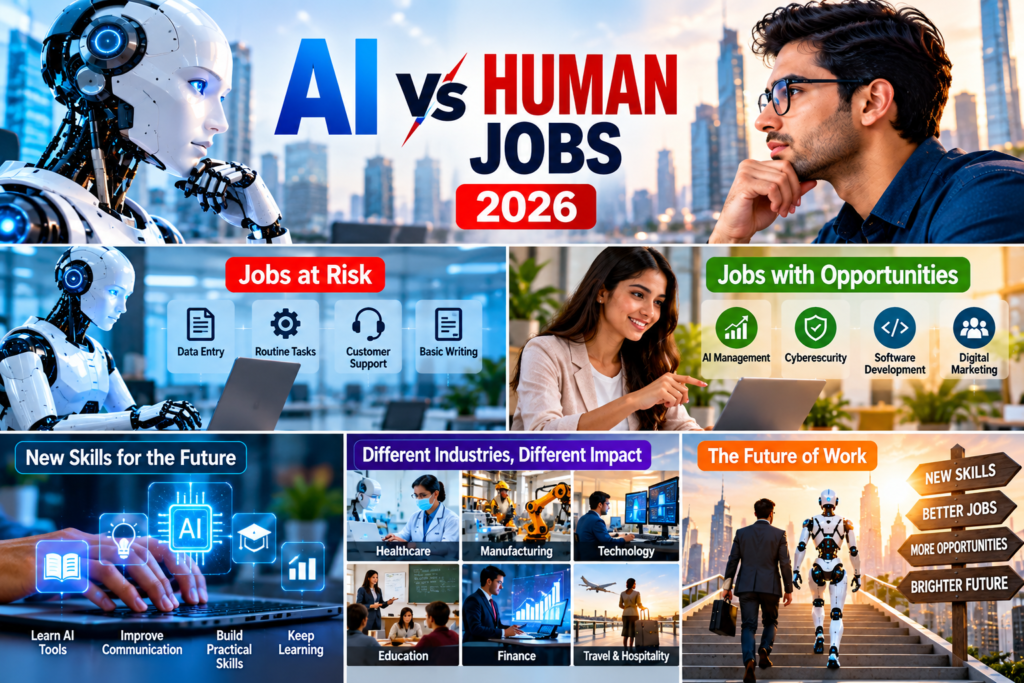
Data entry, basic document processing, scheduling, and repetitive administrative tasks may increasingly be handled by software and AI systems.
Workers can prepare by learning digital tools and developing skills that go beyond repetitive tasks. Accuracy, problem-solving, and the ability to manage complex situations will remain valuable.
Change 2: AI Skills May Become More Important
Employees who understand how to use AI responsibly may be able to complete certain tasks more efficiently. Depending on the role, useful skills could include AI-assisted research, spreadsheet analysis, content editing, workflow automation, and data interpretation.
Workers do not necessarily need to become AI engineers. Learning practical tools relevant to their profession can be a useful starting point.
Change 3: Entry-Level Jobs Could Face New Challenges
Some entry-level responsibilities involve tasks that AI can help perform, such as drafting basic reports, organizing information, or responding to common questions. Employers may redesign these roles as technology improves.
This creates a challenge for students and new graduates who need practical experience. Internships, real projects, communication skills, and hands-on learning can help candidates demonstrate their value.
Change 4: Human Communication and Judgment Still Matter
AI can generate answers and recommendations, but its output may be incomplete, inaccurate, or unsuitable for a particular situation.
People remain important in areas requiring empathy, leadership, negotiation, ethical judgment, relationship-building, and responsibility. Healthcare, education, management, and customer-facing professions may use AI as a support tool while retaining essential human involvement.
Change 5: Some Industries May Change Faster Than Others
Technology, finance, marketing, customer service, education, manufacturing, and healthcare may experience different forms of AI adoption.
Digital tasks can often be automated or assisted more easily than work requiring physical presence, complex human interaction, or unpredictable real-world problem-solving. Even within the same profession, some tasks may change while others remain largely human-led.
Change 6: New Opportunities May Emerge
AI adoption can increase demand for people who can integrate technology into business operations. Opportunities may include AI implementation, cybersecurity, data analysis, automation support, digital marketing, software development, and AI governance.
These are potential opportunities, not guaranteed jobs. Requirements vary, and workers should research the skills and qualifications employers actually seek.
Change 7: Continuous Learning Will Become More Valuable
Technology changes quickly, so workers may need to update their skills throughout their careers. Online courses, professional training, practical projects, and workplace learning can help people adapt.
A useful approach is to choose one AI tool relevant to your field, learn its limitations, and use it to solve a real problem. Always check the results instead of assuming that AI-generated information is correct.
3. What Does AI Mean for Workers in Pakistan, the UK, and the USA?
The effects of AI will vary across countries because industries, digital infrastructure, education systems, and employment patterns are different.
In Pakistan, digital skills, English communication, online services, software development, and responsible use of AI tools may help workers compete for local and international opportunities. However, reliable internet access, training, and affordability remain important considerations.
In the United Kingdom and the United States, businesses may integrate AI into office work, professional services, finance, technology, and customer support. Employees may need to adapt as employers redesign workflows and job requirements.
Across all three markets, workers should focus on practical skills, industry knowledge, communication, and the ability to work effectively with technology rather than relying on a single tool or trend.
4. How Can You Prepare for the Future of Work?
You can take several practical steps to prepare for changes in the job market:
- Learn useful AI tools: Choose tools that match your profession or career goals.
- Strengthen communication: Clear writing, speaking, and teamwork help people collaborate effectively.
- Build practical experience: Create projects, complete internships, or demonstrate real workplace skills.
- Verify AI output: Check important facts, calculations, sources, and recommendations.
- Protect private information: Do not upload confidential company, customer, or personal data into AI tools without proper authorization.
- Keep learning: Review job descriptions in your field and identify skills employers increasingly request.
These steps cannot guarantee employment, but they can help workers respond more confidently to technological change.
5. Will AI Replace Human Workers Completely?
AI will likely replace some tasks, change certain roles, and create demand for other skills. The overall effect will depend on how quickly businesses adopt the technology, whether AI systems are reliable, the cost of implementation, regulation, and the need for human oversight.
The IMF’s research highlights both opportunities and risks, while the ILO’s research emphasizes that many jobs are more likely to be transformed than eliminated entirely. These findings are important because exposure to AI is not the same as a confirmed job loss.
Workers and employers should therefore avoid assuming either that AI will replace everyone or that it will have no effect on employment.
How AI vs Human Jobs 2026 Will Shape Future Careers
The discussion around AI vs Human Jobs 2026 highlights the importance of adapting to changing workplace demands. As businesses adopt artificial intelligence, workers can improve their career prospects by learning digital tools, strengthening communication skills, and gaining practical experience. Understanding AI vs Human Jobs 2026 can help students, professionals, and job seekers prepare for new responsibilities and emerging opportunities. Rather than focusing only on job replacement, workers should learn how to use AI responsibly and combine technology with human creativity and judgment.
For more useful insights on technology, business, and changing global trends, explore the latest articles on <a href=”https://nuvwire.com/”>NuvWire</a> and stay informed about developments shaping everyday life.
Preparing for AI vs Human Jobs 2026
The future of AI vs Human Jobs 2026 will depend on how businesses and workers adapt to new technology. Learning practical AI skills, improving problem-solving, and staying informed about industry changes can help people prepare for evolving career opportunities.
Conclusion: Preparing for AI vs Human Jobs 2026
The future of work will not be determined by technology alone. Decisions made by employers, governments, educators, and workers will influence how AI changes employment and who benefits from its use.
Understanding AI vs Human Jobs 2026 can help people make more informed career decisions. Learn relevant digital skills, strengthen human abilities, verify AI-generated results, and stay open to new ways of working.
AI is a powerful tool, but using it effectively requires people who can think critically, communicate clearly, and take responsibility for the results.
What do you think? Will AI create more job opportunities or replace more workers in the coming years? Share your opinion.
Official Sources
- International Monetary Fund (IMF): https://www.imf.org/en/blogs/articles/2024/01/14/ai-will-transform-the-global-economy-lets-make-sure-it-benefits-humanity
- International Labour Organization (ILO): https://www.ilo.org/publications/generative-ai-and-jobs-2025-update