
The driverless robotaxi tests 2026 have reached an important milestone as Uber, Lucid and Nuro begin testing fully autonomous vehicles on public roads in California without a human safety operator inside. Announced on November 24, 2026, this development brings the three companies closer to introducing a new generation of self-driving ride-hailing services.
The testing marks a major step forward for autonomous transportation. Instead of relying on a human driver to control the vehicle, the specially equipped cars use advanced artificial intelligence, cameras, radar and LiDAR sensors to understand their surroundings and navigate roads.
The companies are preparing for a public robotaxi launch in the San Francisco Bay Area in the first quarter of 2027. Here is what happened, how the technology works and what this development could mean for the future of transportation.
The driverless robotaxi tests 2026 are attracting attention because they demonstrate how autonomous driving technology is moving closer to real-world transportation. Uber, Lucid and Nuro are combining their expertise to develop a service that could change how people book and experience rides in major cities.
Interest in driverless robotaxi tests 2026 is growing as major technology and automotive companies compete to develop practical autonomous transportation solutions. The Uber, Lucid and Nuro partnership is an important example of this changing industry.
Stay updated with the latest technology news and developments through NuvWire.
What Happened in the Uber, Lucid and Nuro Robotaxi Project?
On November 24, 2026, Uber, Lucid and Nuro announced that they had started fully driverless testing on public roads across the San Francisco Bay Area.
This is an important change from their earlier testing program, which involved a human safety operator sitting inside the vehicle.
The latest phase allows specially equipped vehicles to operate without a safety driver inside. The initial testing locations include:
- Palo Alto
- Mountain View
- Los Altos
- Sunnyvale
The companies also confirmed that employee rides in these driverless vehicles are expected to begin soon as they prepare for the commercial launch.
According to Nuro, the project has moved forward after months of supervised testing, extensive simulation and safety validation.
- Anchor text: Uber, Lucid and Nuro’s official robotaxi announcement
- URL: https://www.nuro.ai/blog/nuro-lucid-uber-begin-driverless-testing-on-public-roads
How Uber, Lucid and Nuro Are Working Together
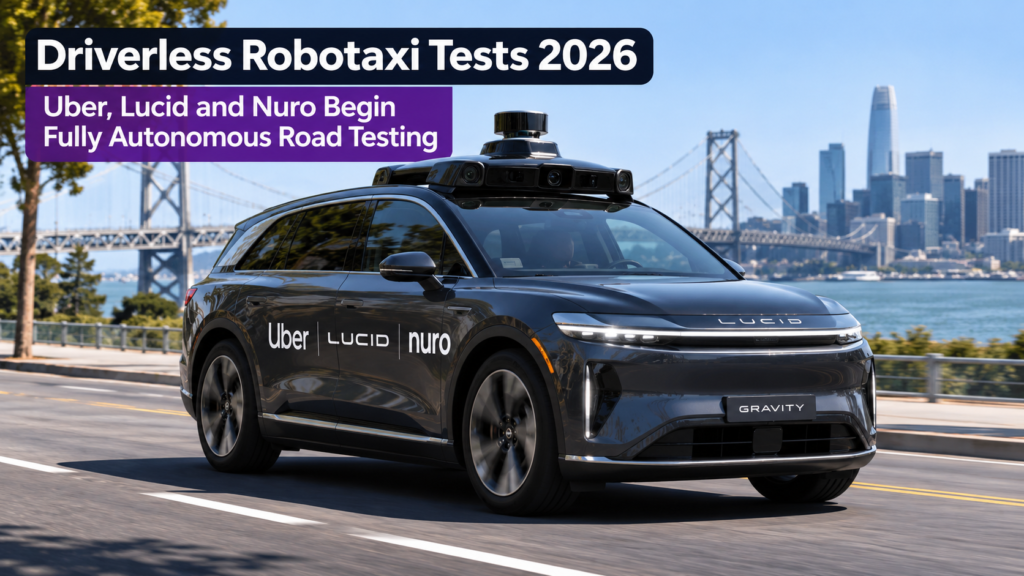
The three companies have different responsibilities in the robotaxi project. Their partnership combines electric vehicle manufacturing, autonomous driving technology and ride-hailing services.
1. Uber: The Ride-Hailing Platform
Uber is responsible for connecting passengers with autonomous vehicles through its ride-hailing network.
The company is also working on the passenger experience, including vehicle access, in-car controls, customer support and fleet operations.
Instead of developing every part of a self-driving vehicle independently, Uber is combining its transportation platform with technology developed by its partners.
One of the most important aspects of the driverless robotaxi tests 2026 is the cooperation between three companies with different areas of expertise. Their partnership combines electric vehicle manufacturing, autonomous driving software and an established ride-hailing platform.
2. Lucid: The Electric Vehicle Manufacturer
Lucid provides the electric vehicles used in the robotaxi program.
The project uses specially equipped Lucid Gravity SUVs, which have been modified to support autonomous driving technology.
Lucid has delivered more than 100 vehicles for this phase of development, according to the companies’ announcement.
The spacious interior is also designed to provide passengers with a comfortable experience during their journeys.
3. Nuro: The Autonomous Driving Technology
Nuro is responsible for developing the self-driving technology.
Its Nuro Driver system processes information from the vehicle’s sensors and helps the car understand road conditions, identify obstacles and make driving decisions.
Nuro also manages important safety validation activities before the vehicles become available to the public.
During driverless robotaxi tests 2026, artificial intelligence plays a central role in interpreting sensor data and helping vehicles respond to changing road conditions. This technology is essential for autonomous driving operations.
The driverless robotaxi tests 2026 could also increase competition among companies developing self-driving transportation services. Better technology, improved safety and passenger convenience will be important factors in this market.
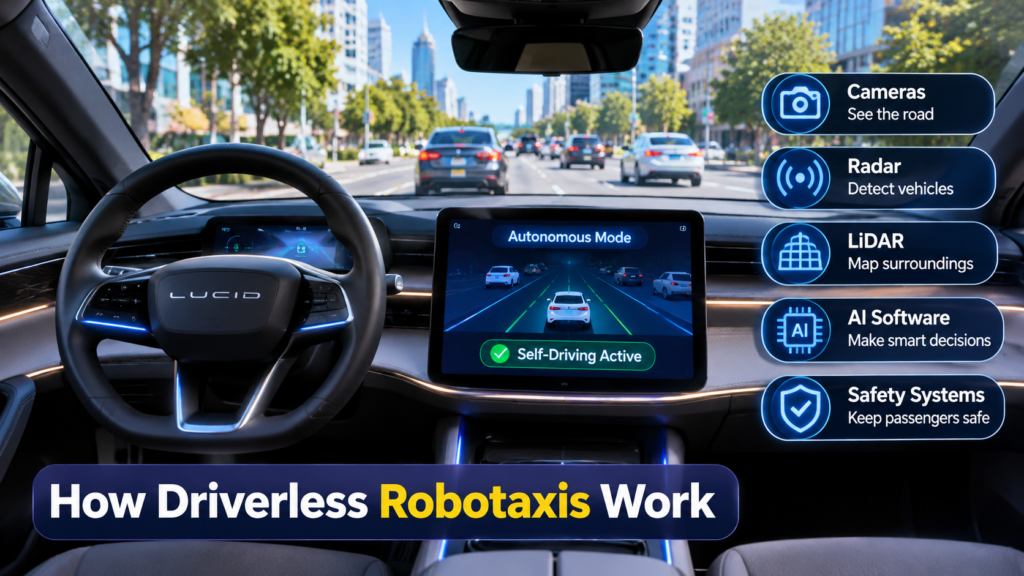
How Do Driverless Robotaxis Work?
A driverless robotaxi uses a combination of artificial intelligence, sensors, cameras and computing systems to navigate roads.
Unlike traditional vehicles, these cars are designed to perform driving tasks without requiring a human driver to control the vehicle continuously.
The technology used in the Uber, Lucid and Nuro project includes several important components.
Cameras
High-resolution cameras capture images of the surrounding environment.
They help the autonomous driving system recognize:
- Traffic lights
- Road signs
- Pedestrians
- Other vehicles
- Lane markings
- Road obstacles
LiDAR Sensors
LiDAR uses laser pulses to measure distances and create detailed information about the vehicle’s surroundings.
This helps the self-driving system understand the position and movement of nearby objects.
Radar Technology
Radar sensors help detect objects and measure their distance and movement.
They provide additional information that supports the vehicle’s understanding of traffic conditions.
Artificial Intelligence
Artificial intelligence processes information collected by the vehicle’s sensors.
The system evaluates road conditions and determines how the vehicle should respond to different situations, such as slowing down, changing lanes or stopping for pedestrians.
These technologies work together to support autonomous driving.
The driverless robotaxi tests 2026 are also helping engineers evaluate how autonomous vehicles respond to everyday road conditions. These tests allow companies to examine sensor performance, artificial intelligence decisions and vehicle responses in real traffic situations.
Why Are Driverless Robotaxi Tests 2026 Important?
The latest development is significant because testing without a safety operator represents another step toward commercial autonomous transportation.
For years, self-driving technology companies have tested vehicles under different conditions. However, moving from supervised testing to fully driverless public-road testing requires extensive technical preparation and safety validation.
There are several reasons why this milestone matters.
1. A Step Toward More Convenient Transportation
Robotaxis could give passengers another way to travel without personally driving a vehicle.
Customers may eventually be able to request a driverless ride through a smartphone application.
2. Growing Competition in the Robotaxi Industry
The autonomous transportation market is becoming increasingly competitive.
Companies such as Waymo, Zoox and Tesla are also developing or operating autonomous vehicle technologies.
Uber’s partnership with Lucid and Nuro gives it another opportunity to expand its position in this growing industry.
3. Better Integration of AI and Electric Vehicles
The project combines artificial intelligence with electric vehicle technology.
This demonstrates how automotive manufacturers and technology companies are working together to develop new transportation services.
4. New Business Opportunities
If commercial robotaxi services become successful, they could create opportunities in vehicle manufacturing, software development, fleet management, charging infrastructure and autonomous transportation services.
Another reason the driverless robotaxi tests 2026 matter is their potential impact on the transportation industry. Successful testing could encourage more investment in autonomous vehicles, electric mobility and AI-powered transportation services.
When Will Uber’s Driverless Robotaxi Service Launch?
The companies are targeting the first quarter of 2027 for the public launch of their robotaxi service in the San Francisco Bay Area.
However, the launch timeline depends on continued testing, safety validation, operational preparation and regulatory requirements.
The November 2026 announcement does not mean that the service is already available to everyone.
The companies are taking a gradual approach, beginning with driverless testing and planning employee rides before opening the service to public passengers.
Houston is also part of the expansion plan, with a robotaxi service expected to launch there in mid-2027.
The longer-term ambition is to expand the program into dozens of markets around the world.
- Anchor text: latest Uber and Nuro robotaxi testing report
- URL: https://techcrunch.com/2026/11/24/uber-and-nuro-begin-driverless-testing-of-lucid-robotaxis-ahead-of-2027-launch/.
The progress of driverless robotaxi tests 2026 will be important for the planned 2027 rollout. Before passengers can book rides, the companies must complete their testing programs and satisfy applicable safety and regulatory requirements.
What Makes the Lucid Gravity Robotaxi Different?
The Lucid Gravity provides the vehicle platform for this robotaxi project.
Unlike smaller autonomous delivery vehicles, the Gravity is a premium electric SUV designed to carry passengers comfortably.
Its robotaxi configuration includes:
- High-resolution cameras
- LiDAR sensors
- Radar technology
- A roof-mounted sensor structure
- Passenger-facing digital displays
- An interactive in-car experience
The vehicle is designed to accommodate up to six passengers, with space for luggage.
Passengers will also be able to interact with the in-car system to personalize parts of their journey, including climate and seating settings.
These features are intended to make autonomous transportation feel more like a premium ride-hailing experience.
Can Driverless Robotaxis Replace Human Drivers?
Driverless vehicles could change the transportation industry, but replacing human drivers completely is not something that can happen overnight.
Autonomous vehicles must deal with complicated real-world situations, including unexpected pedestrian movements, road construction, unusual traffic patterns and difficult weather conditions.
They also need to meet regulatory requirements before operating commercially in different locations.
For this reason, robotaxis are more likely to expand gradually in selected cities and approved operating areas.
Human-driven ride-hailing services may continue to operate alongside autonomous vehicles for many years.
What Does This Development Mean for the Future of Transportation?

The Uber, Lucid and Nuro partnership highlights how quickly autonomous transportation is developing.
Electric vehicles, artificial intelligence and advanced sensor systems are becoming increasingly connected. Companies are no longer focusing only on building cars; they are also developing complete transportation platforms.
If the planned service launches successfully in 2027, it could provide valuable experience for expanding robotaxi operations into additional cities.
However, public trust, safety performance, affordability and regulatory approval will remain important factors.
For passengers, the biggest question is not simply whether a car can drive itself. It is whether people will feel comfortable trusting that vehicle with their everyday journeys.
The results of the driverless robotaxi tests 2026 could influence the future development of autonomous transportation. If the vehicles demonstrate reliable performance and receive the necessary approvals, the partnership could expand its services into additional markets.
As the driverless robotaxi tests 2026 continue, attention will remain on vehicle safety, passenger experience and regulatory approval. These factors will help determine whether autonomous ride-hailing becomes a practical transportation option in 2027.
As driverless robotaxi tests 2026 progress, industry observers will be watching for updates about public availability, vehicle performance and expansion plans. These developments could shape the next stage of autonomous transportation.
Final Thoughts
The beginning of fully driverless testing by Uber, Lucid and Nuro is an important development in the autonomous vehicle industry.
The partnership brings together Uber’s transportation network, Lucid’s electric vehicle engineering and Nuro’s autonomous driving technology.
Although public rides are not yet available, the planned 2027 launch could represent another major step toward making robotaxis part of everyday transportation.
The coming months will show whether these vehicles can successfully move from testing environments into commercial passenger services.
Overall, driverless robotaxi tests 2026 represent an important stage in the development of autonomous mobility. The coming months will reveal how effectively Uber, Lucid and Nuro can turn their testing progress into a reliable commercial service.
Frequently Asked Questions (FAQs)
1. What are the driverless robotaxi tests in 2026?
Uber, Lucid and Nuro began fully driverless public-road testing in the San Francisco Bay Area on November 24, 2026. The vehicles operate without a safety driver inside.
2. Which companies are involved in the robotaxi partnership?
Uber, Lucid and Nuro are the three companies involved. Uber provides the ride-hailing platform, Lucid supplies electric vehicles and Nuro develops autonomous driving technology.
3. Where are Uber, Lucid and Nuro testing driverless robotaxis?
The initial driverless testing locations include Palo Alto, Mountain View, Los Altos and Sunnyvale in California.
4. When will Uber launch its robotaxi service?
The companies are targeting a public launch in the San Francisco Bay Area in the first quarter of 2027.
5. What vehicle is being used for the robotaxi project?
The project uses specially equipped Lucid Gravity electric SUVs with autonomous driving hardware and software.
6. How do Nuro driverless vehicles detect their surroundings?
The vehicles use cameras, LiDAR sensors and radar technology to collect information about nearby objects, pedestrians, traffic and road conditions.
7. Will passengers be able to book robotaxis through Uber?
Yes. The planned robotaxi service is designed to be available through Uber’s ride-hailing network once commercial operations begin.
8. Will Uber’s robotaxi service also launch in Houston?
Yes. Houston is the second planned deployment market, with a service launch expected in mid-2027.
9. How many passengers can the Lucid Gravity robotaxi carry?
The planned robotaxi configuration is designed to accommodate up to six passengers, along with luggage space.
10. Are driverless robotaxis completely safe?
No vehicle technology can guarantee zero risk. Autonomous vehicles must undergo extensive testing, safety validation and regulatory review before commercial deployment. Their performance in real-world conditions will remain important.
Stay connected with NuvWire for the latest technology, artificial intelligence, business and transportation updates.