
Electric cars are becoming an attractive option for drivers who want to reduce fuel expenses, enjoy quieter journeys, and move away from traditional petrol and diesel vehicles. With more electric vehicle (EV) models entering the market, buying one may seem easier than ever.
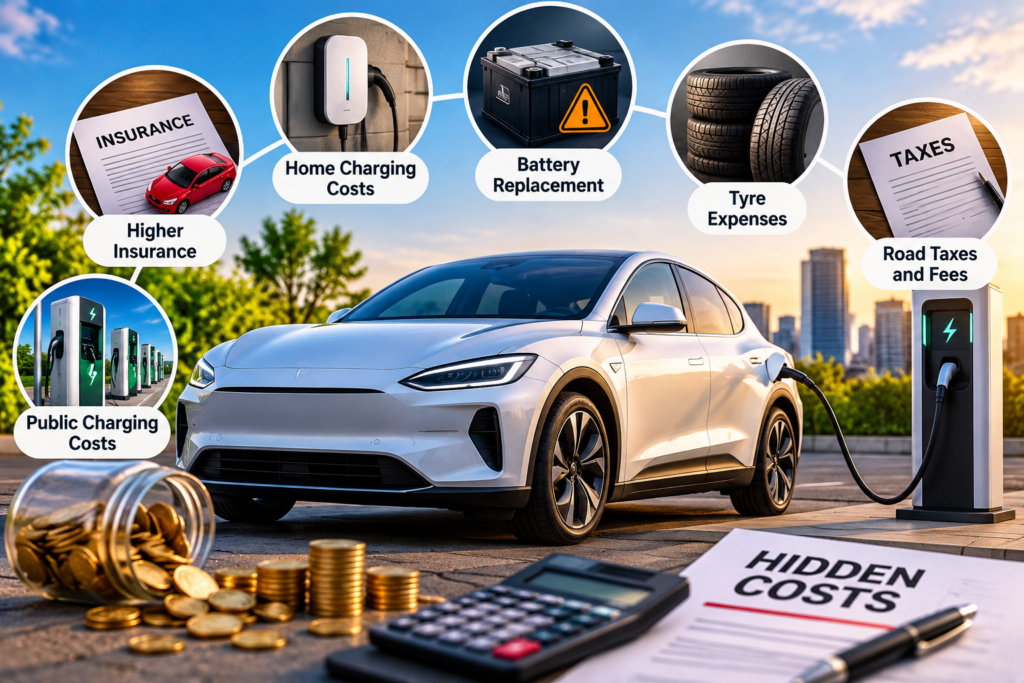
Knowing the electric car hidden costs can help drivers decide whether an EV fits their budget and everyday needs.
But there is something every potential buyer should understand: the purchase price is only one part of the cost of owning an electric car.
Charging equipment, insurance, tyres, repairs, road taxes, and depreciation can all affect the amount you spend over several years. Some EV owners save significantly on everyday driving, while others discover that certain expenses reduce their expected savings.
That does not mean electric cars are a bad investment. It means you should understand the complete financial picture before signing a purchase agreement.
In this guide, we explore nine electric car hidden costs that buyers should consider in 2026, along with practical ways to manage them.
Understanding electric car hidden costs before purchasing can help you plan your budget and avoid unexpected expenses.
Electric Car Hidden Costs: What Buyers Should Know
Understanding electric car hidden costs can help buyers make smarter financial decisions. Beyond the purchase price, charging, insurance, battery repairs, tyres, and depreciation can affect the total cost of ownership.
1. Home Charging Equipment Can Add to Your Budget
Charging at home is one of the biggest advantages of owning an electric car. Instead of visiting a petrol station, you can often charge your vehicle overnight and start the next day with a useful amount of driving range.
However, convenient home charging may require an initial investment.
Depending on your property and local electrical requirements, you might need a dedicated charger, professional installation, additional wiring, or an upgrade to your electrical panel. Installation can become more expensive when the parking space is far from the power supply or the existing system needs improvement.
Renters and apartment residents may face another challenge: getting permission to install a charger or arranging access to shared charging facilities.
How to reduce this cost:
- Ask an installer to assess your property before buying the vehicle.
- Get a written quotation that includes equipment, labour, and any electrical upgrades.
- Check whether a suitable charger is already included with the car.
- Compare the cost of home charging with nearby public charging options.
The key is to calculate the complete installation cost rather than assuming a home charger will be inexpensive or automatically available.
Home charging is one of the electric car hidden costs worth calculating before making your final purchase decision.
2. Electric Car Insurance May Be More Expensive
Insurance is another expense worth checking before choosing an EV.
Electric cars can cost more to insure than comparable petrol vehicles in some markets. Factors may include the vehicle’s purchase price, specialised repair requirements, replacement parts, and the cost of repairing battery-related damage.
However, insurance prices do not follow one universal rule. Some electric cars may have competitive premiums, while others can be considerably more expensive to cover.
Your age, driving history, location, insurer, and chosen level of coverage can also affect the final price.
The US National Association of Insurance Commissioners discusses these factors in its guide to electric vehicle insurance rates.
How to reduce this cost:
- Request insurance quotations before committing to a particular model.
- Compare equivalent coverage levels rather than comparing prices alone.
- Ask how the policy treats battery damage, charging equipment, and specialised repairs.
- Check the deductible and exclusions carefully.
A vehicle that appears affordable at the dealership may become less attractive if its annual insurance premium is substantially higher than expected.
Insurance is one of the electric car hidden costs that buyers should compare before choosing a model.
3. Battery Repairs and Replacement Deserve Attention
The battery is one of the most important components of an electric car. It stores the energy needed to power the motor and has a major influence on driving range.
Like other rechargeable batteries, an EV battery can lose capacity over time. Its condition may be influenced by age, temperature, usage patterns, charging habits, and the particular battery technology.
The expensive part is that battery-related repairs can require specialist equipment and trained technicians. If a battery pack needs replacement outside warranty coverage, the bill can be substantial.
Still, there is an important distinction between battery degradation and battery failure. A gradual reduction in range does not automatically mean that the entire battery must be replaced.
Many newer EV batteries are designed to last for years, and some manufacturers provide long battery warranties with specific mileage and capacity conditions.
For additional context, see Edmunds’ guide to electric car battery replacement costs.
How to reduce this risk:
- Read the battery warranty before purchasing.
- Check whether the warranty transfers to a second owner.
- For a used EV, request a battery health report where available.
- Review the vehicle’s service history and any battery-related repair records.
- Confirm which repairs are covered and which are excluded.
For used electric cars, battery condition can be more informative than mileage alone. A professional inspection can help you understand what you are buying.
Battery warranty coverage is an important part of managing electric car hidden costs, especially when buying a used vehicle.
4. Public Charging Can Cost More Than Expected
Electricity is often cheaper than petrol or diesel on a per-distance basis, especially when drivers can charge at home using favourable electricity rates.
Public charging, however, can produce a different result.
Charging networks may use different pricing structures. Some charge by the amount of electricity consumed, while others may include session fees, parking charges, subscription plans, or time-based fees in certain circumstances.
Rapid charging can also cost more per unit of electricity than charging at home. Drivers who depend almost entirely on public stations may therefore spend more than someone who charges overnight at home.
Prices vary significantly by country, provider, charger type, and electricity tariff.
How to reduce this cost:
- Check public charging prices along your usual routes.
- Compare home electricity rates with public charging tariffs.
- Use scheduled charging if your electricity plan offers cheaper off-peak periods.
- Check for idle fees or parking charges before starting a session.
- Consider subscription plans only if your usage makes them worthwhile.
Before buying an EV, estimate how much charging you will do at home, at work, and on public networks. That mix can make a meaningful difference to your annual expenses.
Public charging prices can make electric car hidden costs higher for drivers who cannot charge at home.
5. Tyres May Need More Frequent Attention
Tyres are easy to overlook when calculating the cost of owning an electric car.
Many EVs deliver strong acceleration immediately, and some models are relatively heavy because of their battery packs. Vehicle weight, driving style, tyre design, road conditions, wheel alignment, and tyre pressure can all affect tyre wear.
This does not mean every electric car wears through tyres quickly. The difference depends on the model and how it is driven.
Some EVs also use tyres designed to meet particular requirements for load capacity, noise, efficiency, or performance. These options may cost more than the tyres fitted to a smaller conventional car.
How to reduce this cost:
- Check replacement tyre prices before purchasing the vehicle.
- Maintain the recommended tyre pressure.
- Have wheel alignment checked when appropriate.
- Avoid unnecessarily aggressive acceleration and braking.
- Rotate tyres according to the manufacturer’s maintenance schedule.
When comparing two vehicles, do not look only at their advertised range and acceleration. Check the cost of replacing their tyres as well.
Tyre replacement should be included when estimating electric car hidden costs over the vehicle’s lifetime.
6. Depreciation Can Affect Your Resale Value
Depreciation is the difference between what you pay for a vehicle and what you eventually receive when selling it.
It is not a bill that arrives every month, but it is a real part of the total cost of ownership.
Electric vehicle resale values can change as manufacturers introduce newer models, prices shift, battery technology improves, and government incentives change. A discount on a brand-new vehicle can also affect the prices buyers are willing to pay for an older model.
The International Energy Agency’s Global EV Outlook 2026 examines used EV markets and the importance of resale values in making electric cars more affordable.
No single depreciation rate applies to every electric vehicle or country. Demand, warranty coverage, brand reputation, battery condition, and local charging infrastructure can all influence resale prices.
How to reduce this risk:
- Research the used prices of the exact model you are considering.
- Compare resale trends for similar model years and battery versions.
- Review the remaining battery warranty and whether it transfers.
- Avoid assuming that today’s resale value will remain unchanged.
- Compare ownership costs over the period you realistically plan to keep the car.
If you intend to sell your vehicle after three or four years, potential resale value should be part of your original budget.
Depreciation is another important factor when calculating electric car hidden costs over several years.
7. Repairs Can Require Specialist Workshops
Electric cars generally have fewer moving parts in their drivetrains than conventional petrol vehicles. They do not require engine oil changes, spark plugs, or many of the routine services associated with combustion engines.
Repair availability is another factor to consider when comparing electric car hidden costs across different brands and models.
That can reduce certain maintenance expenses.
However, an electric car still contains brakes, suspension components, tyres, air-conditioning systems, electronics, and other parts that require attention. Some repairs also involve high-voltage systems that need appropriately trained technicians.
In areas where EV ownership is relatively new, finding a qualified repair centre or obtaining a particular replacement part may be difficult. This can affect repair time and cost.
Collision damage is another consideration. Even when exterior damage looks minor, a workshop may need to inspect nearby electrical components or the battery enclosure before returning the vehicle to service.
How to reduce this cost:
- Identify qualified EV repair centres near your home.
- Check the availability of replacement parts for your chosen model.
- Review the manufacturer’s servicing requirements.
- Ask whether the warranty requires maintenance through an authorised network.
- Compare the availability of roadside assistance and specialist recovery services.
A model with good local service support may be a more practical choice than one that looks better on paper but is difficult to repair in your area.
8. Road Taxes, Registration, and Other Fees Can Change
Some buyers assume that electric vehicles automatically qualify for lower taxes or registration fees.
That assumption can be risky.
Government policies differ by country and sometimes by state, province, or city. Certain regions provide EV incentives or reduced registration fees, while others apply standard charges or introduce new taxes as electric vehicle ownership grows.
Depending on where you live, you may also need to consider annual road charges, inspection fees, parking permits, tolls, or congestion charges.
These rules can change during the ownership period, so a benefit available today may not necessarily remain available for the entire time you own the vehicle.
How to reduce this cost:
- Check the current official government rules for your location.
- Confirm whether incentives apply to your chosen vehicle and purchase date.
- Include annual registration and road-use charges in your budget.
- Do not count an incentive until you have confirmed your eligibility.
- Recheck local rules before renewing registration or planning a long-term purchase.
The most reliable approach is to calculate taxes and fees using your actual location rather than relying on information from another country.
Checking local taxes and registration fees helps buyers estimate electric car hidden costs based on where they live.
9. Road Trips Can Require More Planning and Spending
Daily driving can be straightforward when you have access to convenient charging. Long-distance travel may require additional planning.
Your journey could depend on the availability of compatible charging stations, charging speed, weather, traffic, terrain, and the amount of energy needed to reach the next stop.
In some areas, chargers are widely available. In others, the network may be limited or unreliable along particular routes.
Charging stops can also add time to a journey, particularly when you arrive at a busy station or need to wait for a compatible charger. Depending on the location, you may spend extra money on rapid charging, parking, food, or overnight accommodation.
Modern EVs can be excellent road-trip vehicles, but the experience depends heavily on the route and charging infrastructure.
How to reduce this cost:
- Plan charging stops before setting off on unfamiliar routes.
- Check live charger availability where the service provides it.
- Allow a sensible battery reserve for unexpected delays.
- Compare charging networks and payment requirements.
- Consider the vehicle’s real-world highway range rather than relying only on its official maximum figure.
If you frequently travel through areas with limited charging facilities, test your typical routes before deciding whether an EV suits your lifestyle.
Planning for charging, parking, and occasional accommodation can help you estimate electric car hidden costs more accurately.
Are Electric Cars Still Worth Buying in 2026?
For many drivers, yes. But the right answer depends on how the vehicle will be used and what it costs to own in your particular circumstances.
Comparing electric car hidden costs with the running costs of a petrol vehicle gives buyers a clearer picture of potential savings.
Electric cars can offer lower energy costs, reduced routine maintenance requirements, quiet driving, and a convenient charging experience for people with suitable home or workplace facilities.
At the same time, insurance, charging access, depreciation, tyres, and local taxes can affect the overall financial benefit.
A driver who charges at home, travels predictable daily distances, and keeps a vehicle for several years may experience a very different ownership cost from someone who relies on expensive public charging and changes vehicles frequently.
That is why it is useful to compare the total cost of ownership, rather than judging a car solely by its purchase price or advertised fuel savings.
The International Energy Agency provides an electric vehicle total cost of ownership tool that can help compare relevant cost categories. Its assumptions should be adjusted where possible to reflect your own driving distance, electricity prices, vehicle costs, and local conditions.
A Simple Checklist Before Buying an Electric Car
Before making a final decision, work through these questions:
- What is the total purchase price after applicable taxes and incentives?
- How much will home charging installation cost?
- What are the insurance premiums for the exact model?
- How much will charging cost based on my usual driving distance?
- What warranty covers the battery, and how long does it last?
- How much do replacement tyres cost?
- Are qualified repair centres and replacement parts readily available?
- What registration charges and taxes apply where I live?
- How might depreciation affect the vehicle’s resale value?
- Can the car comfortably handle my usual long-distance journeys?
You do not need to know every future expense precisely. Even reasonable estimates are more useful than assuming that all electric cars are automatically cheap to own.
For more technology insights, explore our latest articles on NuvWire and discover practical guides to emerging technology, digital safety, and smarter everyday decisions.
Final Thoughts
Electric cars offer genuine advantages, but buying one should involve more than comparing advertised range, acceleration, or monthly payments.
The hidden costs of electric car ownership are not the same for everyone. Some expenses, such as home charger installation, may be paid upfront. Others, including insurance, tyres, charging, and registration, can continue throughout ownership. Depreciation may also influence the overall amount you lose or recover when you sell.
The smartest decision comes from comparing realistic costs for the vehicle, your driving habits, and your location.
Before buying an electric car in 2026, calculate the complete cost of ownership—not just the price displayed on the windscreen. That simple step can help you choose a vehicle that fits both your lifestyle and your budget.
Reviewing electric car hidden costs carefully helps you compare vehicles and make a more informed buying decision.
Frequently Asked Questions
1. Are electric cars cheaper to maintain than petrol cars?
They can be cheaper to maintain because they have fewer drivetrain components and do not need engine oil changes. However, tyre replacement, repairs, cabin systems, and other maintenance costs still apply.
2. Is replacing an electric car battery always necessary after several years?
No. Batteries gradually lose capacity, but that does not automatically mean they need replacement. Battery condition, usage, warranty terms, and the vehicle’s performance all matter.
3. Is home charging always cheaper than public charging?
Not always, but home charging can be less expensive when local electricity rates are favourable. Actual savings depend on your tariff, charging equipment, and the prices charged by public networks.
4. Do electric cars have higher insurance costs?
They may in some markets, partly because of vehicle value, repair complexity, and replacement parts. Insurance premiums vary by model, driver, location, insurer, and coverage.
5. What is the most important cost to check before buying a used electric car?
Start by checking battery health and warranty coverage, then review the vehicle’s history, insurance cost, local repair support, and expected resale value.
Sources and further reading
- International Energy Agency — Global EV Outlook 2026: Trends in Electric Cars
- International Energy Agency — Electric Vehicle Total Cost of Ownership Tool
- National Association of Insurance Commissioners — Electric Vehicle Insurance Rates
- Australian Government, Department of Climate Change, Energy, the Environment and Water — Preparing to Buy an Electric Vehicle
- Edmunds — Electric Car Battery Replacement Costs
Editorial note: Costs, incentives, warranties, and regulations vary by country and vehicle. Confirm current local information before making a purchase.