
Managing household expenses becomes easier when you combine energy-saving habits with smart budgeting. Read our guide on how to reduce monthly expenses for more practical ways to manage your money.
Electricity bills can take a significant portion of a household budget, especially when heating, cooling, lighting, and everyday appliances run for hours. Learning how to reduce your electricity bill can help you control monthly expenses without sacrificing comfort. The good news is that many useful changes cost little or nothing, and you can start making them today.
Whether you live in the United States, the United Kingdom, Pakistan, Canada, Australia, or another country, the best approach is to understand where electricity goes and focus on the habits and appliances that consume the most power.
In this guide, you will discover 15 practical ways to use electricity more efficiently, avoid common energy-wasting habits, and make smarter decisions about household spending.
Why Is Your Electricity Bill So High?
Several factors can contribute to a high electricity bill. Your home’s size, local electricity rates, weather conditions, appliance efficiency, and daily routines all affect how much you pay.
Heating and cooling systems can consume substantial amounts of electricity, particularly during extreme temperatures. Refrigerators, water heaters, washing machines, electric ovens, and other frequently used appliances can also add to your consumption.
Sometimes, the problem is not one particularly expensive appliance. It is the combined effect of small habits, such as leaving lights on, running half-full washing machine loads, or keeping electronics in standby mode.
Before changing everything at once, compare your recent bills and check your electricity meter, if accessible. Understanding your usage makes it easier to identify the changes most likely to help.
Learning how to reduce your electricity bill starts with understanding which appliances consume the most energy in your home.
When looking for how to reduce your electricity bill, start by checking your monthly electricity consumption and identifying sudden increases.
Small improvements can make a difference. To understand how to reduce your electricity bill effectively, compare your energy usage before and after changing your daily habits.
How to Reduce Your Electricity Bill: 15 Smart Ways
1. Replace Traditional Bulbs With LED Lighting
Lighting is one of the easiest places to begin saving electricity. Traditional incandescent bulbs use considerably more energy than LEDs to produce a similar amount of light.
LED bulbs can use up to 90% less energy than traditional incandescent bulbs and generally last much longer. Replacing the bulbs you use most frequently can reduce electricity consumption without changing your daily routine.
Start with the kitchen, living room, outdoor lights, and other areas where lights remain on for extended periods. Choose a suitable brightness and color temperature for each room.
For additional guidance, visit the ENERGY STAR guide to saving energy at home.
One practical way to learn how to reduce your electricity bill is to switch off appliances and lights whenever they are not needed.
If you want to know how to reduce your electricity bill without spending much money, begin with free changes such as using natural light and avoiding unnecessary hot-water use.
2. Use Air Conditioning More Efficiently
Air conditioning can be a major source of electricity consumption in hot climates. Running it at an unnecessarily low temperature may increase energy use without providing much additional comfort.
Try these practical steps:
- Choose a comfortable temperature rather than setting the thermostat extremely low.
- Close doors and windows while the air conditioner is running.
- Use curtains or blinds to reduce direct sunlight during hot hours.
- Clean or replace air filters according to the manufacturer’s instructions.
- Arrange professional maintenance when necessary.
A ceiling fan can also help circulate air and improve comfort. However, fans cool people rather than entire rooms, so switch them off when nobody is present.
The best thermostat setting depends on your climate, humidity, health needs, and personal comfort.
3. Turn Off Lights When You Leave a Room
Leaving unnecessary lights on may seem harmless, but the electricity adds up over time, particularly when several lights remain on for hours.
Make it a habit to switch off lights when leaving an unoccupied room. During daylight, open curtains and use natural light whenever practical.
For households that frequently forget to turn lights off, motion sensors or timers may be worth considering in suitable areas.
This simple habit requires no expensive equipment and can help reduce avoidable electricity use.
4. Avoid Leaving Electronics on Standby
Televisions, gaming consoles, desktop computers, speakers, and other electronic devices may continue consuming electricity when they appear to be switched off.
This is commonly called standby power. The amount varies by device, so not every plugged-in product wastes a significant amount.
Switch off equipment that does not need to remain powered. A suitable switched power strip can make it easier to disconnect several devices together.
Do not disconnect equipment that must remain on for safety, security, medical needs, or essential functions. Always follow the manufacturer’s instructions.
5. Use Your Washing Machine With Full Loads
Running a washing machine repeatedly for small loads can waste electricity and water.
Whenever practical, combine laundry into appropriately sized loads without exceeding the machine’s capacity. Choose an eco or energy-saving program if it suits the fabric and level of dirt.
Washing clothes in cold water can also reduce the energy required to heat water. Use warmer cycles when necessary for the clothing, hygiene requirements, or manufacturer’s recommendations.
Avoid unnecessary extra rinse cycles, and select the spin speed recommended for the type of laundry.
6. Keep Your Refrigerator Efficient
A refrigerator operates throughout the day, so its condition and settings matter.
You can improve its efficiency by following these steps:
- Check the door seals for damage or gaps.
- Avoid leaving the door open while deciding what to take out.
- Allow hot food to cool appropriately before storing it.
- Keep vents clear so air can circulate.
- Clean accessible coils if the manufacturer recommends it.
- Follow the recommended temperature settings in the user manual.
Do not set the refrigerator colder than necessary. If it is already working efficiently, replacing it immediately may not be economical. Consider an upgrade when an old appliance needs replacement or has a clear performance problem.
7. Choose Energy-Efficient Appliances
When purchasing a new refrigerator, washing machine, air conditioner, or other major appliance, look beyond the initial price.
An efficient appliance may cost more upfront but use less electricity during its lifetime. Compare the energy labels, estimated annual consumption, capacity, warranty, and expected running costs.
Where available, look for a recognized efficiency certification, such as ENERGY STAR in the United States and Canada for eligible product categories.
Before buying, calculate whether the potential electricity savings justify the additional purchase cost. The most suitable choice depends on your local electricity rate and how often you use the appliance.
8. Reduce Unnecessary Water Heating
Electric water heaters can consume substantial energy, especially when hot water is used frequently.
Consider taking shorter showers, fixing leaking hot-water taps, and using hot water only when needed. If your heater has an adjustable temperature control, follow the manufacturer’s instructions and applicable safety guidance.
For storage water heaters, proper insulation and maintenance may help reduce heat loss where appropriate.
Do not lower temperatures below levels recommended for your equipment or local health and safety guidance. Some systems require specific settings to control bacterial growth.
9. Use Fans and Natural Ventilation Wisely
You may not need air conditioning every time a room feels warm.
When outdoor conditions are suitable, open windows to improve natural ventilation. Use curtains to block strong sunlight and switch on a fan when it helps you feel comfortable.
During very hot or humid weather, however, outside air may make indoor conditions worse. Keep windows closed when necessary and use cooling equipment appropriately.
The goal is to avoid running energy-intensive equipment when a simpler option can provide enough comfort.
10. Unplug Chargers and Unused Devices When Practical
Phone chargers, small electronics, and other plugged-in devices can draw power even when they are not actively charging or operating, depending on their design.
Unplug devices when they are not needed, particularly older equipment that may consume more standby power. Alternatively, use a suitable switched outlet or power strip.
However, do not expect unplugging one modern phone charger to produce a dramatic reduction in your bill. The savings from an individual low-power device may be very small.
Focus on repeated consumption across multiple devices rather than worrying about every single plug.
11. Cook More Efficiently
Cooking habits can influence electricity use, especially in homes that rely on electric ovens, cooktops, or other high-power appliances.
Try these methods:
- Match pots and pans to the size of the heating element.
- Keep lids on pots when suitable.
- Avoid opening the oven repeatedly while food is cooking.
- Use a microwave or another suitable small appliance for small portions when it is more efficient.
- Cook several items together when practical.
- Switch off the cooking appliance when it is no longer needed.
The most efficient option depends on the appliance, cooking time, food quantity, and local energy costs. Choose methods that suit your meals rather than buying new equipment solely for potential savings.
12. Improve Doors, Windows, and Insulation
Gaps around windows and doors can allow unwanted heat to enter or escape. This can make heating and cooling systems work harder.
Check for obvious drafts and use suitable weatherstripping or sealing products where appropriate. Curtains, blinds, and suitable insulation can also help maintain a more comfortable indoor temperature.
In hot regions, shading windows that receive strong sunlight may be particularly helpful. In colder climates, reducing heat loss can improve comfort and reduce heating demand.
For major insulation work, consider a professional assessment before investing. The best solution depends on your building, climate, and existing insulation.
13. Check Your Electricity Usage Regularly
You cannot manage your electricity costs effectively if you never review your usage.
Read your bill carefully and compare consumption across several billing periods. Look for changes in kilowatt-hours (kWh), not only the total amount charged.
Your bill may increase because of higher usage, a change in electricity rates, taxes, seasonal adjustments, or other charges. Understanding the reason helps you choose the right response.
If your utility provides an online account, smart meter, or usage dashboard, use it to identify patterns. A plug-in energy monitor may also help measure certain appliances, provided it is suitable for the device and electrical system.
14. Run Appliances at Suitable Times
Some electricity providers offer time-of-use tariffs, where electricity prices vary according to the time of day.
If your plan uses these rates, operating eligible appliances during cheaper periods may reduce your bill without reducing total electricity consumption.
Check your provider’s tariff and compare the actual price differences before changing your routine.
If your electricity rate stays the same throughout the day, changing the time you run an appliance may not reduce the cost. Focus instead on using less electricity or improving appliance efficiency.
For households with solar panels, using suitable appliances during periods of strong solar generation may also improve the use of self-generated electricity.
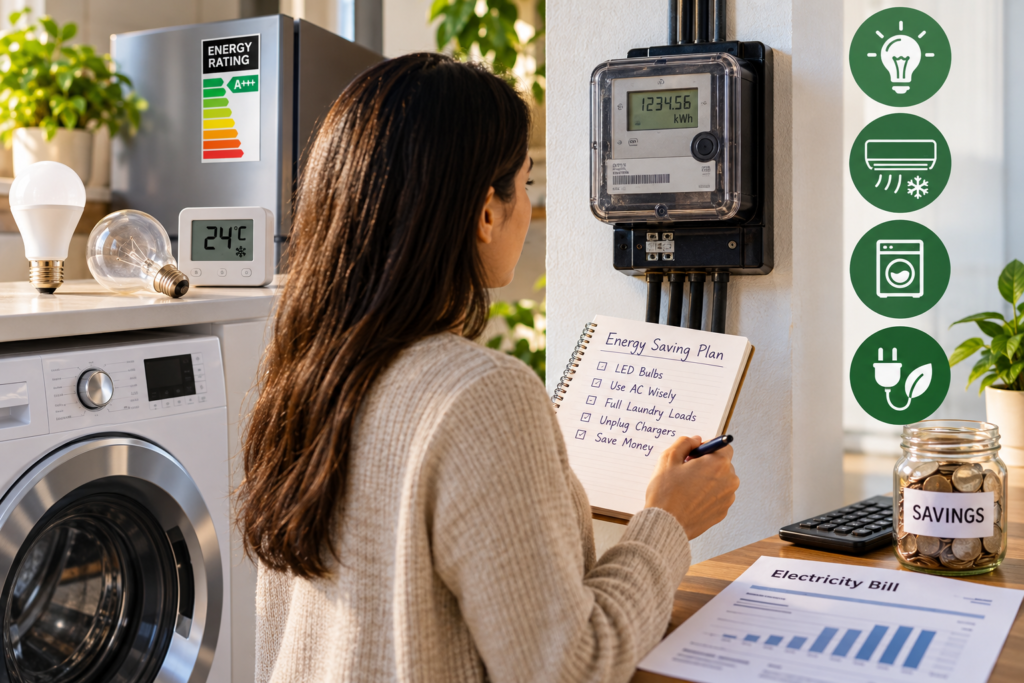
15. Make a Monthly Energy-Saving Plan
Small improvements are easier to maintain when you have a clear plan.
Choose three actions to begin with, such as replacing frequently used bulbs with LEDs, adjusting air-conditioning habits, and switching off unused electronics.
Then follow these steps:
- Record your current electricity consumption.
- Make the selected changes consistently.
- Compare your next bill with a similar previous period.
- Account for differences in weather, occupancy, and electricity rates.
- Keep the changes that provide worthwhile savings.
Avoid purchasing expensive equipment before identifying the biggest sources of consumption in your home.
A practical plan based on your actual usage is more useful than trying every energy-saving suggestion at once.
Which Appliances Use the Most Electricity?
The amount of electricity an appliance consumes depends on its power rating and how long it operates. In many homes, heating, air conditioning, water heating, and frequently used major appliances deserve particular attention.
| Appliance or system | What affects its consumption? |
|---|---|
| Air conditioner | Cooling capacity, temperature setting, weather, and operating hours |
| Electric water heater | Water temperature, hot-water use, and insulation |
| Refrigerator | Age, efficiency, temperature settings, and condition |
| Washing machine | Cycle selection, water heating, and load size |
| Electric oven or cooktop | Power rating, cooking duration, and frequency of use |
| Lighting | Bulb type, wattage, and hours switched on |
| Television and computer | Power consumption, screen settings, and usage time |
This is a general guide rather than a universal ranking. In a hot country, air conditioning may dominate household consumption, while electric heating can be a major expense in colder regions.
Knowing how to reduce your electricity bill can also help you make better decisions when purchasing new household appliances.
How to Calculate the Cost of an Appliance
A simple calculation can help you estimate how much an appliance costs to operate.
Formula:
Electricity used (kWh) = Power (watts) ÷ 1,000 × Hours of use
Estimated electricity cost = Electricity used (kWh) × Your electricity price per kWh
For example, imagine a 100-watt device runs for 5 hours each day:
- Daily consumption: 100 ÷ 1,000 × 5 = 0.5 kWh.
- Monthly consumption over 30 days: 0.5 × 30 = 15 kWh.
- At a hypothetical rate of $0.20 per kWh, the energy cost would be $3 per month.
This example uses an illustrative electricity rate, not a current rate for any specific country. Actual costs may include additional charges, and some appliances do not operate continuously at their rated power.
Common Mistakes That Can Increase Your Electricity Bill
Even people who try to save energy can overlook habits that increase consumption.
Setting the air conditioner unnecessarily low: Extremely low settings can increase cooling demand. Choose a comfortable temperature instead.
Ignoring appliance maintenance: Dirty filters, damaged seals, and blocked vents may reduce performance. Follow the manufacturer’s maintenance guidance.
Buying an appliance based only on its price: A cheaper model may have higher running costs. Compare efficiency and estimated lifetime costs.
Assuming standby power is always a major expense: Some devices use very little power when idle. Prioritize larger and repeated sources of waste.
Replacing working equipment without calculating the savings: A new appliance may be more efficient, but the purchase cost can outweigh the savings if your current equipment is already efficient.
Expecting the same results in every season: Weather and household routines affect consumption. Compare similar periods whenever possible.
Frequently Asked Questions
1. What is the easiest way to reduce your electricity bill?
Start by reducing unnecessary air conditioning or heating, switching off unused lights and equipment, and replacing frequently used traditional bulbs with LEDs. The best starting point depends on which activities consume the most electricity in your home.
2. Do LED bulbs really help save electricity?
Yes. LEDs generally use much less electricity than traditional incandescent bulbs for similar light output and usually last longer. Savings depend on the number of bulbs replaced and how many hours they are used.
3. Does unplugging appliances reduce electricity costs?
It can, particularly for devices that consume standby power. However, savings vary by device. Switching off several unused electronics may help, but unplugging a single low-power charger is unlikely to make a large difference.
4. Does turning off the air conditioner when leaving home save money?
It can reduce electricity use when cooling is unnecessary. The best approach depends on the weather, how long you are away, your home’s insulation, and any humidity or health requirements. Programmable settings can help maintain comfort while avoiding unnecessary operation.
5. How can I reduce my electricity bill without buying anything?
Use natural light, switch off unused lights, run appropriately sized laundry loads, avoid unnecessary hot-water use, adjust cooling and heating sensibly, and turn off electronics that do not need to remain powered.
6. Can I reduce my electricity bill by 50%?
Some households may achieve large reductions when they have substantial avoidable energy use or make significant efficiency improvements. However, a 50% reduction is not realistic for every household. Your results depend on your starting consumption, electricity rates, climate, appliances, and available options.
7. Why is my electricity bill high even when I use fewer appliances?
Your bill may reflect higher electricity prices, seasonal consumption, estimated meter readings, fixed charges, or the operation of high-consumption equipment such as heating and cooling systems. Compare the kWh usage and charges on your bill to identify the cause.
8. Are energy-saving appliances worth the investment?
They can be worthwhile when the electricity savings over their useful life exceed the additional purchase cost. Compare efficiency labels, estimated annual consumption, local electricity rates, and the amount of time you expect to use the appliance.
The best strategy for how to reduce your electricity bill is to monitor your energy usage and focus on the biggest sources of consumption.
Final Thoughts
Learning how to reduce your electricity bill does not require changing your entire lifestyle. Start with simple habits, pay attention to your biggest electricity users, and choose improvements that make financial sense for your household.
Use your bills to measure progress rather than relying on guesses. Even when individual changes produce modest results, combining several practical habits can help you manage household expenses more effectively over time.
The smartest first step is simple: review your electricity usage today, choose three changes you can maintain, and check the results on your next comparable bill.
Disclaimer: This article provides general energy-saving information. Electricity rates, appliance efficiency, and potential savings vary by location and household. Follow local electrical safety guidance and appliance manufacturers’ instructions.
For more practical money-saving ideas, explore our other guides in the Finance category.