
Japan MMX Mars Moon Mission is an ambitious space exploration project led by the Japan Aerospace Exploration Agency (JAXA). The mission aims to explore Phobos, one of Mars’ moons, collect surface samples, and bring them back to Earth for scientific research.
The mission could help scientists understand how Mars’ moons formed and reveal new information about the history of our Solar System. Its planned sample return is targeted for 2031, although mission schedules can change.
Japan MMX Mars Moon Mission: Goals and Scientific Discoveries
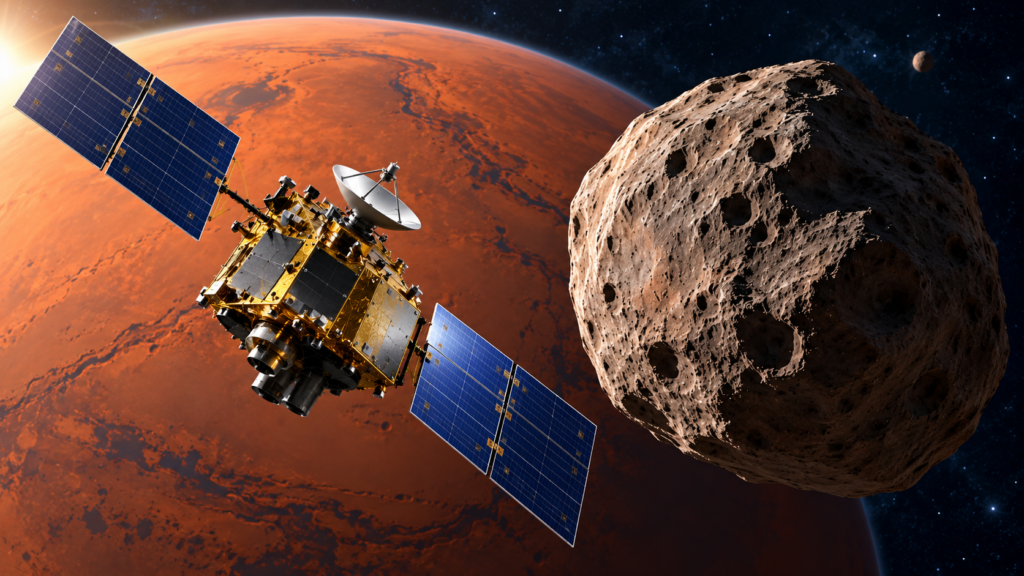
The Martian Moons eXploration mission, commonly known as MMX, is led by the Japan Aerospace Exploration Agency (JAXA). Its main target is Phobos, the larger of Mars’ two small moons. The spacecraft will also observe Deimos, the second moon.
Unlike a mission that only photographs a distant object, MMX is designed to travel to the Martian system, study the moons at close range, collect surface material from Phobos and return a sample capsule to Earth.
JAXA plans to bring back at least 10 grams of material. Scientists will then be able to examine the samples in laboratories using instruments that can provide more detailed analysis than spacecraft observations alone.
Why Is Phobos So Important?
Phobos is a small, irregularly shaped moon that orbits relatively close to Mars. Despite decades of planetary exploration, scientists still do not know exactly how Phobos and Deimos formed.
One theory suggests that the moons formed from debris produced by a large impact on Mars. Another possibility is that they are asteroid-like objects captured by Mars’ gravity.
Studying Phobos directly could help scientists determine which explanation is more likely. The samples may also contain clues about the history of Mars and the materials present in the early Solar System.
The mission is not designed to confirm the existence of extraterrestrial life. Instead, it will investigate planetary origins and processes relevant to understanding how potentially habitable environments develop.
The Japan MMX Mars Moon Mission is designed to investigate the origin and composition of Phobos. Scientists hope that analysing samples collected from its surface will provide valuable clues about the history of Mars and its moons.
A major goal of the Japan MMX Mars Moon Mission is to determine whether Phobos formed from material ejected by an impact on Mars or originated from a different process. The returned samples could help researchers investigate these competing theories.
How Will the MMX Spacecraft Collect Samples?
The mission will use a series of carefully planned operations. After travelling to the Martian system, the spacecraft is expected to study Phobos in detail and identify suitable locations for sample collection.
A small rover, developed through European cooperation, is also part of the mission. It will help investigate the moon’s surface and support the scientific objectives of the exploration.
The main spacecraft is designed to perform sampling operations at Phobos and store the collected material inside a return capsule. After completing its observations, the spacecraft will begin its journey back toward Earth.
According to the mission schedule, the sample capsule is targeted to return to Earth in 2031. These operations are technically challenging because Phobos has extremely weak gravity and the spacecraft must operate across vast distances with communication delays.
International Cooperation Behind the Mission
Although Japan leads MMX, the mission involves international scientific cooperation. NASA is contributing the MEGANE instrument, which will measure gamma rays and neutrons to help scientists investigate the composition of Phobos.
The European Space Agency (ESA), Germany’s aerospace center (DLR), and France’s space agency (CNES) are also contributing to the wider mission.
This cooperation demonstrates how major space projects increasingly combine expertise, instruments and technology from different countries to investigate questions that no single nation can easily answer alone.
Could MMX Change Future Space Exploration?
The mission could provide important information about the origins of Mars’ moons and the evolution of the Martian system. It will also test technologies for travelling to a planetary moon, operating near its surface, collecting samples and returning them safely to Earth.
These capabilities could support the development of future robotic exploration missions. Researchers studying Mars and planning more ambitious journeys may benefit from the scientific results and engineering experience gained through MMX.
However, the mission’s success will depend on several complex stages, from launch and arrival at Mars to sampling, departure and safe recovery of the capsule.
The Japan MMX Mars Moon Mission could also demonstrate new ways to collect and return samples from small planetary bodies. These technologies may support future robotic missions across the Solar System.
When Will the Samples Return to Earth?
The mission is planned to span several years. Following its scheduled 2026 launch, the spacecraft is expected to reach the Mars system in 2027. It will then investigate Phobos and carry out its planned operations before starting the return journey.
The sample capsule is currently targeted to reach Earth in 2031. This is a planned milestone rather than a guaranteed outcome, as deep-space missions can face technical challenges or schedule changes.
Readers can follow official mission updates through the JAXA MMX website and NASA’s MMX mission page.
The Japan MMX Mars Moon Mission could provide valuable scientific evidence about the origins of Phobos. Researchers around the world will be interested in the returned samples and what they reveal about the history of Mars and its moons.
Final Thoughts
Japan’s MMX mission represents an ambitious new chapter in planetary science. By collecting material from Phobos, scientists hope to answer longstanding questions about the origins of Mars’ moons and gain a better understanding of the Solar System.
If the mission achieves its objectives, the returned samples could become an important resource for researchers worldwide. The project will also demonstrate how international cooperation and advanced engineering can push the boundaries of space exploration.
As the scheduled launch approaches, MMX is a mission worth watching for anyone interested in science, technology and the future of humanity’s exploration of space.
Ultimately, the Japan MMX Mars Moon Mission could become an important milestone in planetary science by providing researchers with material from the Martian moon Phobos.
For more technology news, science discoveries and digital innovations, explore the latest updates in our Technology section on NuvWire.