
Meta is expanding its AI age detection technology worldwide to identify more teenagers on Instagram and automatically place them into Teen Account protections, even when they have entered an adult date of birth. The move aims to strengthen online safety for young users and make it harder for teenagers to bypass age-based restrictions.
Social media has become a major part of everyday life, particularly for teenagers. Millions of young people use Instagram to communicate with friends, watch videos, follow creators and discover new interests. However, ensuring that young users receive age-appropriate experiences has remained a challenge for social media companies.
Now, Meta is taking another step towards addressing that challenge. On November 9, 2026, the company announced a global expansion of its Meta AI age detection technology, which is designed to identify accounts that may belong to teenagers, even if those users have registered with an adult birthday.
The announcement could affect millions of Instagram users worldwide. It also raises important questions about artificial intelligence, online privacy, parental supervision and the future of age verification on social media.
What Is Meta AI Age Detection?
Meta AI age detection is a technology-based approach that helps the company estimate whether an Instagram account may belong to a teenager.
Traditionally, social media platforms have relied heavily on the date of birth users provide when creating an account. However, some teenagers enter an older birth date to access features and experiences intended for adults.
This creates a problem because age-based safety settings may not work properly when a user’s registered age is inaccurate.
Meta says its technology can identify accounts it suspects belong to teenagers, even when those accounts list an adult birthday. The platform can then place those users into Instagram’s Teen Account experience.
The latest announcement expands this approach globally, bringing additional teenagers under built-in safety protections.
Why Is Meta Expanding AI Age Detection on Instagram?
One of the biggest challenges facing social media platforms is making sure young users receive suitable content and protection.
A teenager who registers as an adult may avoid restrictions designed to limit unwanted contact, inappropriate content and other online risks.
Meta says its expanded age-estimation technology is intended to address this issue by identifying teenagers beyond the information they provide during registration.
The company wants more young users to receive age-appropriate settings automatically, rather than depending entirely on users entering their correct date of birth.
The expansion is also part of Meta’s wider efforts to improve age assurance across its platforms and strengthen protections for younger audiences.
The expansion of Meta AI age detection reflects a growing effort to make Instagram safer for younger audiences. By identifying accounts that may belong to teenagers, Meta aims to ensure that more young users receive age-appropriate settings without depending entirely on their registered birth dates.
How Does Meta’s AI Age Detection Technology Work?
Meta has not published every technical detail of the latest global rollout. However, the company has previously explained that its age-assurance systems can consider different signals to identify accounts that may belong to younger users.
These may include contextual information found across account activity and profile content.
For example, Meta has described using signals such as:
- References to school grades or school-related activities.
- Birthday celebrations and other age-related context.
- Information appearing in posts, comments, captions and biographies.
- Other patterns that may suggest an account belongs to a teenager.
Meta has also separately described AI-powered visual analysis for identifying potentially underage accounts. The company says this is not facial recognition and does not identify a specific person in an image.
It is important to understand that these are details from Meta’s broader age-assurance work. The company has not confirmed that every signal or method is used in exactly the same way for the newly announced global Teen Account expansion.
The overall goal is to make age estimation more effective than relying on a self-reported birthday alone.
One important advantage of Meta AI age detection is that it looks beyond the birthday entered during account registration. This approach may help Instagram identify teenagers who use incorrect age information to access adult account settings and experiences.
What Are Instagram Teen Accounts?
Instagram Teen Accounts are designed to give younger users a more restricted and age-appropriate experience.
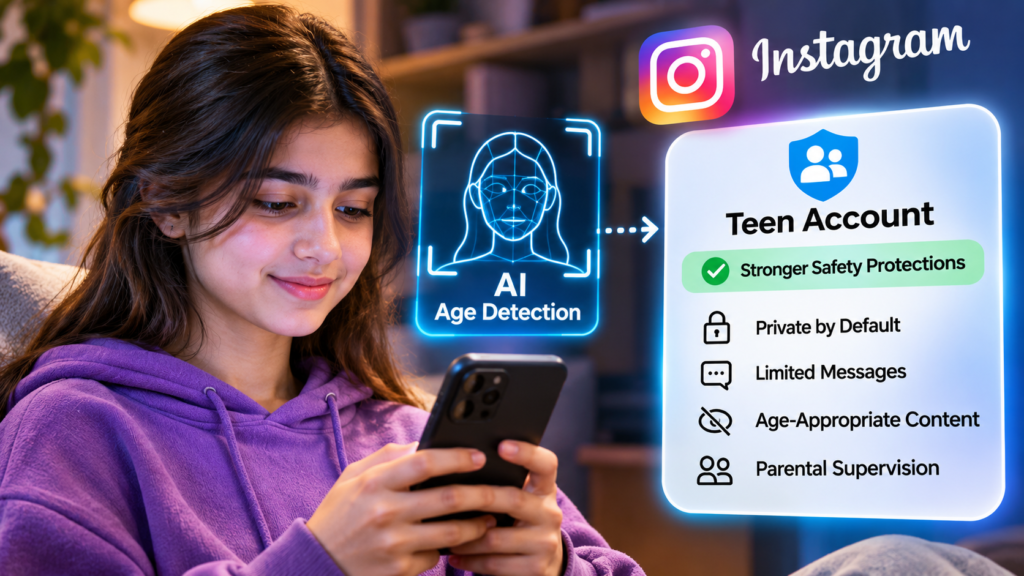
Instead of allowing teenagers to use all the same settings as adult users, these accounts include built-in protections that limit certain interactions and content.
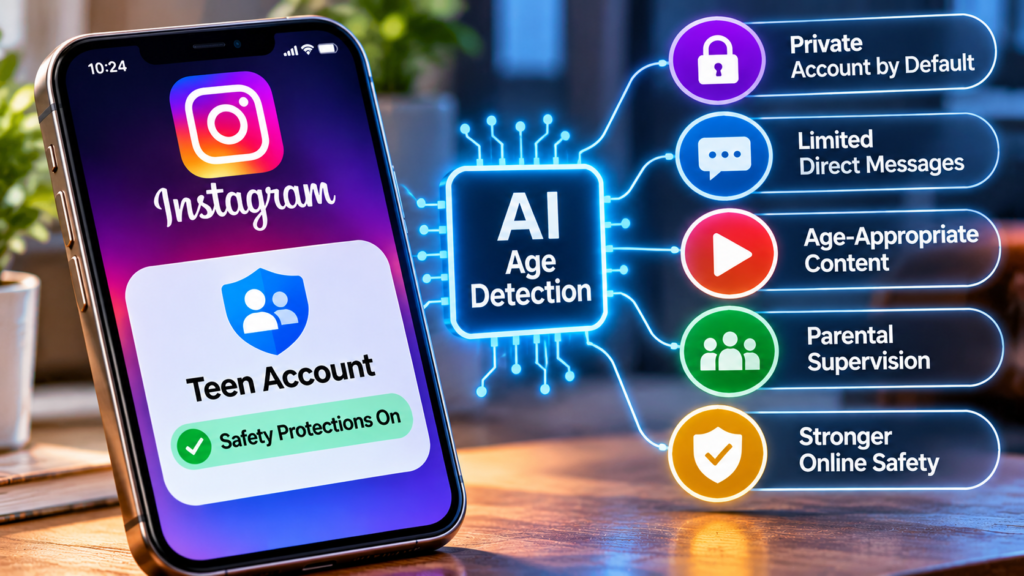
Some of the key protections include:
1. Private Accounts by Default
Teen accounts are set to private by default, helping young users control who can see their posts and interact with their profiles.
2. More Restricted Direct Messages
Teenagers receive messages from a more limited group of people, helping reduce unwanted contact from strangers.
3. Stronger Content Restrictions
Instagram applies age-appropriate content settings to help limit teenagers’ exposure to certain material that may not be suitable for their age group.
4. Restrictions on Sensitive Interactions
Additional settings are designed to limit unwanted interactions and provide a safer social media experience.
5. Parental Supervision
Parents and guardians can use Instagram’s supervision features to support their teenagers’ online activity and manage certain settings.
These protections are intended to make Instagram more suitable for younger users, although no online safety system can prevent every possible risk.
Will Instagram Detect Teenagers Who Use Fake Birth Dates?
Yes. This is one of the main purposes of the expanded Meta AI age detection system.
Meta says it uses technology to identify accounts it suspects belong to teenagers, even if the account holder has entered an adult date of birth.
When the system identifies an account as potentially belonging to a teenager, Instagram can place it into Teen Account protections.
This means that entering an older birthday may no longer be enough to avoid age-appropriate restrictions.
However, age estimation is not the same as knowing someone’s exact age with certainty. Automated systems can make mistakes, which is why age-related decisions and verification processes remain important.
What Happens If Instagram Gets Someone’s Age Wrong?
AI systems are not perfect. An adult user could potentially be identified as a teenager, while a younger user might not be recognised correctly.
That makes accuracy and appeal options important parts of any age-estimation system.
Users who believe Instagram has incorrectly identified their age should follow the age-confirmation or verification instructions presented by the platform.
Depending on the situation, Instagram may ask users to complete an age-verification process to confirm their information.
Users should always follow the official instructions inside Instagram or its Help Center rather than sharing identity documents or personal information through suspicious messages or unofficial websites.
However, Meta AI age detection must balance safety with accuracy. If an adult is incorrectly classified as a teenager, a clear age-confirmation process can help resolve the issue and restore the appropriate account experience.
What Does the New Update Mean for Parents?
For parents, the global expansion may provide an additional layer of protection when teenagers use Instagram.

Meta announced that parents in the United States would begin receiving an Instagram notification explaining how the company places teenagers into age-appropriate protections and how families can help ensure that a teen’s age information is accurate.
The company also highlighted its use of Apple’s age-range signal in Australia as an additional way to understand a user’s age range.
Parents can take several practical steps to support their children’s online safety:
- Check whether their teenager’s Instagram account is set up as a Teen Account.
- Explore available parental supervision settings.
- Talk openly about online strangers, suspicious messages and inappropriate content.
- Encourage teenagers to provide accurate age information.
- Discuss healthy screen-time habits and responsible social media use.
Technology can help, but parental guidance and communication remain important.
Does Meta AI Age Detection Raise Privacy Concerns?
Although the expansion is intended to improve online safety, it also raises questions about how social media companies estimate users’ ages.
Some users may be concerned about automated analysis of their account activity, profile information, photos or other content.
There is also the question of accuracy. A system that estimates age could incorrectly classify an adult as a teenager or fail to identify an account that belongs to a young person.
Meta has previously explained that its visual analysis technology for underage-account enforcement is not facial recognition. However, users may still want clearer information about what data is assessed, how decisions are made and how mistakes can be challenged.
For technology companies, the challenge is to balance child protection with user privacy, transparency and fair treatment.
Effective age assurance should protect young users without unnecessarily collecting sensitive personal information.
Will Meta Introduce the Same AI Age Detection Technology on Facebook and Threads?
Instagram is the main focus of the November 9 announcement, but Meta’s broader plans extend beyond one platform.
The company says it is continuing to roll out age-estimation technology on Facebook. It also plans to begin launching similar technology globally on Threads later in 2026.
This suggests that Meta wants to develop a more consistent approach to age-appropriate experiences across its social media services.
However, the timing and exact features may differ between platforms. Users should look for official announcements before assuming that every feature will arrive everywhere at the same time.
What Does This Update Mean for the Future of Social Media?
The expansion of Meta AI age detection highlights how artificial intelligence is becoming an increasingly important part of online safety.
Social media platforms are under growing pressure from parents, regulators and safety organisations to provide stronger protections for children and teenagers.
AI-based age estimation could help companies identify accounts that might otherwise bypass age restrictions. At the same time, it creates new responsibilities around accuracy, transparency and privacy.
Other technology companies may also face pressure to improve their own age-assurance systems.
For users, the bigger question is whether these changes will lead to safer online experiences without creating unnecessary privacy concerns.
Meta’s latest announcement is another major development in that ongoing debate. Its real impact will depend on how accurately the technology works, how clearly the company explains its decisions and how effectively teenagers receive the protections intended for them.
Frequently Asked Questions (FAQs)
1. What is Meta AI age detection?
Meta AI age detection is a technology-based system designed to estimate whether an account may belong to a teenager. It can help Instagram place suspected teenage users into Teen Account protections, even if they entered an adult birthday.
2. When did Meta announce the global AI age detection expansion?
Meta announced the global expansion on November 9, 2026. The update is intended to bring millions more teenagers into Instagram’s built-in Teen Account protections.
3. Can Instagram detect fake birthdays?
Meta says its technology can identify accounts it suspects belong to teenagers, even when users have entered an adult date of birth. The system is designed to look beyond the birthday provided during registration.
4. What are Instagram Teen Accounts?
Instagram Teen Accounts are accounts designed for younger users. They include protections such as private-by-default settings, restrictions on direct messages and age-appropriate content controls.
5. Does Meta use facial recognition to detect teenagers?
Meta has clarified that its previously described visual analysis technology for underage-account enforcement is not facial recognition. It looks for general visual clues and does not identify a specific person in an image.
6. Can adults be mistakenly placed in Instagram Teen Accounts?
Automated age-estimation systems can make mistakes. Users who believe their age has been incorrectly identified should follow Instagram’s official age-confirmation or verification instructions.
7. Will Meta use AI age detection on Facebook and Threads?
Meta says it is continuing to roll out age-estimation technology on Facebook and plans to begin launching similar technology globally on Threads later in 2026.
8. How can parents help protect teenagers on Instagram?
Parents can review Teen Account settings, use available supervision tools, discuss online risks and encourage teenagers to provide accurate age information.
9. Does Meta AI age detection guarantee complete online safety?
No. Age estimation and Teen Account protections can reduce certain risks, but they cannot eliminate every online threat. Parental guidance, responsible platform use and effective safety policies remain essential.
As Meta AI age detection expands across social media platforms, its effectiveness will depend on reliable age estimation, transparent policies and appropriate privacy safeguards. The technology could become an important part of online safety, but users should also have a fair way to challenge incorrect decisions.
Final Thoughts
Meta’s global expansion of AI-powered age estimation marks an important development in the effort to improve Instagram safety for teenagers. By identifying accounts that may belong to young users, even when they provide an adult birthday, the company hopes to make age-appropriate protections more widely available.
However, stronger safeguards must also come with transparency, accuracy and respect for privacy. The success of Meta AI age detection will ultimately depend on whether it can protect teenagers effectively while treating users fairly.
For parents and teenagers, the message is clear: understand the available safety settings, use supervision tools where appropriate and stay informed about changes to social media platforms.