
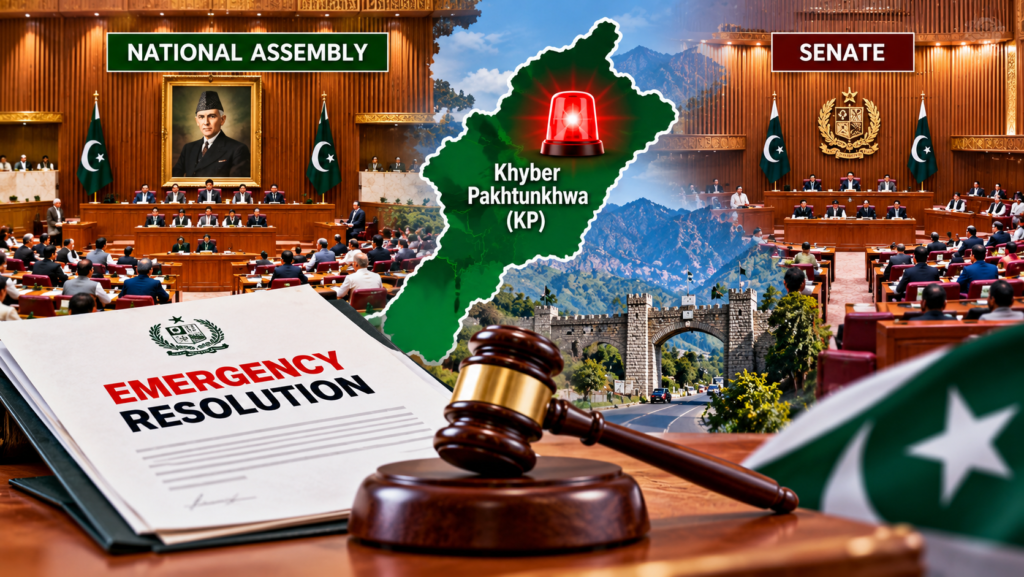
Pakistan’s National Assembly and Senate have approved resolutions endorsing the federal government’s imposition of an emergency in Khyber Pakhtunkhwa (KP), marking a major political development amid growing concerns over security and terrorism in the province.
Both Houses of Parliament passed the resolutions on October 14, 2026, following the presidential proclamation issued on October 11. The federal government says the move is necessary to improve coordination against terrorism, while the opposition Pakistan Tehreek-e-Insaf (PTI) has strongly opposed the decision.
The development has intensified political tensions between the federal government and the PTI, which previously governed the province. It has also raised questions about constitutional procedures, provincial autonomy, and the future of security operations in northwestern Pakistan.
The KP emergency has also sparked a political and constitutional debate in Pakistan. Opposition leaders have raised concerns about the decision, while the government maintains that the measure is necessary to address serious security challenges in the province.
1. What Happened in Parliament?
The National Assembly passed a resolution endorsing the emergency proclamation after a debate led by government representatives. The Senate subsequently approved its resolution by a majority vote.
Minister for Parliamentary Affairs Tariq Fazal Chaudhry presented the resolutions, while Law Minister Azam Nazeer Tarar explained the government’s position.
According to the government, parliamentary approval was required under Article 232 of Pakistan’s Constitution. The provision sets out the constitutional procedure for an emergency proclamation and its presentation before Parliament.
The approvals represent a significant step in the federal government’s response to the security situation in Khyber Pakhtunkhwa.
Source: Dawn — National Assembly and Senate approve KP emergency
2. Why Did the Federal Government Impose the Emergency?
The federal government says the decision was driven by worsening security concerns, terrorist incidents, and what it describes as insufficient cooperation from the provincial administration.
During the parliamentary debate, Law Minister Azam Nazeer Tarar cited official figures indicating that 3,787 terrorist incidents were recorded in KP between October 15, 2025, and October 9, 2026. He contrasted this with 2,911 incidents recorded between 2021 and 2024.
Government representatives argued that stronger coordination between federal authorities and security agencies was necessary to address the threat.
These figures and explanations were presented by government officials during the debate. They should be understood as the government’s stated justification rather than an independent determination of responsibility for the province’s security problems.
The decision has also renewed debate about how federal and provincial governments should cooperate on counterterrorism while respecting constitutional responsibilities.
Source: Radio Pakistan — National Assembly adopts resolution approving KP emergency
3. How Has PTI Responded?
PTI has opposed the federal government’s action, arguing that the emergency and related measures are politically motivated and should be challenged through constitutional and legal channels.
Opposition lawmakers protested during parliamentary proceedings, and PTI members walked out during the Senate vote, according to media reports.
PTI Chairman Barrister Gohar Ali Khan has also challenged the emergency and governor’s rule in the Peshawar High Court. The legal challenge could become an important part of the dispute over the federal government’s decision.
The government maintains that its action was necessary to address security concerns. The opposition disputes the move, creating a political and constitutional confrontation that could continue through parliamentary debate and the courts.
The legal status and outcome of the challenge will depend on the proceedings before the court.
Source: Business Recorder — Parliament ratifies KP emergency amid opposition protest
4. What Is the Difference Between Emergency and Governor’s Rule?
The emergency proclamation and governor’s rule are related but distinct constitutional measures.
Article 232 of the Constitution deals with the proclamation of an emergency in circumstances specified by the Constitution. Article 234 concerns provisions relating to a failure of constitutional machinery in a province, commonly associated with governor’s rule.
The federal government announced both measures for Khyber Pakhtunkhwa. Parliament’s resolutions on October 14 endorsed the emergency proclamation under Article 232.
Governor’s rule follows a separate constitutional procedure. Reports on October 14 indicated that a joint sitting of Parliament was scheduled for October 15 to consider the related measure under Article 234.
These distinctions matter because each measure has its own constitutional requirements, parliamentary procedures, and legal implications.
Readers should therefore avoid treating the two measures as interchangeable or assuming that the approval of one automatically completes every procedure associated with the other.
5. What Could Happen Next?
Several developments will shape the situation in the coming days.
First, the federal government is expected to focus on security coordination and its stated counterterrorism objectives. The effectiveness of these measures will depend on implementation, cooperation between institutions, and the security situation on the ground.
Second, the opposition’s legal challenge could bring the constitutional basis and procedure of the measures under judicial scrutiny. Any ruling by the Peshawar High Court may influence the next stage of the dispute.
Third, political negotiations could remain important. During the parliamentary debate, PPP Chairman Bilawal Bhutto-Zardari called for collective efforts against terrorism and urged political stakeholders to return to dialogue.
The KP emergency will remain under public and political scrutiny as Pakistan considers the security situation and constitutional implications. The coming days may bring further clarification from government officials, opposition parties, and relevant courts. Readers should rely on verified reports to understand how the KP emergency affects provincial governance and the people of Khyber Pakhtunkhwa.
A sustained political disagreement could make cooperation more difficult, while constructive engagement could help build consensus on security policy.
For residents of Khyber Pakhtunkhwa, the most important questions concern public safety, continuity of essential services, the functioning of institutions, and the effectiveness of measures intended to reduce violence.
The future of the KP emergency will depend on the next constitutional and political steps. Developments in Parliament and the courts may shape how the emergency is implemented and what it means for governance in Khyber Pakhtunkhwa.
Why This Development Matters for Pakistan
Khyber Pakhtunkhwa has faced persistent security challenges, including militant attacks and cross-border security concerns. The province’s situation has implications for national security, political stability, and relations between federal and provincial authorities.
The emergency decision also raises broader questions about provincial autonomy and the constitutional balance between different levels of government.
Supporters of the federal decision argue that extraordinary circumstances require stronger coordination. Critics warn that such measures must remain subject to constitutional safeguards, legal scrutiny, and democratic accountability.
A balanced assessment requires examining both the government’s stated security rationale and the opposition’s objections, while distinguishing verified events from political allegations.
The KP emergency has drawn attention to the balance between national security, provincial autonomy, and constitutional responsibilities. The situation should be assessed through verified information and official developments rather than political claims alone.
For more updates on Pakistan’s political developments and national affairs, visit our Pakistan politics and latest news on NuvWire. You can also explore our latest coverage of business news, technology updates, and international developments to stay informed about important events affecting Pakistan and the world.
Final Thoughts
The approval of the KP emergency resolutions by Pakistan’s National Assembly and Senate marks a major development in the country’s political and security landscape.
The federal government says the measure is needed to strengthen the fight against terrorism, while PTI opposes the action and has pursued a legal challenge. The separate constitutional process relating to governor’s rule is another important issue to follow.
The coming days will be significant for parliamentary proceedings, court hearings, political negotiations, and security policy in the province.
NuvWire will continue to cover developments in Pakistan politics and national security with a focus on reliable sources, balanced reporting, and clear explanations of important events.
The KP emergency remains an important national issue, with implications for security, provincial governance, and constitutional procedures. Readers should follow verified updates as the situation develops.
NuvWire — Useful Ideas. Real Insights.