
Pakistan has entered an exciting new chapter in space exploration after Muhammad Zeeshan Ali became the first Pakistani astronaut to travel into Earth’s orbit and join China’s Tiangong space station. The historic achievement has attracted international attention and opened new opportunities for scientific cooperation between Pakistan and China.
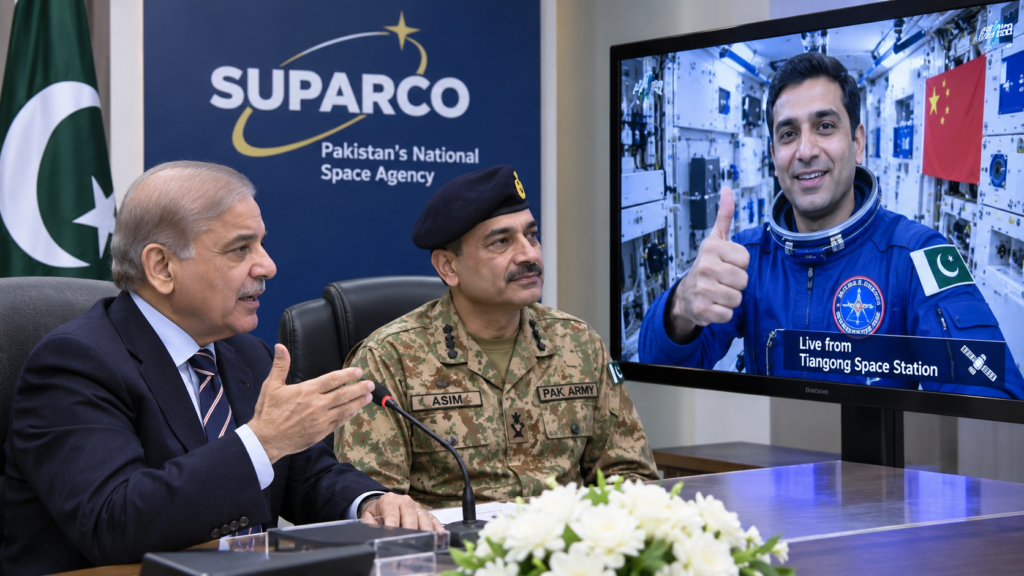
The Pakistani astronaut Chinese space station mission reached another important moment on November 28, 2026, when Prime Minister Shehbaz Sharif and Chief of Defence Forces Field Marshal Syed Asim Munir held a live conversation with Zeeshan Ali from the headquarters of Pakistan’s Space and Upper Atmosphere Research Commission (SUPARCO).
During the conversation, the astronaut shared his experience aboard the station and confirmed that his duties and scientific research were progressing according to plan.
The mission is more than a symbolic achievement. It represents Pakistan’s growing participation in international space research, advanced technology and scientific development.
Pakistan’s space programme has reached a historic milestone, with the Pakistani astronaut Chinese space station mission attracting international attention. Muhammad Zeeshan Ali’s journey represents a major step forward in Pakistan’s scientific and technological ambitions. The Pakistani astronaut Chinese space station achievement marks an important chapter in the country’s journey toward advanced scientific research.
But who is Muhammad Zeeshan Ali, what is he doing aboard China’s space station, and how could this mission influence Pakistan’s future in space exploration?
Let’s explore the details.
Pakistani Astronaut Chinese Space Station Mission: What Happened?
Muhammad Zeeshan Ali made history on November 25, 2026, when he travelled to China’s Tiangong space station aboard the Shenzhou-24 spacecraft.
The spacecraft launched from the Jiuquan Satellite Launch Centre in northwestern China using a Long March-2F rocket.
Ali travelled alongside Chinese astronauts Tang Hongbo and Wu Yi. After a successful journey, the spacecraft docked with the Tiangong space station.
His arrival marked an important milestone because he became the first Pakistani to reach Earth’s orbit and the first foreign astronaut to participate in China’s crewed space programme.
According to reports, the mission is expected to last approximately five to ten days.
Ali is serving as a payload specialist, meaning his responsibilities include scientific experiments and research activities rather than commanding the spacecraft.
The achievement also represents an important development in the Pakistani astronaut Chinese space station partnership, which has been built through cooperation between the two countries’ space institutions.
The Pakistani astronaut Chinese space station mission is expected to strengthen Pakistan’s experience in international space research.
The Pakistani astronaut Chinese space station mission also highlights growing cooperation between Pakistan and China in human spaceflight, scientific research and advanced technology.
PM Shehbaz Sharif and Asim Munir Speak with Zeeshan Ali in Space
One of the most memorable moments of the mission came on November 28, when Prime Minister Shehbaz Sharif and Field Marshal Syed Asim Munir spoke directly with the astronaut.
The conversation took place during their visit to SUPARCO headquarters in Islamabad.
The prime minister congratulated Ali on representing Pakistan in space and described the achievement as a proud moment for the country.
He highlighted the importance of education, scientific research and technological development, particularly for younger generations.
Shehbaz Sharif also expressed gratitude to China for providing Pakistan with the opportunity to participate in its human spaceflight programme.
Field Marshal Asim Munir also congratulated the astronaut and praised his achievement, describing it as a source of pride for Pakistan.
During the conversation, Zeeshan Ali thanked the Pakistani leadership for its support and shared an update about his experience.
He said everything was progressing according to plan and that he was performing his assigned responsibilities and research activities.
The astronaut also encouraged young Pakistanis to focus on education, science and technology so that future generations could explore even greater opportunities in space.
The live conversation demonstrated how the Pakistani astronaut Chinese space station mission has become an important national event.
Who Is Muhammad Zeeshan Ali?
Muhammad Zeeshan Ali is a former Pakistan Air Force pilot who became the first Pakistani to travel into Earth’s orbit.
His selection for the Chinese space programme followed a competitive process involving Pakistani candidates.
In April 2026, two Pakistani candidates, Muhammad Zeeshan Ali and Khurram Daud, were selected to begin astronaut training in China.
Both candidates underwent specialised preparation at the Astronaut Centre of China.
After completing the selection and training process, Ali was chosen for the Shenzhou-24 mission, while Khurram Daud served as his backup.
His preparation included several important areas:
- Spacecraft systems and operations
- Space station procedures
- Scientific research techniques
- Emergency response training
- Physical and survival preparation
- Chinese-language training
Learning Chinese operational commands was an important part of his preparation because communication and technical instructions are essential during a space mission.
His journey demonstrates how international cooperation can create opportunities for professionals from countries that do not yet operate independent human spaceflight programmes.
What Is China’s Tiangong Space Station?

China’s Tiangong space station is an independently operated space laboratory designed to support scientific research, astronaut activities and long-term human presence in low Earth orbit.
The name Tiangong means Heavenly Palace.
The station is an important part of China’s growing space programme and provides facilities for scientific experiments in microgravity.
Unlike laboratories on Earth, experiments aboard a space station can take place in an environment where gravity has a much smaller influence on certain physical and biological processes.
Tiangong supports research in several areas, including:
1. Biological Research
Scientists can investigate how living organisms respond to microgravity.
This research may help improve understanding of plant growth, microorganisms and biological processes during future space missions.
2. Materials Science
Researchers can study how different materials behave in space.
Microgravity conditions can provide opportunities to investigate material properties and manufacturing processes.
This Pakistani astronaut Chinese space station collaboration could open doors for future technology and research partnerships.
3. Space Technology
Astronauts also conduct experiments involving equipment, spacecraft systems and technologies that may support future missions.
4. Long-Term Human Spaceflight
Research aboard Tiangong can help scientists understand the challenges associated with keeping astronauts healthy and productive during extended missions.
For Pakistan, participating in this research programme offers valuable experience and an opportunity to strengthen its scientific capabilities.
What Scientific Experiments Is Pakistan Conducting in Space?
Scientific research is one of the most important parts of the Pakistani astronaut Chinese space station mission.
According to reports from Business Recorder and Radio Pakistan, Pakistani researchers have prepared experiments that will be conducted aboard the station.
The mission includes four Pakistani scientific research projects developed with contributions from local universities.
These projects cover materials science and biotechnology.
1. Graphene-Based Composite Materials
One research area involves graphene-based composite materials.
Graphene is a carbon-based material known for its strength, electrical conductivity and lightweight structure.
Scientists are interested in understanding how these materials behave under different environmental conditions.
Research in this area could contribute to future developments in advanced materials and engineering.
2. Self-Healing Carbon-Fibre Composites
Another project focuses on self-healing carbon-fibre composite materials.
These materials are designed to repair certain types of damage or improve their durability.
Studying their behaviour under space conditions could provide useful information for future engineering applications.
3. Quinoa Seed Research
Scientists are also studying how microgravity affects quinoa seeds.
Quinoa is considered a potentially valuable food crop because of its nutritional characteristics.
Understanding how seeds respond to space conditions could contribute to future research into food production during long-duration space missions.
4. Microalgae and Cyanobacteria Research
Another important research area involves microalgae and cyanobacteria.
These organisms are interesting to space scientists because some can contribute to oxygen production and support biological systems.
Research into their behaviour could help scientists explore potential biological support systems for future space missions.
Together, these experiments demonstrate that the mission is not only about sending an astronaut into orbit. It also gives Pakistani researchers an opportunity to contribute to international scientific knowledge.
The Pakistani astronaut Chinese space station mission gives Pakistani researchers an opportunity to contribute to experiments in areas such as biotechnology and materials science.
How Did Pakistan and China Make This Mission Possible?
The Pakistani astronaut Chinese space station mission is the result of a formal cooperation agreement between Pakistan and China.
In February 2025, Pakistan’s SUPARCO and the China Manned Space Agency established an agreement for Pakistani astronaut training and participation in China’s human spaceflight programme.
Under the arrangement, two Pakistani candidates were selected for training, with one eventually joining a Chinese space mission.
China provided specialised training and access to its human spaceflight programme.
Pakistan contributed through candidate selection, scientific preparation and cooperation involving its research institutions.
This partnership is especially significant because China has now welcomed a foreign astronaut into its crewed space programme for the first time.
The development also coincides with the 75th anniversary of diplomatic relations between Pakistan and China in 2026.
For both countries, the mission represents an opportunity to expand cooperation beyond traditional areas such as trade, infrastructure and defence. Through the Pakistani astronaut Chinese space station programme, both countries are creating new opportunities for scientific collaboration and knowledge exchange.
Why Is This Mission Important for Pakistan?
Pakistan has operated its national space programme through SUPARCO since 1961.
However, the country has not independently developed a human spaceflight programme comparable to those operated by major space powers.
Participation in China’s space mission provides Pakistan with practical experience in astronaut preparation, scientific research and international space operations.
Here are some important reasons why the achievement matters.
New Opportunities for Pakistani Scientists
Pakistani universities and researchers can gain experience through participation in international scientific projects.
This may help strengthen local research capabilities and encourage further investment in science and technology.
Inspiration for Young Students
The mission could encourage Pakistani students to consider careers in engineering, physics, astronomy, biotechnology and aerospace research.
Seeing a Pakistani astronaut working aboard a space station makes space exploration feel more achievable for younger generations.
Stronger International Cooperation
The mission creates opportunities for Pakistan and China to expand their scientific partnership.
Future cooperation could involve additional research projects, astronaut training and advanced space technologies.
Development of Advanced Technology
Space research often contributes to innovations in materials, communications, engineering and scientific equipment.
Although not every experiment produces an immediate commercial application, the knowledge gained can support future technological development.
Could Pakistan Send More Astronauts into Space?
The success of Muhammad Zeeshan Ali’s mission has naturally raised questions about Pakistan’s future human spaceflight ambitions.
There is potential for additional cooperation with China, particularly in astronaut training and scientific research.
However, one mission does not automatically mean Pakistan has established an independent human spaceflight programme.
Developing such a programme would require substantial investment, specialised training facilities, research infrastructure and long-term technical planning.
For now, cooperation with experienced international space agencies provides Pakistan with a practical way to gain experience and participate in advanced research.
The Pakistani astronaut Chinese space station mission could therefore become a foundation for future opportunities, provided that Pakistan continues investing in its scientific and technological capabilities.
What Happens After Zeeshan Ali Returns to Earth?
After completing his assigned activities, Zeeshan Ali is expected to return to Earth as part of the mission’s planned return arrangements.
His mission is expected to last approximately five to ten days.
The experience gained during the flight could be valuable for Pakistan’s future space research activities.
The scientific data collected during the experiments may also help researchers continue their work after the astronaut returns.
Future priorities could include analysing experiment results, strengthening university research partnerships and exploring further opportunities with China.
The real long-term value of the mission will depend on how effectively Pakistan uses the knowledge and experience gained through this historic participation.
The Pakistani astronaut Chinese space station achievement could inspire more young Pakistanis to pursue careers in science, engineering and space research. For Pakistan, the Pakistani astronaut Chinese space station milestone is more than a space mission; it is an opportunity to inspire the next generation.
Final Thoughts
Muhammad Zeeshan Ali’s journey aboard China’s Tiangong space station is a historic achievement for Pakistan.
The November 28 conversation with Prime Minister Shehbaz Sharif and Field Marshal Asim Munir brought national attention to the mission and highlighted the importance of scientific cooperation.
More importantly, the Pakistani astronaut Chinese space station mission gives Pakistani researchers an opportunity to participate in advanced experiments involving materials science and biotechnology.
The achievement should also remind young Pakistanis that education, scientific curiosity and international cooperation can open doors to opportunities once considered far beyond reach.
Pakistan’s journey in space exploration is still developing, but this mission represents an important beginning.
The next challenge will be turning this historic achievement into stronger research institutions, advanced technology and more opportunities for future generations.
Frequently Asked Questions (FAQs)
1. Who is Pakistan’s first astronaut in space?
Muhammad Zeeshan Ali is the first Pakistani to travel into Earth’s orbit. He joined China’s Shenzhou-24 mission and travelled to the Tiangong space station in November 2026.
2. When did Pakistan’s first astronaut travel into space?
Muhammad Zeeshan Ali launched aboard the Shenzhou-24 spacecraft on November 25, 2026, from China’s Jiuquan Satellite Launch Centre.
3. Which space station is hosting the Pakistani astronaut?
He is aboard China’s Tiangong space station, an independently operated orbital research laboratory.
4. Did PM Shehbaz Sharif speak with the Pakistani astronaut?
Yes. On November 28, 2026, Prime Minister Shehbaz Sharif and Field Marshal Asim Munir held a live conversation with Muhammad Zeeshan Ali from SUPARCO headquarters in Islamabad.
5. How long will Muhammad Zeeshan Ali stay in space?
His mission is expected to last approximately five to ten days, according to reports about the Shenzhou-24 mission.
6. What is the name of the spacecraft carrying Pakistan’s astronaut?
The spacecraft is called Shenzhou-24. It launched using a Long March-2F rocket from China’s Jiuquan Satellite Launch Centre.
7. What experiments is Pakistan conducting aboard the Chinese space station?
The Pakistani research projects include graphene-based composite materials, self-healing carbon-fibre composites, quinoa seed research and studies involving microalgae and cyanobacteria.
8. Who was selected alongside Muhammad Zeeshan Ali for astronaut training?
Khurram Daud was selected alongside Muhammad Zeeshan Ali as a Pakistani astronaut candidate. He served as Ali’s backup for the mission.
9. Why is Pakistan’s participation in China’s space mission important?
It provides Pakistan with opportunities to participate in human spaceflight, conduct scientific research, develop technical expertise and strengthen international cooperation.
10. Does Pakistan have its own space agency?
Yes. Pakistan’s national space agency is the Space and Upper Atmosphere Research Commission, commonly known as SUPARCO. It was established in 1961.
11. Is Muhammad Zeeshan Ali the first foreign astronaut aboard China’s space station?
Yes. His participation in Shenzhou-24 marks the first time a foreign astronaut has joined China’s crewed space programme aboard Tiangong.
12. What could Pakistan’s next step in space exploration be?
Possible future priorities include additional astronaut training, university research partnerships, advanced materials research and further cooperation with international space agencies. No specific future crewed mission has been confirmed in the sources reviewed.
Original Sources and Further Reading
- Radio Pakistan – PM and CDF Hold Live Conversation with Pakistan’s First Astronaut
- Pakistan Information Department – PM Congratulates China on Historic Shenzhou-24 Mission
- SUPARCO – Official Website
- China Embassy in Pakistan – Joint Spaceflight Mission by Chinese and Pakistani Astronauts
- Business Recorder – PM Shehbaz and CDF Munir Speak to Pakistan’s Astronaut
- Associated Press – Pakistani Leader and Army Chief Speak to First Astronaut Aboard Chinese Craft