SEO (Search Engine Optimization) is one of the most important ways to help a website reach people online. Whether you run a personal blog, an online store, a business website, or a digital publication, understanding SEO can make it easier for potential visitors to discover your content through search engines.
Imagine publishing a detailed article that answers an important question, but hardly anyone visits your website. This is a common problem for new website owners. Creating useful content is only one part of building an online presence. People also need a way to find it. That’s where SEO becomes valuable.
In this guide, we will explore what SEO means, how it works, why it matters in 2026, and which practical steps beginners can take to improve their websites without spending a fortune.
What Is SEO?
SEO stands for Search Engine Optimization. It refers to the process of improving a website so search engines can understand its pages and users can discover relevant information more easily.
When someone searches for a topic on Google, the search engine attempts to display pages that best match the person’s needs. SEO helps website owners make their content understandable, accessible, useful, and relevant to those searches.
For example, someone searching for “best budget smartphones” expects helpful information about affordable phones. A website with a well-organized article, accurate details, useful comparisons, and a clear page structure may be a relevant result.
However, SEO is not a trick that guarantees the first position on Google. It is an ongoing process focused on improving the overall quality and discoverability of a website.
How Does SEO Work?
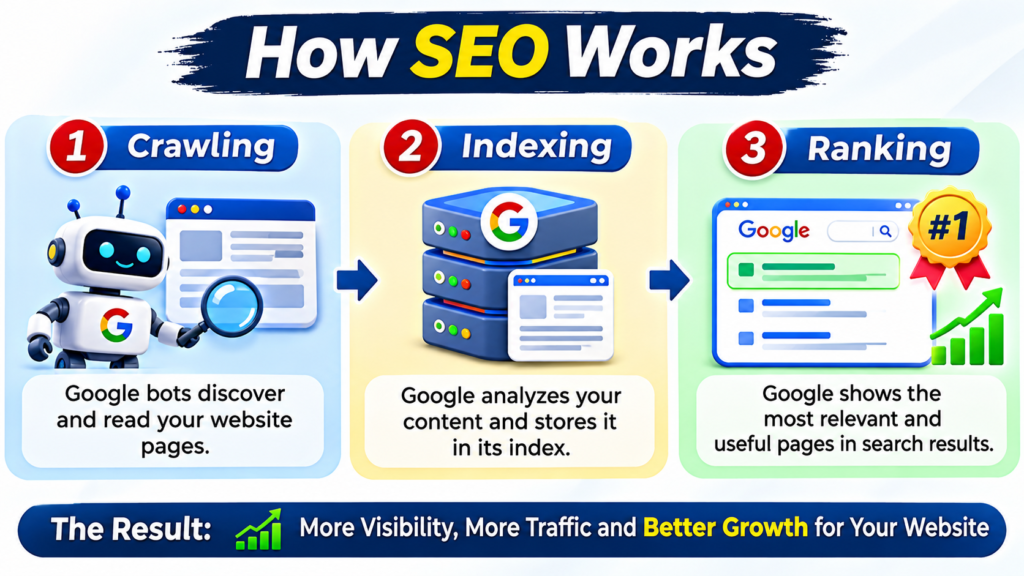
Search engines use automated systems to discover, understand, and organize information from websites. Google generally describes this process through three major stages.
1. Crawling
Crawling happens when search engine bots discover pages and follow links to find additional content.
For example, when you publish a new article and connect it to another relevant page on your website, search engines may discover the new page through that link.
2. Indexing
After discovering a page, Google may analyze its content, images, titles, and other information before deciding whether to include it in its search index.
Being indexed does not guarantee that a page will rank highly. It simply means the page may be eligible to appear in relevant search results.
3. Ranking
When someone performs a search, search engines use various systems to determine which results are most relevant and useful.
Factors can include the meaning of the search, relevance of the content, quality of information, usability, and other signals.
Understanding these stages helps website owners focus on more than simply inserting keywords into articles.
Why Is SEO Important for Websites?
A website needs visitors to grow. SEO can help attract people who are already searching for information, products, or services related to what you offer.
Here are some important benefits.
1. Helps Increase Organic Traffic
Organic traffic refers to visitors who reach your website through unpaid search results.
A well-optimized page can continue attracting visitors after publication, although its performance may change as search demand and competition evolve.
2. Builds Brand Awareness
Appearing in relevant search results can introduce your website to people who have never heard of your brand.
Even when visitors do not click immediately, repeated visibility can help people become familiar with your website.
3. Improves User Experience
Good SEO practices often encourage better website organization, readable content, descriptive headings, mobile-friendly layouts, and faster page experiences.
These improvements make websites easier for visitors to explore.
4. Supports Business Growth
Businesses can use SEO to reach potential customers who are actively researching products and services.
For example, a local service provider can create useful pages explaining its services, locations, pricing factors, and frequently asked questions.
5. Creates Long-Term Opportunities
Unlike paid advertisements, organic search traffic does not require paying for every click. However, SEO still requires time, content development, maintenance, and sometimes professional tools.
What Are the Main Types of SEO?
SEO is commonly divided into several areas. Understanding each one can help beginners develop a balanced strategy.
1. On-Page SEO
On-page SEO involves improving individual website pages and their content.
Important elements include:
- Using a clear and descriptive SEO title.
- Including the primary keyword naturally.
- Writing useful meta descriptions.
- Organizing content with H2 and H3 headings.
- Adding descriptive image alt text.
- Using relevant internal links.
- Creating readable URLs.
- Answering the reader’s actual question.
For example, an article about website security should explain practical security measures rather than repeatedly inserting the phrase “website security” without adding useful information.
2. Off-Page SEO
Off-page SEO includes activities outside your website that can help establish its reputation and visibility.
Some examples include:
- Earning links from relevant websites.
- Publishing original research that others may reference.
- Building relationships with industry publications.
- Receiving genuine brand mentions.
- Sharing useful resources with relevant communities.
Quality and relevance matter more than collecting large numbers of unrelated backlinks.
3. Technical SEO
Technical SEO focuses on making a website easier for search engines to access, crawl, and understand.
Important areas include:
- Website loading performance.
- Mobile usability.
- HTTPS security.
- XML sitemaps.
- Robots.txt configuration.
- Proper redirects.
- Fixing broken links.
- Managing duplicate URLs.
- Structured data where appropriate.
A technically sound website gives search engines a better opportunity to discover and process its content.
4. Local SEO
Local SEO helps businesses become more visible to people searching for products or services in a particular geographical area.
For example, a restaurant in London may want to appear when someone searches for restaurants near their location.
Businesses can improve local visibility by maintaining accurate business information, creating relevant location pages, and managing their Google Business Profile.
How to Improve Your SEO in 2026
SEO strategies continue to develop as search technology and user expectations change. Beginners should focus on practical improvements instead of chasing every new trend.
1. Understand Search Intent
Search intent means understanding what someone actually wants when entering a search query.
There are four commonly discussed types:
- Informational: The user wants to learn something.
- Navigational: The user wants to find a particular website.
- Commercial: The user is comparing available options.
- Transactional: The user is ready to purchase or take action.
Before writing an article, think about the question behind the keyword. Your content should satisfy that need.
2. Perform Keyword Research
Keyword research helps identify the phrases people use when searching online.
Beginners can explore tools such as Google Keyword Planner, Google Trends, and Google Search Console.
Look for keywords that are relevant to your website and match the type of information you can provide.
Do not choose a keyword only because a tool shows a high search volume. Competition, search intent, relevance, and your website’s authority also matter.
3. Publish Helpful and Original Content
Useful content is at the heart of a sustainable SEO strategy.
Instead of rewriting existing articles, add your own explanations, examples, research, comparisons, and practical recommendations.
A good article should answer the reader’s main question without forcing them to visit several other websites to understand the topic.
4. Optimize Website Images
Images can make articles more attractive and easier to understand.
Use relevant, high-quality images and descriptive file names. Add meaningful alt text that explains the image for visitors who use assistive technology.
Compress images where appropriate to avoid unnecessary loading delays.
5. Improve Mobile Experience
Many people browse websites using smartphones and tablets.
Make sure your website displays correctly on smaller screens. Check text readability, menu navigation, image sizing, and buttons.
A page that looks excellent on a desktop but is difficult to use on a phone can create a poor visitor experience.
6. Build Relevant Internal Links
Internal links connect one page of your website to another.
For example, an article about SEO tools could link to a related guide about keyword research.
This helps visitors discover additional information and gives search engines more context about how your pages are connected.
7. Monitor Website Performance
Use Google Search Console to understand how your website performs in Google Search.
You can monitor impressions, clicks, search queries, indexing information, and certain technical issues.
Review the data regularly and identify pages that may benefit from better titles, more useful information, or improved internal linking.
Best Free SEO Tools for Beginners
You do not need an expensive subscription to begin learning SEO. Several free tools provide valuable information.
Google Search Console: Helps website owners monitor search performance, indexing, and technical reports.
Google Analytics 4: Provides information about website visitors and how they interact with your content.
Google Trends: Helps explore search interest and compare topics over time.
Google Keyword Planner: Offers keyword ideas and advertising-related search estimates.
PageSpeed Insights: Helps evaluate page performance and identify possible improvements.
Bing Webmaster Tools: Provides search performance and website diagnostic information for Bing.
Using these tools together can help beginners make more informed decisions.
Common SEO Mistakes to Avoid
Even a well-designed website can struggle when its content and technical setup are not properly managed.
Here are some mistakes worth avoiding:
- Keyword stuffing: Repeating the same phrase excessively makes content difficult to read.
- Publishing thin content: Short pages that provide little useful information rarely satisfy readers.
- Ignoring search intent: An article may target the right keyword but still fail to answer the actual question.
- Buying low-quality backlinks: Unnatural link-building practices can create serious SEO risks.
- Ignoring mobile users: Poor mobile usability can frustrate visitors.
- Using duplicate content: Publishing substantially similar pages without a clear purpose can create confusion.
- Expecting instant results: Search visibility generally takes time and cannot be guaranteed.
Avoiding these mistakes creates a stronger foundation for sustainable website growth.
Does AI Affect SEO in 2026?
Artificial intelligence has changed how people discover and interact with online information.
AI-powered search experiences can provide summaries, recommendations, and answers alongside traditional search results. This means website owners should think carefully about how their content delivers value.
AI tools can assist with research, outlining, editing, and brainstorming. However, simply generating large amounts of similar content does not create a successful SEO strategy.
The most useful approach is to combine technology with human judgment, fact-checking, original insights, and a clear understanding of the audience.
Google’s guidance continues to emphasize helpful, reliable, people-first content rather than content created primarily to manipulate rankings.
https://support.google.com/webmasters/answer/10268906?hl=en&utm_source=chatgpt.com
How Long Does SEO Take to Show Results?
There is no fixed timeline for SEO success.
Some pages may begin receiving impressions relatively quickly, while others may take several months to gain meaningful visibility.
Results depend on several factors, including:
- Website age and history.
- Competition for the target keywords.
- Content quality and relevance.
- Technical website condition.
- Website reputation and backlinks.
- Search demand.
- Frequency of meaningful improvements.
Instead of expecting overnight success, monitor progress over time and continue improving pages based on real performance data.
https://developers.google.com/search/docs?utm_source=chatgpt.com
For more useful insights, practical tips, and informative resources, explore the latest articles on the NuvWire Blog.
Final Thoughts
SEO remains an important part of building a successful online presence in 2026. It helps websites become easier to discover, improves the experience for visitors, and creates opportunities to reach people who are actively searching for useful information.
For beginners, the best starting point is simple: understand your audience, choose relevant keywords, publish original content, maintain a technically healthy website, and monitor your performance.
There is no guaranteed shortcut to the top of Google. Consistent effort, useful information, and a reader-first approach provide a much stronger foundation for long-term growth.
Frequently Asked Questions (FAQs)
1. What does SEO stand for?
SEO stands for Search Engine Optimization. It is the process of improving a website’s visibility and discoverability in search engine results.
2. Is SEO free?
Organic SEO does not require paying search engines for individual clicks. However, website hosting, professional services, paid tools, and content production may involve costs.
3. Can beginners learn SEO?
Yes. Beginners can learn SEO through free educational resources, practical website experience, and tools such as Google Search Console and Google Trends.
4. Which SEO tool is best for beginners?
Google Search Console is an excellent starting point because it provides information about search performance, indexing, and website visibility.
5. Does SEO still matter in 2026?
Yes. People continue to use search engines to discover information, compare products, and find services. SEO helps websites make their content more accessible and relevant.
6. Can AI-generated content rank on Google?
AI-assisted content can appear in search results when it provides useful, original, reliable information and follows Google’s policies. Automatically generating content primarily to manipulate rankings can violate spam policies.
7. What is the difference between SEO and SEM?
SEO focuses on improving visibility in organic search results, while search engine marketing (SEM) commonly refers to paid search advertising and, in broader usage, search marketing activities.
8. What is the most important part of SEO?
There is no single element that guarantees success. Relevant, helpful content, good technical accessibility, and a positive user experience all contribute to a strong SEO strategy.