
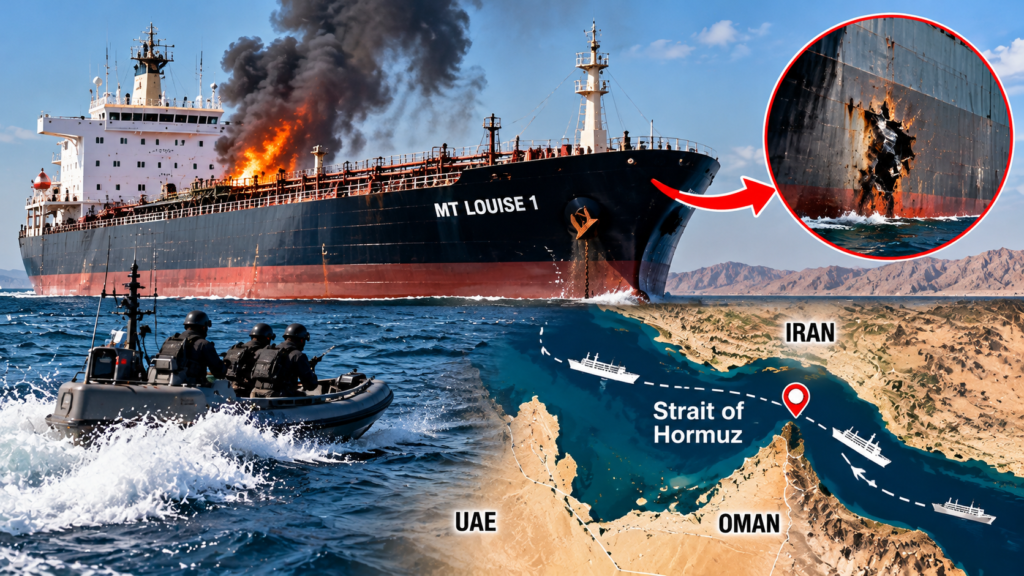
A Strait of Hormuz tanker attack has raised fresh concerns about maritime security after an oil tanker carrying 27 Indian seafarers was struck by explosive devices in one of the world’s most important shipping routes. The incident took place on October 30, 2026, when the Panama-flagged tanker MT Louise 1 was reportedly targeted by two limpet mines near the coast of Oman. The explosions caused a fire in the engine room and temporarily disabled the vessel. Fortunately, all 27 Indian crew members were reported safe, with no injuries.
The incident has attracted international attention because the Strait of Hormuz is a critical route for global oil shipments. It also highlights the growing security risks facing commercial vessels operating in the region amid continuing tensions in the Middle East.
What Happened in the Strait of Hormuz Tanker Attack?
The incident occurred on Thursday, October 29, according to the initial maritime incident reporting, with details emerging on October 30 and October 31.
The tanker involved was MT Louise 1, a Panama-flagged crude oil vessel carrying 27 Indian seafarers. According to maritime security sources cited by Reuters, a small boat approached the moving tanker and attached two limpet mines to its hull before leaving the area.
The explosive devices subsequently detonated, causing a fire in the vessel’s engine room. The incident temporarily disabled the tanker and raised concerns about the safety of other commercial ships travelling through the waterway.
The crew managed to bring the fire under control. Reports confirmed that all 27 Indian seafarers survived without injuries.
Following the reported Strait of Hormuz tanker attack, the safety of the crew remains a major concern for shipping companies and maritime authorities.
The United Kingdom Maritime Trade Operations (UKMTO) reported that the incident took place approximately 25 nautical miles northeast of Khasab, Oman.
Although the initial maritime report did not identify the vessel, maritime security sources later identified it as MT Louise 1.
The Strait of Hormuz tanker attack has raised serious questions about the safety of commercial vessels passing through one of the world’s most important shipping routes.
Were the 27 Indian Seafarers Safe?
Yes. All 27 Indian crew members aboard MT Louise 1 were reported safe following the incident.
India’s Union Minister for Ports, Shipping and Waterways, Sarbananda Sonowal, confirmed the safety of the Indian nationals through a public statement.
The Indian government also said it was monitoring the situation and coordinating with the ship management company to support the safety and well-being of its seafarers.
According to the available reports:
- All 27 Indian seafarers were safe.
- No injuries were reported among the crew.
- The fire in the engine room was extinguished.
- No environmental damage was reported.
- The vessel continued towards its next port of call.
The safe condition of the crew was an important development, considering the potential dangers associated with an explosion aboard an oil tanker.
What Are Limpet Mines and How Do They Threaten Ships?
One of the most concerning aspects of the Strait of Hormuz tanker attack was the reported use of limpet mines.
Limpet mines are specialised explosive devices designed to attach directly to the hull of a vessel. They are generally secured using magnets or other attachment mechanisms.
Unlike conventional attacks involving missiles or large naval weapons, limpet mines can be deployed using relatively small boats or underwater operations.
Their small size can make them difficult to detect before they are attached to a ship.
When detonated, these explosives can damage a vessel’s structure, machinery or other important systems. Depending on their location and the strength of the explosion, they may also cause fires, flooding or serious operational problems.
In the case of MT Louise 1, the reported explosions caused an engine-room fire and temporarily disabled the tanker.
Maritime security experts have warned that the use of relatively inexpensive explosive devices can create significant challenges for commercial shipping, particularly in busy maritime routes.
Why Is the Strait of Hormuz So Important?
The Strait of Hormuz is a narrow but strategically important waterway connecting the Persian Gulf with the Gulf of Oman and the Arabian Sea.
In an earlier report, NuvWire explored how the Strait of Hormuz crisis could affect global oil prices and disrupt international shipping routes. Read our detailed analysis of the [Strait of Hormuz Crisis and Global Oil Prices].
It is one of the most important maritime routes for international energy transportation.
Large quantities of crude oil and petroleum products travel through this passage from major energy-producing countries in the Gulf region to international markets.
Countries in Asia, Europe and other regions depend on energy supplies transported through this route.
Any major disruption can create uncertainty in international energy markets, increase transportation costs and affect oil supply chains.
The waterway is particularly important because alternative shipping routes may involve longer journeys and additional expenses.
The Strait of Hormuz tanker attack highlights how quickly a maritime security incident can affect international shipping and global energy markets.
The Strait of Hormuz tanker attack could increase concerns among shipping operators about the risks of transporting oil through the region.
For this reason, security incidents in the Strait of Hormuz attract attention from governments, shipping companies, energy traders and international organisations.
Was Another Indian-Linked Tanker Also Attacked?
Yes. Reports also highlighted a separate incident involving another tanker in the same strategic waterway.
On October 29, 2026, the Liberia-flagged very large crude carrier MT Arzanah, carrying two Indian nationals, was targeted in a projectile attack.
India’s shipping minister confirmed that the two Indian seafarers aboard that vessel were also safe.
This means a total of 29 Indian nationals aboard the two vessels were reported safe following the separate incidents.
However, the two attacks should not be confused. MT Louise 1 was reportedly struck by limpet mines, while MT Arzanah was targeted in a separate projectile attack.
Both incidents increased concerns about the safety of Indian seafarers and other international crews working in the region.
Who Was Behind the Strait of Hormuz Tanker Attack?
At the time of reporting on October 31, 2026, the people or organisation responsible for the attack on MT Louise 1 had not been officially identified.
Maritime security sources provided information about the suspected use of limpet mines, but that does not establish who organised or carried out the operation.
The incident occurred during a period of heightened tensions involving Iran, the United States and other regional actors.
Iran has imposed restrictions on maritime traffic through the Strait of Hormuz during the wider conflict, while commercial shipping has faced repeated security incidents.
However, there was no confirmed public evidence establishing responsibility for the specific MT Louise 1 attack.
It is important to distinguish the wider regional conflict from the confirmed details of an individual maritime incident. Further investigation and official statements will be needed before responsibility can be established.
What Does the Attack Mean for Global Oil Shipping?
The incident has renewed questions about the security of oil tankers operating in the Strait of Hormuz.
Commercial vessels travelling through the area may face several risks, including:
- Explosive devices attached to ship hulls.
- Projectile attacks against commercial vessels.
- Fires and damage to essential ship machinery.
- Delays caused by security inspections and route restrictions.
- Higher insurance and shipping expenses.
- Uncertainty for international energy transportation.
Even when an attack does not cause casualties or a major oil spill, it can affect the confidence of shipping companies and insurers.
If security incidents continue, shipping operators may reconsider their routes, insurance arrangements and safety procedures.
Such changes could increase the cost of transporting energy supplies and create additional pressure on international markets.
However, the long-term impact will depend on the frequency of further incidents, the response of regional governments and the security measures adopted by shipping operators.
What Happens Next?
The safety of the crew aboard MT Louise 1 was the most important immediate outcome. The vessel continued towards its next port after the fire was extinguished.
Authorities and maritime security organisations will continue monitoring developments in the Strait of Hormuz.
Shipping companies operating in the region are also likely to remain alert to potential threats and follow maritime security advisories.
For India, protecting its seafarers remains an important concern because Indian nationals work aboard commercial vessels operating across international shipping routes.
The investigation into the attack and the identification of those responsible remain important unanswered questions.
Although further verified details are needed, the Strait of Hormuz tanker attack demonstrates why maritime security in the Gulf region remains important.
For more international breaking news, technology updates and global developments, visit NuvWire.
Conclusion
The Strait of Hormuz tanker attack involving MT Louise 1 demonstrates how quickly maritime security incidents can threaten commercial shipping and international energy transportation.
Although the tanker suffered an engine-room fire after reportedly being struck by two limpet mines, all 27 Indian seafarers were confirmed safe. A separate attack involving MT Arzanah also left two Indian nationals unharmed.
The incident has once again drawn international attention to the importance of protecting commercial vessels travelling through the Strait of Hormuz.
As tensions continue in the region, governments, shipping companies and maritime security organisations will need to remain alert to developments that could affect the safety of seafarers and the movement of global energy supplies.
NuvWire will continue following important international developments and bringing readers verified news updates and useful explanations.