
The Tesla Cybertruck production shutdown announcement has surprised the electric vehicle industry. Elon Musk has indicated that Tesla will wind down Cybertruck production at its Gigafactory Texas around the middle of 2027. The decision comes after years of attention, ambitious sales expectations and challenges in turning the futuristic electric pickup into a mainstream success.
The Cybertruck was introduced as one of Tesla’s most ambitious vehicles. Its unusual stainless-steel body, sharp design and electric performance attracted worldwide attention. However, actual sales remained far below the original expectations.
According to Musk, the production shift will make more room for Tesla’s Cybercab, an autonomous vehicle designed for the company’s robotaxi ambitions.
So, does this mean the Cybertruck is officially finished? Here is what happened, why Tesla is changing direction and what it could mean for the future of electric vehicles.
The Tesla Cybertruck production shutdown has raised questions about the future of Tesla’s electric pickup strategy and whether the company can meet its original market expectations.
1. Elon Musk Announces Tesla Cybertruck Production Shutdown
On November 6, 2026, Elon Musk announced that Tesla would wind down Cybertruck production at its Texas Gigafactory around mid-2027.
He explained that the factory space would be needed to increase production of the Cybercab, Tesla’s planned autonomous taxi.
The announcement marked a significant change for a vehicle that once represented Tesla’s ambitions to enter the electric pickup market.
However, Musk did not provide a detailed explanation of what would happen to the Cybertruck after production winds down at the Texas facility.
It is also important to understand that winding down production at one factory does not automatically confirm that the vehicle will permanently disappear from Tesla’s entire lineup.
For now, the confirmed announcement concerns the Texas production facility.
According to Reuters’ report on Tesla’s Cybertruck production plans, the planned production wind-down will free up factory capacity for the Cybercab. However, Tesla has not clarified whether Cybertruck manufacturing will move to another facility or stop completely.
2. Why Is Tesla Ending Cybertruck Production?

The decision comes after the Cybertruck struggled to achieve the sales figures originally expected by Tesla.
When the vehicle was first introduced, Elon Musk projected that production could eventually reach approximately 250,000 units annually.
However, the actual market response was considerably smaller.
According to Kelley Blue Book figures reported by Reuters and CBS News, Tesla sold approximately 20,237 Cybertrucks in the United States during 2025, compared with 38,965 in 2024.
That represents a decline of around 48%.
Several factors have contributed to the challenges surrounding the vehicle:
- Its relatively high purchase price.
- Competition from established pickup manufacturers.
- Questions about its unusual exterior design.
- Multiple vehicle recalls.
- Limited availability in international markets.
- Lower demand than Tesla originally anticipated.
These factors have made it difficult for the Cybertruck to reach its original sales ambitions.
The electric vehicle industry is also expanding in emerging markets such as Pakistan. Read our related report on Pakistan’s electric vehicle market and charging infrastructure in 2026 to understand how the global shift towards electric mobility is developing.
Another factor behind the Tesla Cybertruck production shutdown is the company’s decision to prioritise manufacturing resources for its upcoming autonomous vehicle projects.
3. Cybertruck Sales Fell Far Below Elon Musk’s Expectations

The difference between the original sales ambition and actual deliveries tells an important part of the story.
When Tesla began preparing the Cybertruck for production, Musk discussed the possibility of producing around 250,000 vehicles every year.
However, the company’s US sales figures were much lower.
According to Kelley Blue Book estimates cited in recent reporting:
| Year | US Cybertruck sales |
|---|---|
| 2024 | 38,965 |
| 2025 | 20,237 |
<text color=”secondary” size=”xs”>Source: Kelley Blue Book figures reported by Reuters and CBS News.</text>
<text weight=”medium”>Cybertruck US sales comparison</text>
| Year | Sales |
|---|---|
| 2024 | 38,965 |
| 2025 | 20,237 |
The numbers show that the vehicle lost considerable sales momentum between the two years.
Tesla does not publish a separate, comprehensive Cybertruck sales figure in its regular delivery reports, so these figures should be understood as industry estimates rather than a separately reported Tesla total.
The sales figures were also highlighted by CBS News in its November 6, 2026 report, which discussed the gap between Tesla’s original sales ambitions and the vehicle’s actual market performance.
These figures help explain why the Tesla Cybertruck production shutdown is becoming an important discussion across the global electric vehicle industry.
The Tesla Cybertruck production shutdown could also influence how customers view the availability and long-term value of this electric pickup.
4. Tesla Cybercab Is Taking Priority
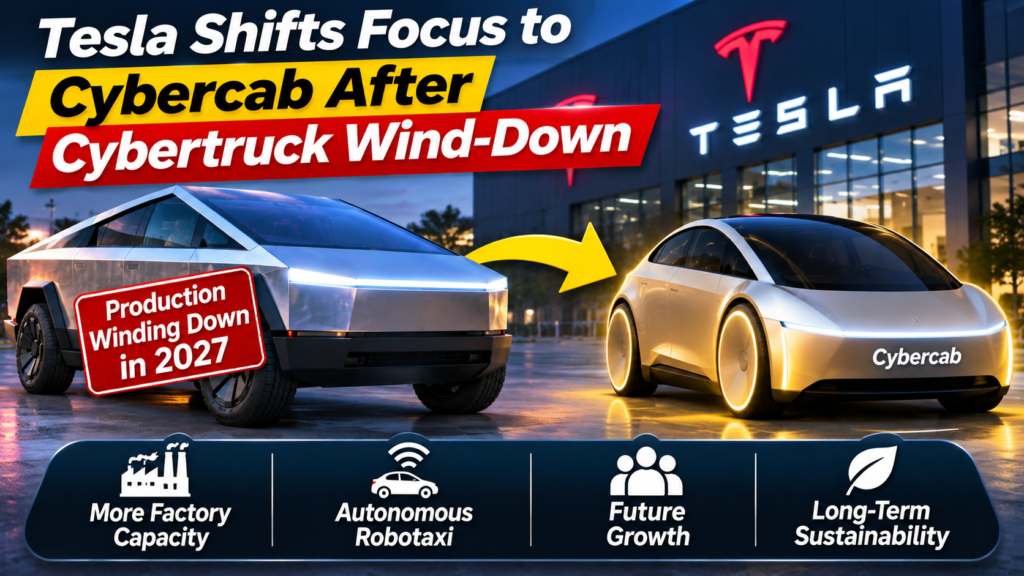
One of the biggest reasons behind the production change is Tesla’s growing focus on autonomous transportation.
The Cybercab is a two-seat electric vehicle designed for Tesla’s robotaxi ambitions.
Unlike conventional cars, the vehicle was designed without a steering wheel or traditional driving pedals. Its purpose is to support an autonomous ride-hailing service.
Tesla started Cybercab production at its Texas factory in April 2026 and began offering paid rides in Austin in September, according to recent reporting.
Musk wants the Cybercab to become an important part of Tesla’s future business.
Increasing its production capacity requires factory space and manufacturing resources. This helps explain why Tesla is preparing to reduce Cybertruck production at the same facility.
However, the Cybercab still faces regulatory questions surrounding its safety certification and autonomous operation.
Its long-term commercial success will depend on how effectively Tesla addresses these challenges.
Tesla is not the only international automaker attracting attention in the electric vehicle market. Explore our coverage of the Geely Auto Pakistan launch and its new electric vehicles for another perspective on the changing automotive industry.
The Tesla Cybertruck production shutdown also reflects Tesla’s changing manufacturing priorities as it prepares to expand its Cybercab programme.
For Tesla, the Tesla Cybertruck production shutdown represents a shift in manufacturing capacity towards autonomous transportation technology.
5. Cybertruck Faced Recalls and Quality Concerns
The Cybertruck attracted attention from the beginning, but its journey was not without problems.
During its November 2019 unveiling, Tesla attempted to demonstrate the strength of its specially designed windows. However, the demonstration did not go as planned when the glass cracked after being struck by a metal ball.
The vehicle also experienced production delays before customer deliveries began in November 2023.
Since its launch, Cybertruck owners have encountered various issues involving vehicle components and software.
These have resulted in multiple recalls, including cases involving accelerator pedal components and exterior body panels.
Reuters reported on November 6, 2026, that the Cybertruck had faced 11 recalls since entering the market.
Recalls do not necessarily mean that a vehicle is unsuccessful, but repeated quality and safety concerns can affect customer confidence and a vehicle’s reputation.
For more details about the vehicle’s production delays, quality concerns and recalls, read Reuters’ detailed report on the Cybertruck’s difficult journey.

6. What Will Happen to Existing Cybertruck Owners?
Tesla’s production announcement does not mean existing Cybertruck owners will suddenly lose access to their vehicles.
The company’s Cybertruck engineering lead, Wes Morrill, described the vehicle as an important technology development platform and said its technology would continue through the Cybercab.
He also indicated that service support and spare parts would continue.
For existing owners, the important considerations remain:
- Vehicle servicing and maintenance.
- Availability of replacement components.
- Software updates.
- Warranty and repair support.
- Long-term resale value.
A production slowdown does not automatically cancel existing warranties or service arrangements.
However, the longer-term effects on resale values and parts availability remain uncertain.
7. Is Tesla Completely Discontinuing the Cybertruck?
This is the question many Tesla fans and potential buyers are asking.
At the time of writing, Tesla has announced plans to wind down Cybertruck production at its Texas Gigafactory around mid-2027.
However, Elon Musk has not clearly confirmed that Cybertruck production will permanently end at every possible location.
The Texas factory is currently the known production facility for the vehicle, but the company has not provided a complete public explanation of its long-term plans for the model.
Therefore, it is more accurate to describe this development as a planned production wind-down rather than a confirmed worldwide permanent cancellation.
Readers should watch for further announcements from Tesla before assuming the Cybertruck has disappeared permanently.
What Does This Mean for Tesla’s Future?
Tesla’s decision highlights how the company’s priorities are changing.
The Cybertruck was developed to expand Tesla’s presence in the electric pickup market. The Cybercab, on the other hand, represents a move towards autonomous transportation.
These are two very different business directions.
The electric vehicle market is also becoming more competitive, with established manufacturers and newer companies competing for customers.
Tesla now faces the challenge of proving that its robotaxi ambitions can become a sustainable business.
For the Cybertruck, the coming months will be important as the company moves towards its planned production changes.
Frequently Asked Questions (FAQs)
1. Is Tesla ending Cybertruck production?
Tesla plans to wind down Cybertruck production at its Texas Gigafactory around mid-2027. A permanent worldwide discontinuation has not been clearly confirmed.
2. Why is Elon Musk stopping Cybertruck production?
Musk said Tesla needs more factory space for increased Cybercab production, its autonomous robotaxi vehicle.
3. When will Cybertruck production end?
Tesla plans to wind down production at its Texas factory around the middle of 2027. No exact final production date has been announced.
4. How many Cybertrucks did Tesla sell in 2025?
Kelley Blue Book estimates cited by Reuters and CBS News put US Cybertruck sales at approximately 20,237 units in 2025.
5. What is the Tesla Cybercab?
The Cybercab is Tesla’s two-seat autonomous electric vehicle designed for its robotaxi service. It was developed without a traditional steering wheel or driving pedals.
6. Will existing Cybertruck owners receive service support?
Tesla’s Cybertruck engineering lead has indicated that spare parts and service support will continue. Owners should still check Tesla’s official service and warranty information.
7. Is the Cybertruck completely cancelled?
Not officially. The confirmed announcement concerns winding down production at the Texas factory. Tesla has not clearly confirmed a permanent worldwide cancellation.
Although the Tesla Cybertruck production shutdown is planned for 2027 at the Texas factory, the vehicle’s long-term future remains uncertain.
Industry observers will be watching closely to see how the Tesla Cybertruck production shutdown affects Tesla’s future vehicle lineup.
Final Thoughts
The Tesla Cybertruck production shutdown announcement marks an important moment for one of the company’s most recognisable electric vehicles.
The truck attracted enormous attention when it was introduced, but its sales performance did not match the ambitious expectations set during its development.
Tesla is now preparing to give more manufacturing capacity to the Cybercab as it expands its focus on autonomous transportation.
Whether the Cybertruck eventually disappears from Tesla’s lineup or returns in another form remains uncertain. What is clear is that Tesla’s priorities are changing, and the next chapter of its automotive business will increasingly involve robotics and self-driving technology.
Follow NuvWire for more updates on Tesla, electric vehicles, technology and global business news.
For more updates, visit NuvWire Technology News and explore the latest developments in electric vehicles, artificial intelligence and automotive innovation.