Xiaomi HyperOS 4 is the latest major software upgrade from Xiaomi, bringing a redesigned interface, smoother performance, smarter AI tools and improved privacy features. As of November 5, 2026, Xiaomi has officially published its global rollout schedule, with updates beginning in early November and continuing through December 2026. The new software aims to make Xiaomi, Redmi and POCO devices feel faster, more intelligent and easier to use.
For Xiaomi users, this update is more than a visual makeover. It introduces new customization options, improved memory management, AI-powered productivity tools and a refreshed user experience. Here’s everything you need to know about HyperOS 4, including its most important features, supported devices and expected availability in Pakistan.
What Is Xiaomi HyperOS 4?
Xiaomi HyperOS 4 is the company’s latest generation of its operating system, designed to improve the experience across smartphones and tablets.
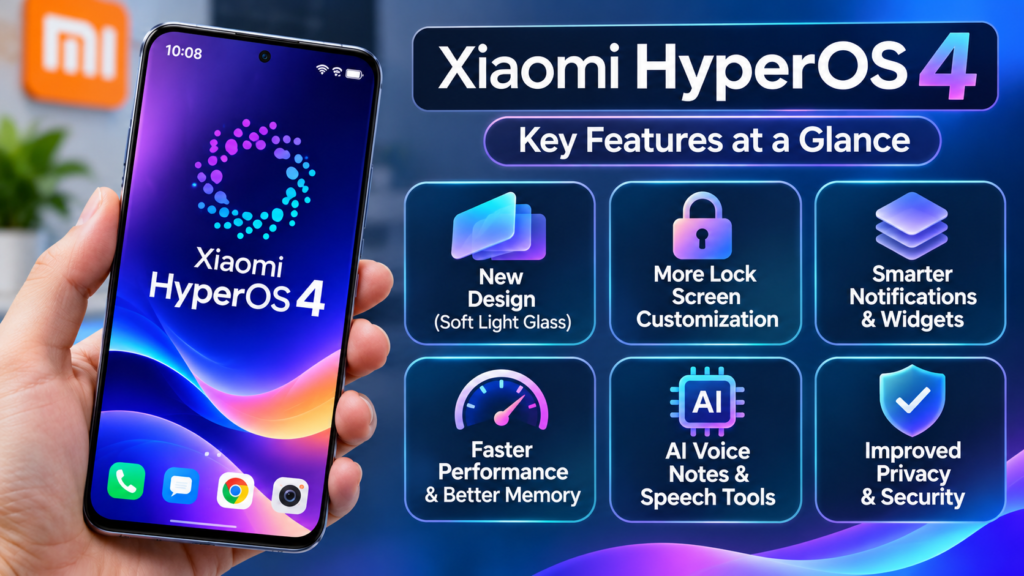
The update focuses on three major areas: design, performance and artificial intelligence. Xiaomi has introduced a new visual style called Soft Light Glass, alongside improved system management and additional AI-powered features.
The company is also working to create a more connected experience across its ecosystem, making it easier for users to work between compatible Xiaomi devices.
According to the official Xiaomi HyperOS 4 website, the update introduces a refreshed interface, improved performance and new AI-powered features.
7 Exciting New Features of Xiaomi HyperOS 4
1. New Soft Light Glass Design
One of the most noticeable changes in HyperOS 4 is its Soft Light Glass interface.
The redesigned appearance uses transparency, light effects, layered elements and smoother visual transitions. Different interface elements can adapt their appearance to create a cleaner and more modern experience.
Users can also expect improved visual effects when interacting with supported menus and controls.
2. Improved Lock Screen Customization
Xiaomi is introducing more flexibility for lock screen personalization.
The new options include:
- Flexible clock sizing.
- Variable typography styles.
- Improved visual layouts.
- More ways to personalize the lock screen.
This gives users greater control over how their phone looks without requiring additional customization applications.
3. Better Notifications and Home Screen Widgets
HyperOS 4 introduces notification stacking, allowing notifications to appear in a more organized layout.
Other home screen improvements include:
- Resizable home screen folders on supported phones.
- Widget stacking for easier organization.
- Improved widget browsing.
- More flexible home screen arrangements.
These changes are designed to make everyday phone navigation simpler and less cluttered.
4. Faster Performance and Better Memory Management
Performance is another major focus of Xiaomi HyperOS 4.
Xiaomi has introduced improved workload scheduling, memory preloading and an upgraded application runtime environment.
According to Xiaomi’s internal laboratory tests, the total hot launch time for 30 applications after nine hours of use decreased from 40.3 seconds on HyperOS 3 to 36.8 seconds on HyperOS 4.
The company also reports improvements in camera launch times and video playback stability.
These results are based on Xiaomi’s own testing and may differ depending on the phone model and everyday usage.
5. Smarter AI Voice Notes
HyperOS 4 brings new AI-powered voice note capabilities.
Users can record voice notes and use supported AI tools to organize the information more effectively.
Some of the announced capabilities include:
- Converting voice notes into structured entries.
- Asking questions directly about saved notes.
- Extracting useful to-do items.
- Creating mind maps from information.
These features could be particularly useful for students, professionals and people who regularly record meetings or personal reminders.
6. Advanced AI Speech Recognition
Xiaomi is also improving its speech recognition capabilities.
The new system can help users organize recordings, identify important discussion points and create summaries.
Additional features include automatic outlines, image markers and the ability to skip silent sections in supported recordings.
This could make long recordings easier to review without listening to every second.
7. Improved Privacy and Security
Privacy is another important part of the new operating system.
Xiaomi highlights improvements such as post-quantum encryption for certain communication security functions, secure data transmission and privacy protection across on-device and cloud-based AI processing.
However, some security capabilities are limited to supported devices and specific services.
Users should check their individual device’s software documentation to understand which protections are available.
Xiaomi HyperOS 4 Global Release Date
Xiaomi has officially announced a phased global rollout beginning in early November 2026.
The update is scheduled to reach eligible smartphones and tablets in three major stages.
Here is the announced schedule:
| Rollout period | Expected availability |
|---|---|
| Early November 2026 | First group of eligible devices |
| Mid-November 2026 | Second group of devices |
| December 2026 | Additional older devices |
The schedule represents the beginning of each rollout phase, not a guaranteed update date for every individual phone.
Xiaomi HyperOS 4 Eligible Devices List
Xiaomi’s official global schedule includes smartphones from Xiaomi, Redmi and POCO, along with selected tablets.
If you are interested in the latest smartphone technology, also read our guide on [POCO X8S: Expected Price, Specs and Launch Updates] for more information about upcoming smartphone developments.
Early November 2026
The first rollout group includes:
Xiaomi phones:
- Xiaomi 17 Ultra
- Leica Leitzphone powered by Xiaomi
- Xiaomi 17
- Xiaomi 17T Pro
- Xiaomi 17T
Redmi phones:
- Redmi Note 15 Pro+ 5G
- Redmi Note 15 Pro 5G
- Redmi Note 15 Pro
- Redmi Note 15 5G
- Redmi Note 15
- Redmi 17 series
- Redmi 15C series
POCO phones:
- POCO F8 Ultra
- POCO F8 Pro
- POCO X8 Pro Max
- POCO X8 Pro
- POCO M8 Pro
- POCO M8
- POCO C95 Pro
- POCO C85
Tablets:
- Xiaomi Pad 8 Pro
- Xiaomi Pad 8
Mid-November 2026
The second rollout stage includes:
- Xiaomi 15 Ultra
- Xiaomi 15
- Xiaomi 15T Pro
- Xiaomi 15T
- POCO F9 Ultra
- POCO F9 Pro
- POCO F7 Ultra
- POCO F7 Pro
- POCO F7
- POCO X8
- POCO X7 Pro
- Redmi Note 17 series
- Xiaomi Pad 7 series
- Redmi Pad 2 Pro series
- POCO Pad X1
- POCO Pad M1
December 2026
The December rollout is expected to cover additional older devices, including:
- Xiaomi 14 Ultra
- Xiaomi 14
- Xiaomi 13 Ultra
- Xiaomi 13 Pro
- Xiaomi 13
- Xiaomi MIX Flip
- Xiaomi 14T Pro
- Xiaomi 14T
- Xiaomi 13T Pro
- Xiaomi 13T
- Redmi Note 14 series
- POCO F6 series
- POCO X8s
- POCO X7
- POCO X6 Pro
- POCO M7
- Selected Redmi and POCO tablets
Important: This is a selection of devices from Xiaomi’s published global schedule. The full list includes additional models, and rollout dates may change depending on region, carrier, device variant and software development progress.
Will Xiaomi HyperOS 4 Be Available in Pakistan?
Yes, the global HyperOS 4 rollout is relevant to compatible Xiaomi, Redmi and POCO devices sold outside mainland China, including eligible global-version phones in Pakistan.
However, Pakistani users should understand that the update may not arrive on every device at the same time.
Availability can depend on several factors:
- Your phone’s exact model number.
- Global or regional ROM version.
- Carrier and regional software requirements.
- Xiaomi’s phased update process.
For example, two users with the same smartphone model may receive the update on different days.
It is therefore better to wait for the official notification rather than relying on unofficial installation files.
How to Check for the HyperOS 4 Update
When the update becomes available for your device, you can check it manually.
Follow these steps:
- Open Settings on your Xiaomi, Redmi or POCO phone.
- Select About phone.
- Tap the HyperOS version section.
- Select Check for updates.
- If the update is available, follow the on-screen installation instructions.
Before installing a major software update, make sure your important data is backed up and your phone has sufficient battery and storage space.
Is Xiaomi HyperOS 4 Worth the Upgrade?
Based on Xiaomi’s announced features, HyperOS 4 looks like a meaningful improvement over the previous version.
The new interface offers more customization, while performance optimizations aim to improve app responsiveness and everyday usability.
The AI tools are also worth watching. Voice notes, automatic summaries and smarter speech recognition could make compatible devices more useful for everyday tasks.
However, not every feature will be available on every phone. Some AI tools and visual features are restricted to selected models, regions and languages.
Users should therefore consider the actual update available for their device rather than assuming every advertised feature will be included.
Frequently Asked Questions About Xiaomi HyperOS 4
1. What is Xiaomi HyperOS 4?
Xiaomi HyperOS 4 is the next-generation software experience for Xiaomi devices, designed to improve the interface, performance, connectivity, and smart features.
2. When will Xiaomi HyperOS 4 be released?
The expected global rollout timeline should be confirmed through Xiaomi’s official announcements. Release timing may vary by device and region.
3. Which devices will receive Xiaomi HyperOS 4?
Eligible devices are expected to include selected Xiaomi, Redmi, and POCO smartphones. The final supported-device list depends on Xiaomi’s official update announcement.
4. What new features can users expect in HyperOS 4?
Expected improvements may include a refreshed design, smoother performance, smarter AI tools, better customization, and enhanced privacy features.
5. How can I check for the Xiaomi HyperOS 4 update?
Open Settings on your Xiaomi phone, select About phone, and tap the HyperOS version or System update option to check for available updates.
Final Thoughts
Xiaomi HyperOS 4 brings an interesting combination of design improvements, performance enhancements, AI features and security updates. Its global rollout, beginning in November 2026, gives millions of Xiaomi, Redmi and POCO users a new software experience to look forward to.
For users in Pakistan, the most important thing is to check their device’s regional software version and wait for the official update notification.
If Xiaomi delivers the promised improvements consistently across supported devices, HyperOS 4 could become one of its most significant software upgrades yet.
Stay connected with NuvWire for the latest Xiaomi updates, smartphone news and technology developments.