Google has introduced Gemini 4 Neon, a new artificial intelligence model designed to handle complex coding, advanced reasoning, scientific research, and demanding professional tasks. Announced on November 18, 2026, the latest addition to Google’s Gemini 4 family aims to make AI more useful for businesses, software developers, researchers, and everyday professionals.
Unlike basic AI chatbots that mainly respond to individual questions, Gemini 4 Neon is designed to complete complicated tasks involving multiple steps, different types of information, and extended workflows. Its capabilities include analysing documents, working with spreadsheets, writing software, and supporting technical research.
The announcement also highlights Google’s growing competition in the artificial intelligence industry, where companies are working to develop faster, more capable, and cost-efficient AI systems.
But what makes Gemini 4 Neon different, how much does it cost, and who can use it? Here is everything worth knowing about Google’s latest AI model.
Google has shared more details about its latest AI developments through its [official Gemini announcement].
What Is Gemini 4 Neon?
Gemini 4 Neon is Google’s latest frontier AI model, developed by Google DeepMind. It is designed to balance advanced intelligence, speed, and operating costs while handling complex professional tasks.
The model focuses on three important areas:
- Advanced software engineering and coding.
- Complex analytical and scientific reasoning.
- Multi-step business and productivity workflows.
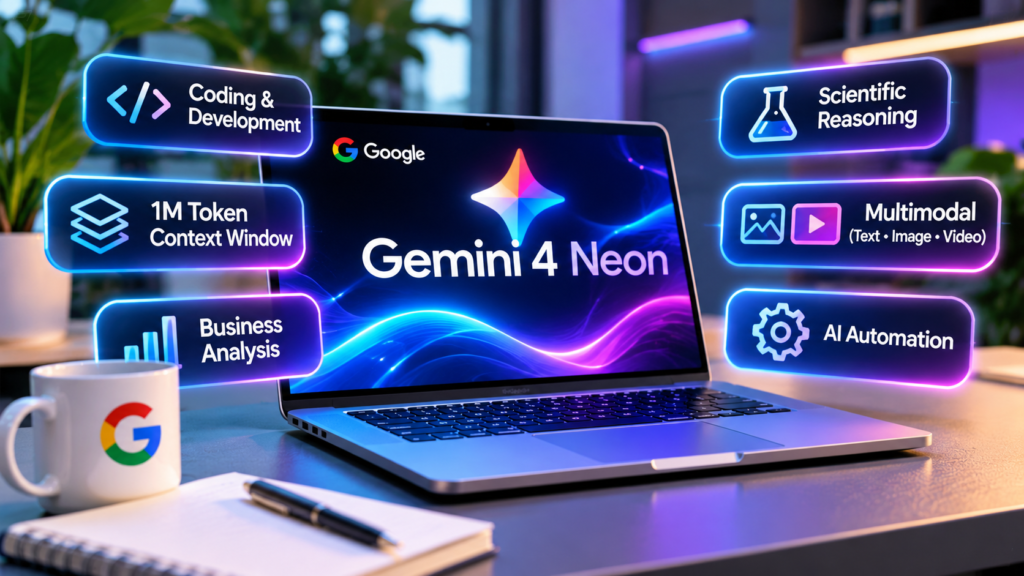
One of its major features is a 1-million-token context window. This allows the model to work with large amounts of information within a single context, including documents, spreadsheets, charts, audio, and video.
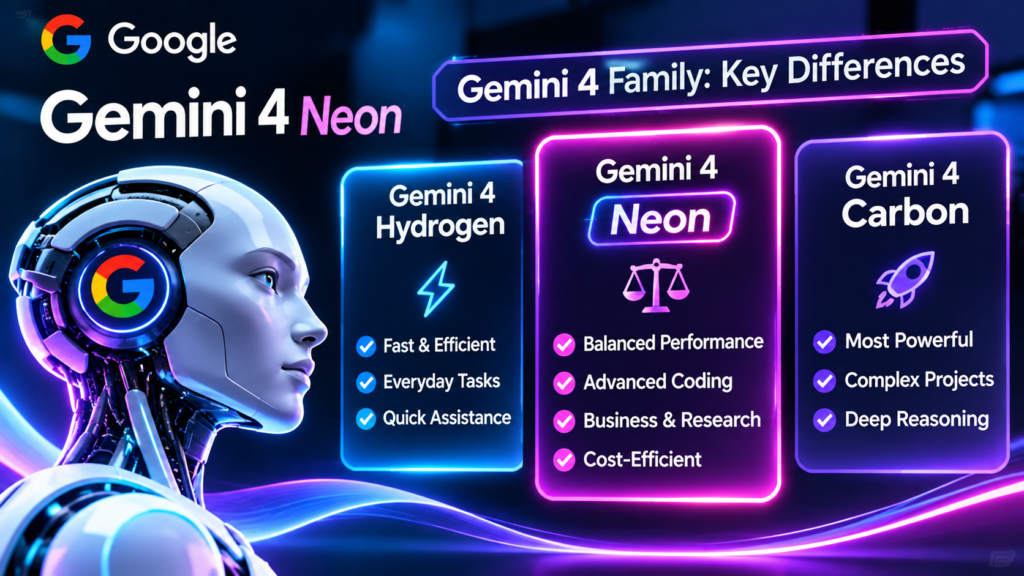
Google positions Neon between its other Gemini 4 models, Carbon and Hydrogen. While Carbon is designed for particularly demanding long-running tasks, Neon aims to provide a balance of performance and efficiency for more frequent professional workflows.
For businesses and developers, this could make advanced AI assistance more accessible without always needing the largest and most expensive model.
9 Powerful Features of Gemini 4 Neon
1. Advanced AI Coding and Software Development
One of the most important capabilities of Gemini 4 Neon is its ability to handle complicated software development tasks.
Developers often spend considerable time understanding existing code, identifying bugs, testing changes, and improving application performance. Basic AI assistance may help with individual coding questions, but larger projects require a more organised approach.
Gemini 4 Neon is designed to work through these multi-step engineering processes.
According to Google, the model achieved a 58.6 score on the Artificial Analysis Coding Agent Index and 65.2% on Terminal-Bench 4.1.
These results highlight its potential for software engineering, although actual performance can vary depending on the project and development environment.
2. A Massive 1 Million Token Context Window
Another major feature is the model’s 1-million-token context window.
A context window determines how much information an AI model can consider during a conversation or task.
For professionals, this capability could be particularly useful when working with:
- Large PDF documents.
- Business reports and spreadsheets.
- Technical documentation.
- Research papers.
- Audio and video materials.
- Multiple files from the same project.
Instead of repeatedly dividing large projects into smaller sections, users may be able to provide more information within a single workflow.
However, the amount of information a model can process does not automatically guarantee that every detail will be interpreted correctly.
3. Improved Scientific and Mathematical Reasoning
Gemini 4 Neon is also designed for advanced scientific and mathematical work.
Google reports strong performance across several specialised evaluations, including:
- Terminal-Bench Science: 70.5%.
- RiemannBench: 84.0%.
- HLE-Diamond: 71.3%.
These results suggest that the model can support demanding research and quantitative reasoning tasks.
Scientists and researchers could use such AI systems to explore technical questions, analyse data, organise research material, and investigate mathematical problems.
Nevertheless, scientific conclusions still require verification, particularly when the results influence important experiments or real-world decisions.
4. Better Business and Financial Analysis
Businesses regularly work with complicated information spread across spreadsheets, financial documents, charts, and reports.
Gemini 4 Neon is designed to bring different types of information together and turn them into structured outputs.
Google reports that the model performed strongly in evaluations involving finance, accounting, spreadsheet modelling, and complex instruction following.
Potential business applications include:
- Analysing financial reports.
- Comparing business performance.
- Organising spreadsheet information.
- Preparing research summaries.
- Identifying patterns in business data.
- Supporting financial planning.
For small businesses, advanced AI tools could reduce the time required for repetitive analytical work.
However, financial decisions should never depend entirely on AI-generated recommendations.
5. Faster Multi-Step AI Workflows
Many professional tasks require several connected actions rather than a single answer.
For example, preparing a business report may involve reviewing documents, extracting information, comparing figures, analysing trends, and creating a final summary.
Gemini 4 Neon is designed to handle these extended workflows more efficiently.
Google says the model achieved strong results in automation-related evaluations, including a 56.3% score on Zapier’s AutomationBench.
This development is important because the AI industry is gradually moving beyond simple chatbots towards systems that can assist with more complicated tasks.
6. Improved Instruction Following and Steerability
Another area of improvement is how the model responds when users change instructions during a task.
Imagine asking an AI assistant to prepare a detailed business report and then requesting a different structure, additional information, or a change in priorities.
A useful AI system should be able to adjust without losing important details from the original instructions.
Google reports that Gemini 4 Neon ranked second on the Agent Arena Index for steerability.
This capability could make it more practical for professionals who regularly revise instructions while working on large projects.
7. Strong Performance on Professional Research Tasks
Gemini 4 Neon is not limited to coding and general productivity.
Google also reports strong results in specialised professional evaluations, including the Legal Research Bench and Tax Agent Bench, where Neon achieved first-place results.
These capabilities could support professionals working with complex documents, regulations, financial information, and research material.
However, AI-generated legal and tax information must be reviewed by qualified professionals before being used for important decisions.
8. More Cost-Efficient AI Performance
The cost of running advanced AI models is an important consideration for developers and businesses.
Google has positioned Gemini 4 Neon as a balance between intelligence, speed, and affordability.
According to its announcement, the model is priced at:
- Input: $3 per million tokens.
- Cached input: $0.15 per million tokens.
- Output: $15 per million tokens.
Cached input pricing offers a substantial discount when eligible previously processed information is reused.
This pricing structure could make the model attractive for applications that process large amounts of information regularly.
Actual costs will depend on usage, token consumption, and the applicable API billing conditions.
9. Multimodal Understanding for Different Types of Information
Modern businesses rarely work with text alone.
They use images, presentations, audio recordings, videos, charts, and spreadsheets to communicate information.
Gemini 4 Neon is designed to work across multiple information formats within its large context window.
This could make it useful for professionals who need to combine different types of material into one organised workflow.
For example, a business could use AI assistance to review a presentation, analyse supporting spreadsheets, and prepare a written summary.
The ability to process different formats together is becoming an increasingly important feature in modern AI systems.
Gemini 4 Neon vs Gemini 4 Carbon vs Gemini 4 Hydrogen
Google’s Gemini 4 family includes models designed for different workloads.
| Feature | Gemini 4 Neon | Gemini 4 Carbon | Gemini 4 Hydrogen |
|---|---|---|---|
| Main purpose | Balanced advanced AI | Complex long-running work | Fast everyday execution |
| Coding | Advanced | Highly demanding engineering | Routine coding tasks |
| Reasoning | Advanced | Frontier-level complex reasoning | Everyday reasoning |
| Business use | Frequent professional workflows | Complex enterprise projects | Quick assistance |
| Main advantage | Speed and efficiency balance | Greater depth for demanding tasks | Fast execution |
The three models are intended to serve different requirements rather than replace one another in every situation.
Users should choose a model based on the complexity of their work, available access, performance requirements, and budget.
Google’s earlier AI development is also worth exploring in our article about [Gemini 4 Carbon and its powerful features].
Gemini 4 Neon Price: How Much Does It Cost?
Google has published the following API pricing for Gemini 4 Neon:
| API usage | Price |
|---|---|
| Input tokens | $3 per million |
| Cached input tokens | $0.15 per million |
| Output tokens | $15 per million |
For developers, pricing is an important consideration when building AI applications or integrating advanced models into existing software.
The cached input rate is particularly useful for eligible repeated information because it can reduce processing costs.
Developers can review the [official Gemini API pricing] before choosing a plan.
Users should always check Google’s official pricing and API documentation before starting a paid project, as pricing and usage conditions may change.
How to Access Gemini 4 Neon
Google announced the initial rollout of Gemini 4 Neon on November 18, 2026.
Its availability includes several platforms:
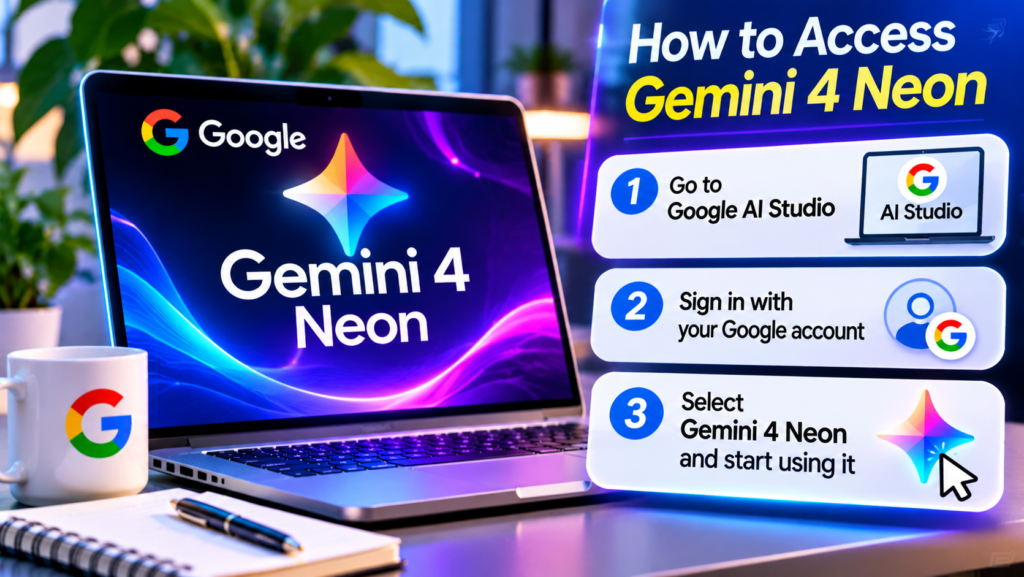
For developers: The model is available through the paid Gemini API tier in Google AI Studio and supported developer environments.
For businesses: Eligible organisations can access Neon through Gemini for business and supported API integrations.
For individual users: Eligible Google AI Pro and Ultra subscribers can access the model through supported Gemini app and Google Antigravity experiences.
Availability depends on the subscription, platform, and rollout conditions.
Users interested in testing the model should visit Google’s official website for the latest access information.
How Gemini 4 Neon Could Change the AI Industry
The introduction of Gemini 4 Neon reflects a broader shift in the artificial intelligence industry.
AI companies are increasingly competing on more than conversational ability. They are focusing on coding performance, research capabilities, automation, productivity, and the ability to complete complex tasks.
For software developers, this could mean faster debugging and more efficient development workflows.
For businesses, it could mean better support for research, reporting, and data analysis.
For students and researchers, advanced reasoning tools could provide new ways to explore difficult subjects and organise information.
However, these opportunities also come with challenges involving data privacy, accuracy, security, and the need for human supervision.
Google’s latest model is another significant development in a rapidly changing AI market, but independent real-world testing will remain important.
To understand how artificial intelligence is transforming employment, read our detailed guide on [AI vs Human Jobs in 2026].
Challenges and Limitations of Gemini 4 Neon
Despite its reported performance, Gemini 4 Neon is not a perfect solution for every task.
There are several factors users should consider before relying on it.
1. Access restrictions: Some features require paid subscriptions or API access.
2. API expenses: Large projects can generate significant token usage and costs.
3. Accuracy concerns: AI models can still produce incorrect or misleading information.
4. Data privacy: Businesses should review data-handling policies before uploading confidential information.
5. Human supervision: Important coding, financial, scientific, and legal decisions require independent review.
Understanding these limitations is essential for using advanced AI responsibly.
Final Verdict: Is Gemini 4 Neon Worth Watching?
Gemini 4 Neon represents an important step in Google’s artificial intelligence development.
Its combination of advanced coding, a 1-million-token context window, scientific reasoning, business analysis, and multimodal capabilities makes it a model worth watching.
The biggest attraction is its attempt to balance strong performance with speed and cost efficiency.
For developers and businesses, the model could provide new ways to approach complicated digital work. For everyday users, its availability through eligible Gemini subscriptions could expand access to more advanced AI capabilities.
However, benchmark results are only one part of the picture. Its long-term value will depend on real-world reliability, accessibility, pricing, and how effectively people use it.
As competition in the AI industry continues, Gemini 4 Neon could become an important part of Google’s strategy to bring advanced artificial intelligence into everyday professional workflows.
Frequently Asked Questions (FAQs)
1. What is Gemini 4 Neon?
Gemini 4 Neon is Google’s advanced artificial intelligence model designed for coding, scientific reasoning, business analysis, and complex multi-step workflows.
2. When was Gemini 4 Neon announced?
Google officially announced Gemini 4 Neon on November 18, 2026.
3. Who developed Gemini 4 Neon?
Gemini 4 Neon was developed by Google DeepMind as part of Google’s Gemini 4 model family.
4. What is the context window of Gemini 4 Neon?
Gemini 4 Neon features a 1-million-token context window, allowing it to process large amounts of information across supported formats.
5. How much does Gemini 4 Neon cost?
Its announced API pricing is $3 per million input tokens, $0.15 per million cached input tokens, and $15 per million output tokens.
6. Is Gemini 4 Neon available for free?
The initial availability includes paid API access and eligible Google AI Pro and Ultra subscriptions. Access conditions may vary by platform.
7. Can Gemini 4 Neon write and debug code?
Yes. The model is designed to support advanced software engineering, including coding, debugging, and multi-step development tasks.
8. What is the difference between Gemini 4 Neon and Gemini 4 Carbon?
Neon focuses on balancing advanced intelligence, speed, and cost efficiency, while Carbon is designed for particularly demanding, long-running engineering and reasoning tasks.
9. Is Gemini 4 Neon better than other AI models?
Its reported benchmark results are competitive, but no single model is best for every task. Performance depends on the workload, cost, speed, and reliability requirements.
10. Where can users try Gemini 4 Neon?
Eligible users can access it through supported Gemini app subscriptions, Google AI Studio, Gemini API, and other announced Google platforms.
Conclusion
Google’s Gemini 4 Neon announcement highlights how quickly artificial intelligence is moving towards more capable, task-oriented systems.
With advanced reasoning, coding support, multimodal understanding, and competitive API pricing, it could become a useful tool for developers, businesses, and researchers.
The next important step will be seeing how these capabilities perform in everyday projects and how access expands over time.