Pakistan has taken another step towards supporting small and medium-sized enterprises (SMEs) and encouraging more businesses to enter international markets. On November 20, 2026, the Economic Coordination Committee (ECC) approved changes to the Long-Term Export Growth Financing Facility, making its export eligibility requirement less restrictive for smaller businesses and emerging exporters.
Under the revised condition, eligible businesses will now need to achieve a minimum export share of 50% within four years, compared with the previous requirement of 80%. The facility is administered through the Export-Import Bank of Pakistan (EXIM Bank).
This decision could make long-term export financing more accessible to businesses that have the potential to sell internationally but need additional time to build their export operations.
For Pakistan’s small business community, the change is worth watching. Access to finance can help companies purchase machinery, improve production capacity, develop products and reach customers outside the country.
But what exactly has changed, who could benefit, and what should business owners understand before considering this financing facility? Here is a closer look.
Pakistan SME export financing is an important step towards helping small and medium-sized businesses enter international markets. Many Pakistani businesses have the products and skills to export but need suitable financing to increase production, purchase raw materials and manage export orders. The latest changes aim to make long-term export financing more accessible to eligible businesses, including smaller exporters that are working towards expanding their international sales.
Pakistan SME Export Financing: What Has Changed?
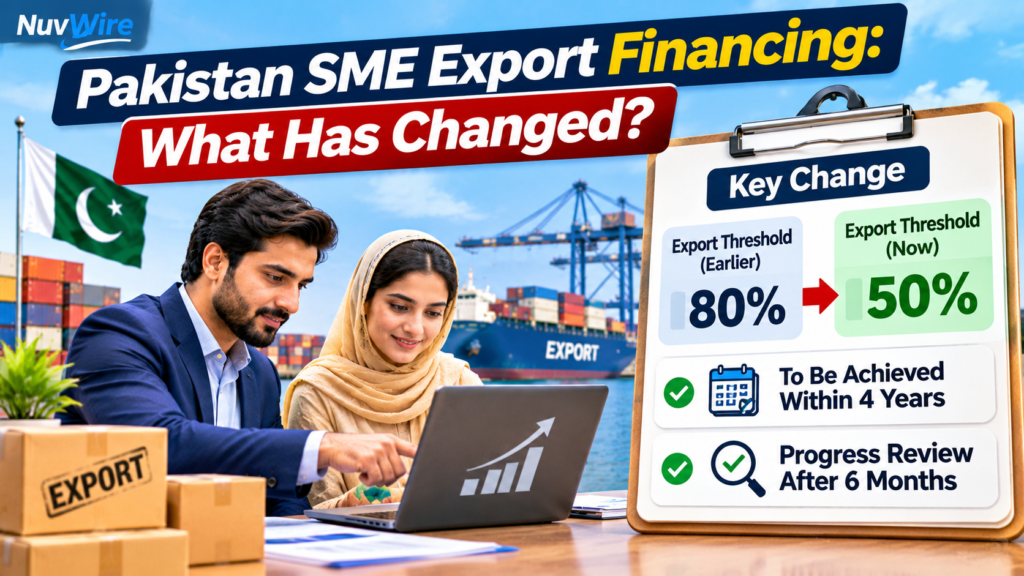
The latest Pakistan SME export financing update focuses on reducing the export performance requirement under the Long-Term Export Growth Financing Facility (LTEGFF). The minimum export threshold has been reduced from 80% to 50%, with businesses expected to achieve the requirement within four years. This change may give eligible small businesses more flexibility while developing their export operations. According to the official ECC announcement, the progress review will take place after six months.
The latest decision concerns the Long-Term Export Growth Financing Facility (LTEGFF), a government-backed financing arrangement administered through EXIM Bank of Pakistan.
Previously, businesses using the facility were required to meet an export threshold of 80%. The ECC has now reduced this requirement to 50%, with the revised level to be achieved within four years.
The purpose is to facilitate small and medium-sized enterprises and support emerging exporters that may need time to develop their international business.
Pakistan SME export financing can play an important role in helping small businesses compete in international markets. Small manufacturers often need funds to purchase raw materials, improve production facilities and fulfil large export orders. Better access to suitable financing can help eligible businesses manage these requirements and plan for long-term growth.
The committee also directed that progress under the revised facility should be reviewed after six months.
Here are the key points:
| Policy detail | Previous / New condition |
|---|---|
| Facility | Long-Term Export Growth Financing Facility |
| Administered by | EXIM Bank of Pakistan |
| Previous export threshold | 80% |
| Revised export threshold | 50% |
| Time allowed | Within four years |
| Progress review | After six months |
| Approval | Economic Coordination Committee |
The change does not mean that every small business automatically qualifies for financing. Applicants must still meet the applicable eligibility conditions and requirements of the facility.
1. Lower Export Requirement Could Help Emerging Exporters
One of the biggest challenges for a new exporter is building a reliable international customer base.
A business may have the equipment, workers and products needed for export, but securing overseas buyers and maintaining regular orders can take time.
Under the previous 80% export requirement, businesses could face greater pressure to generate a high proportion of their sales through exports.
The revised 50% threshold provides a lower export requirement within the specified four-year period.
This could give eligible businesses more room to develop their export operations while continuing to serve domestic customers.
For example, imagine a Pakistani manufacturer producing sports goods, clothing or leather products. The company may initially receive most of its orders from local buyers while gradually developing relationships with international distributors.
Although Pakistan SME export financing rules have become more flexible, businesses should not assume that every applicant automatically qualifies. Exporters must check the applicable conditions, financial requirements and approval process with the relevant financing institution before applying.
A lower export threshold could make the financing arrangement more practical for businesses following this type of growth path, provided they meet all other requirements.
2. Small and Medium Businesses May Get More Opportunities

Small and medium-sized enterprises are an important part of Pakistan’s economy.
They operate across different industries, including textiles, sports goods, food processing, engineering, leather products and manufacturing.
However, many smaller companies face difficulties when trying to secure long-term financing for expansion.
They may need funds to purchase machinery, upgrade production facilities, improve product quality or increase manufacturing capacity.
For small manufacturers and emerging exporters, Pakistan SME export financing can support business expansion by helping them invest in production capacity, equipment and export-related operations. Businesses should carefully review the facility’s eligibility conditions and financing requirements before applying. They can visit the official EXIM Bank of Pakistan website for relevant information and updates about export financing facilities.
The revised export requirement is intended to make the long-term financing facility more accessible to SMEs and emerging exporters.
Businesses that previously found the export threshold difficult may now have a better opportunity to assess whether they qualify.
However, financing approval will still depend on the scheme’s detailed conditions and the lender’s assessment.
3. EXIM Bank Will Play an Important Role
The Export-Import Bank of Pakistan, commonly known as EXIM Bank, administers the Long-Term Export Growth Financing Facility.
Export financing institutions play an important role in supporting companies that want to participate in international trade.
For an exporter, access to suitable financing can help address the cost of machinery, production improvements and investment in export-oriented projects.
EXIM Bank’s role in administering the facility means businesses should follow its official announcements and published eligibility requirements before applying.
Companies should also prepare their financial statements, business plans, export records and other documents that may be required during the application process.
Official information is available through the EXIM Bank of Pakistan website.
4. Why Long-Term Financing Matters for Export Businesses

Export growth often requires investment before a company receives revenue from international customers.
A manufacturer may need to purchase new machinery, increase production capacity, hire additional workers or meet international quality standards.
These improvements can require significant capital.
Long-term financing may help eligible businesses spread investment costs over a suitable repayment period rather than relying entirely on short-term borrowing.
For example, a sports goods manufacturer in Sialkot may want to expand production to serve more international buyers. A textile company in Faisalabad may need upgraded equipment to meet the requirements of overseas customers.
Similarly, a leather goods manufacturer may need investment in production facilities and quality-control processes.
Access to suitable long-term financing can support these types of business plans, although the actual benefits depend on financing terms, eligibility and commercial performance.
5. The Government Will Review Progress After Six Months
Another important part of the ECC decision is the six-month progress review.
The committee has directed that progress under the facility should be reviewed after six months.
This review will be important because changing eligibility rules is only one part of improving access to finance.
The practical results will depend on whether eligible businesses can understand the requirements, submit applications and obtain financing within reasonable timeframes.
The review could help policymakers understand whether the revised threshold is making the facility more accessible to the intended businesses.
Businesses involved in manufacturing and export-related activities may explore Pakistan SME export financing if they meet the relevant facility requirements. However, companies should check the latest eligibility criteria, documentation requirements and financing conditions directly with EXIM Bank before making an application.
For exporters, the implementation of the change will be just as important as the announcement itself.
6. What Other Export Financing Support Is Available for SMEs?
The long-term financing amendment should be understood separately from Pakistan’s short-term Export Finance Scheme (EFS).
In September 2026, the government announced that the overall Export Finance Scheme envelope had been increased from PKR 1,000 billion to PKR 1,500 billion for FY 2026-27.
The government also announced that PKR 300 billion had been earmarked specifically for SME exporters, agricultural SMEs and new borrowers.
This short-term financing support is intended to help businesses meet working-capital requirements and support export activity.
Pakistan SME export financing may help eligible small businesses invest in better machinery, increase production and fulfil international orders. These improvements can support businesses that want to expand their operations and become more competitive in overseas markets.
The latest changes could create new opportunities for eligible small businesses looking to expand beyond the domestic market. If implemented effectively, Pakistan SME export financing may support production growth, encourage new exporters and strengthen Pakistan’s small-business export sector over time.
The long-term facility and the short-term Export Finance Scheme serve different financing purposes. Businesses should check the relevant programme’s conditions rather than assuming that one set of rules applies to both.
More details are available in the Government of Pakistan’s September 2026 export financing announcement.
7. What Should Small Business Owners Do Next?

The revised export threshold may create an opportunity for eligible businesses, but business owners should prepare carefully before seeking financing.
Access to Pakistan SME export financing, combined with a clear business plan and reliable international buyers, may help small enterprises develop sustainable export operations. Businesses should monitor official announcements for further updates about the facility and its implementation.
Here are some practical steps worth considering.
Review Your Business Eligibility
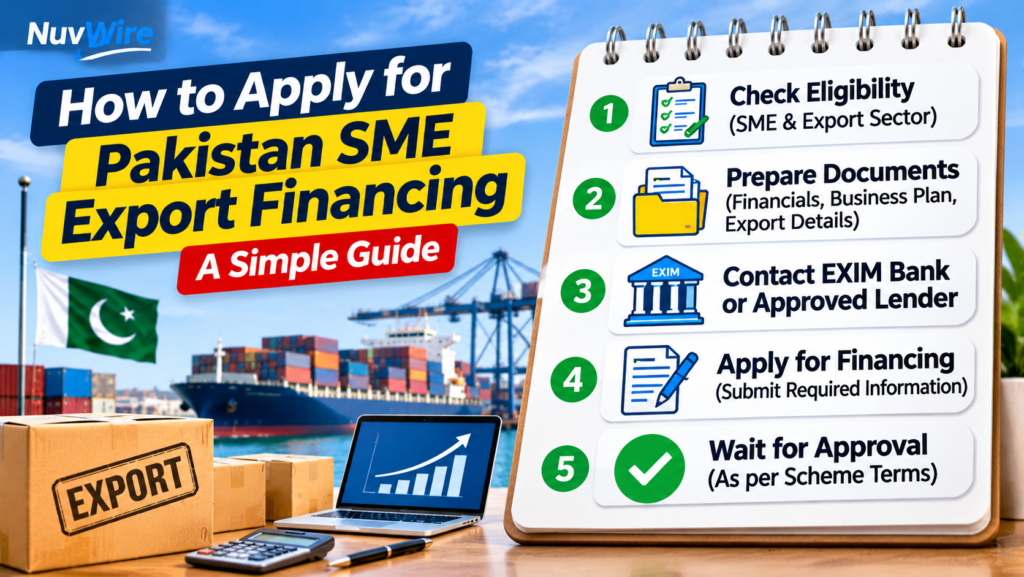
Start by checking whether your company meets the definition of an SME and whether its activities fall within the facility’s eligible sectors.
Do not assume that all businesses automatically qualify.
Prepare Financial Records
Maintain accurate financial statements, sales records, tax documents and other relevant business information.
Clear financial records can help lenders assess a company’s financial position and repayment capacity.
Before seeking Pakistan SME export financing, business owners should prepare their financial records, business registration documents, export plans and estimated funding needs. They should also understand the repayment terms and applicable conditions so they can decide whether the financing facility suits their business plans.
Develop an Export Business Plan
A business plan should explain what products the company wants to export, which markets it intends to target and how it expects to generate international sales.
It should also include realistic estimates of production costs, operating expenses and expected revenue.
Understand the Financing Conditions
Before applying, review the available financing amount, markup or pricing, repayment schedule, security requirements and other applicable terms.
These details should be confirmed directly with EXIM Bank or the relevant participating financial institution.
Contact the Relevant Institution
Businesses should use official channels to confirm the latest application process and documentation requirements.
The reduced export threshold does not by itself guarantee approval.
How This Decision Could Affect Pakistan’s Export Economy
Pakistan’s export sector includes businesses of different sizes and capabilities.
Large exporters may already have established overseas customers, production facilities and financial resources. Smaller businesses, however, may need more time and investment to build a similar international presence.
Making financing requirements more accessible could help some emerging exporters develop their operations and compete in overseas markets.
If the revised facility is implemented effectively, it may encourage eligible businesses to invest in production, improve product quality and explore new international customers.
However, financing alone cannot guarantee export growth.
Companies also need competitive pricing, reliable product quality, efficient logistics, skilled workers and stable access to international markets.
The reduction in the export requirement could make Pakistan SME export financing more accessible to businesses that are still developing their international customer base. Instead of meeting the previous 80% threshold, eligible businesses will now work towards a 50% requirement within the specified four-year period.
The six-month review will therefore be an important opportunity to assess whether the revised conditions are producing practical benefits.
Frequently Asked Questions (FAQs)
1. What is Pakistan’s SME export financing change in 2026?
On November 20, 2026, the Economic Coordination Committee approved a reduction in the minimum export requirement under the Long-Term Export Growth Financing Facility from 80% to 50% within four years.
2. What is the new export threshold for SMEs?
The revised minimum export threshold is 50%, which eligible businesses must achieve within four years under the amended facility.
3. Which institution administers the Long-Term Export Growth Financing Facility?
The facility is administered by the Export-Import Bank of Pakistan, also known as EXIM Bank.
4. Does the revised export threshold guarantee financing approval?
No. The reduced threshold does not guarantee approval. Businesses must meet the facility’s other eligibility requirements and complete the applicable financing assessment.
5. When will the government review the revised financing facility?
The ECC has directed that progress under the facility should be reviewed after six months.
6. Is the Long-Term Export Growth Financing Facility the same as the Export Finance Scheme?
No. They are separate financing arrangements. The long-term facility supports longer-term export-oriented investment, while the Export Finance Scheme provides short-term export financing support.
7. How can Pakistani SMEs check financing requirements?
Businesses should consult EXIM Bank of Pakistan and the relevant official financing channels to confirm current eligibility conditions, application procedures and required documents.
8. Can a small manufacturing business benefit from export financing?
An eligible manufacturing business may benefit if it meets the applicable scheme conditions. Businesses should confirm whether their sector, financial position and export plans meet the requirements.
Along with financing, small businesses should also strengthen their online presence to reach international customers. An online store can help exporters display their products, receive enquiries and build a digital sales channel. Read our guide on how to build an online store with WooCommerce to understand how businesses can create an e-commerce website. Combining digital selling strategies with suitable Pakistan SME export financing may help eligible businesses prepare for future growth.
Final Thoughts
Pakistan’s decision to reduce the minimum export requirement under the Long-Term Export Growth Financing Facility from 80% to 50% is an important development for small and medium-sized enterprises.
The revised condition could give eligible businesses more flexibility as they develop international sales and invest in export-oriented operations.
However, the real impact will depend on how effectively the revised rules are implemented, how easily businesses can access the facility and whether the financing supports sustainable export growth.
For Pakistani SMEs, this is a good time to review their business plans, organise financial records and explore the official financing options available to them.
The next six months will be particularly important in showing whether the policy change improves access to long-term export financing for emerging exporters.
This article is for general news and information purposes. Financing eligibility, approval and terms are subject to the official rules and assessment of the relevant institution.